 Add to Chrome
 Add to Firefox
 Add to Edge
LabDex: A Hierarchical Benchmark for Dexterous Manipulation in Laboratories
Aug 19, 2026
Autonomous laboratories hold great promise for accelerating scientific discovery. To achieve this vision, robots are supposed to dexterously manipulate diverse labware and instruments and execute long-horizon, state-dependent experimental procedures. Yet existing benchmarks do not jointly capture dexterous hand use, real-world laboratory interactions, and multi-stage experimental procedures, limiting systematic training and evaluation. To bridge this gap, we introduce LabDex, a large-scale real-world dataset and benchmark for dexterous manipulation in chemistry laboratories, organized around a hierarchical task taxonomy spanning atomic skills, compositional tasks, and long-horizon experiments. First, LabDex is cross-platform and, for the first time, unifies real-world and simulation platforms under a common framework, providing standardized task definitions, demonstrations, and evaluation protocols. Second, LabDex is large-scale and systematically organizes chemistry laboratory operations into three interconnected levels: Atomic Skills, which characterize fundamental dexterous manipulation capabilities; Compositional Skills; and Long-Horizon Laboratory Workflows. This hierarchical design not only supports the evaluation of end-task performance, but also enables the analysis of how fundamental dexterous skills compose and influence more complex laboratory operations. We conduct cross-level evaluations of representative robot learning methods in both real-world and simulation environments. The experimental results validate the effectiveness of the LabDex task design and demonstration data, and show that the benchmark supports the training and systematic evaluation of existing robotic policies across laboratory dexterous manipulation tasks at different levels, providing a foundation for further research and development of autonomous laboratory robots.

NDGGNET-A Node Independent Gate based Graph Neural Networks
May 11, 2022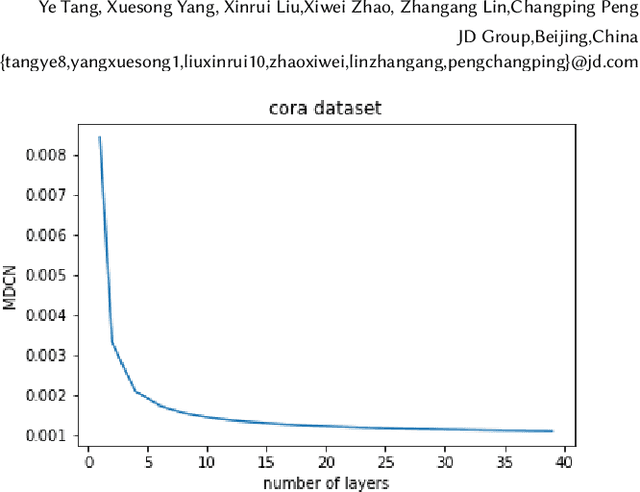
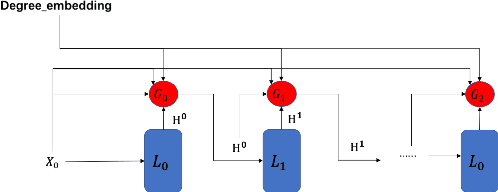
Graph Neural Networks (GNNs) is an architecture for structural data, and has been adopted in a mass of tasks and achieved fabulous results, such as link prediction, node classification, graph classification and so on. Generally, for a certain node in a given graph, a traditional GNN layer can be regarded as an aggregation from one-hop neighbors, thus a set of stacked layers are able to fetch and update node status within multi-hops. For nodes with sparse connectivity, it is difficult to obtain enough information through a single GNN layer as not only there are only few nodes directly connected to them but also can not propagate the high-order neighbor information. However, as the number of layer increases, the GNN model is prone to over-smooth for nodes with the dense connectivity, which resulting in the decrease of accuracy. To tackle this issue, in this thesis, we define a novel framework that allows the normal GNN model to accommodate more layers. Specifically, a node-degree based gate is employed to adjust weight of layers dynamically, that try to enhance the information aggregation ability and reduce the probability of over-smoothing. Experimental results show that our proposed model can effectively increase the model depth and perform well on several datasets.
Mission schedule of agile satellites based on Proximal Policy Optimization Algorithm
Jul 05, 2020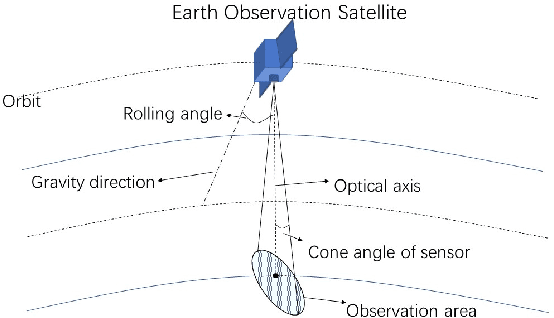
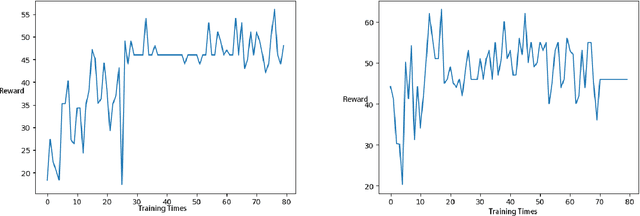
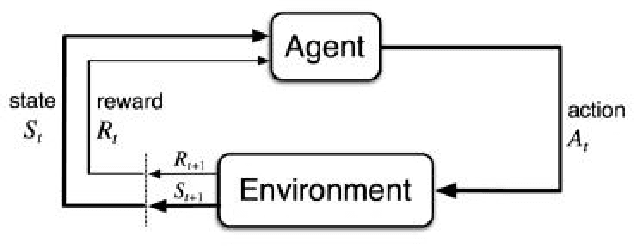
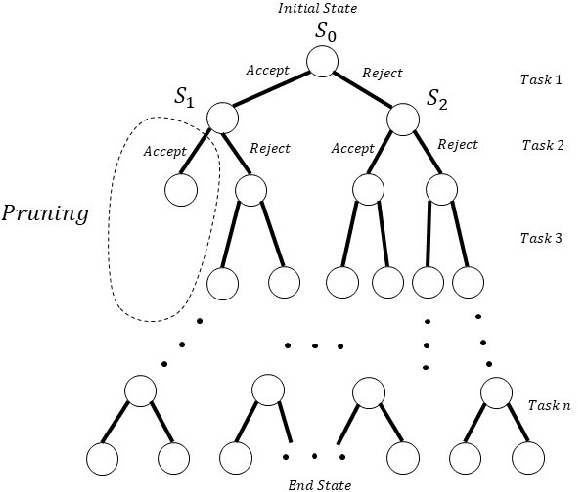
Mission schedule of satellites is an important part of space operation nowadays, since the number and types of satellites in orbit are increasing tremendously and their corresponding tasks are also becoming more and more complicated. In this paper, a mission schedule model combined with Proximal Policy Optimization Algorithm(PPO) is proposed. Different from the traditional heuristic planning method, this paper incorporate reinforcement learning algorithms into it and find a new way to describe the problem. Several constraints including data download are considered in this paper.