 Add to Chrome
 Add to Firefox
 Add to Edge
Steal My Artworks for Fine-tuning? A Watermarking Framework for Detecting Art Theft Mimicry in Text-to-Image Models
Nov 22, 2023
The advancement in text-to-image models has led to astonishing artistic performances. However, several studios and websites illegally fine-tune these models using artists' artworks to mimic their styles for profit, which violates the copyrights of artists and diminishes their motivation to produce original works. Currently, there is a notable lack of research focusing on this issue. In this paper, we propose a novel watermarking framework that detects mimicry in text-to-image models through fine-tuning. This framework embeds subtle watermarks into digital artworks to protect their copyrights while still preserving the artist's visual expression. If someone takes watermarked artworks as training data to mimic an artist's style, these watermarks can serve as detectable indicators. By analyzing the distribution of these watermarks in a series of generated images, acts of fine-tuning mimicry using stolen victim data will be exposed. In various fine-tune scenarios and against watermark attack methods, our research confirms that analyzing the distribution of watermarks in artificially generated images reliably detects unauthorized mimicry.

Rich and Poor Texture Contrast: A Simple yet Effective Approach for AI-generated Image Detection
Nov 21, 2023Recent generative models show impressive performance in generating photographic images. Humans can hardly distinguish such incredibly realistic-looking AI-generated images from real ones. AI-generated images may lead to ubiquitous disinformation dissemination. Therefore, it is of utmost urgency to develop a detector to identify AI-generated images. Most existing detectors suffer from sharp performance drops over unseen generative models. In this paper, we propose a novel AI-generated image detector capable of identifying fake images created by a wide range of generative models. Our approach leverages the inter-pixel correlation contrast between rich and poor texture regions within an image. Pixels in rich texture regions exhibit more significant fluctuations than those in poor texture regions. This discrepancy reflects that the entropy of rich texture regions is larger than that of poor ones. Consequently, synthesizing realistic rich texture regions proves to be more challenging for existing generative models. Based on this principle, we divide an image into multiple patches and reconstruct them into two images, comprising rich-texture and poor-texture patches respectively. Subsequently, we extract the inter-pixel correlation discrepancy feature between rich and poor texture regions. This feature serves as a universal fingerprint used for AI-generated image forensics across different generative models. In addition, we build a comprehensive AI-generated image detection benchmark, which includes 16 kinds of prevalent generative models, to evaluate the effectiveness of existing baselines and our approach. Our benchmark provides a leaderboard for follow-up studies. Extensive experimental results show that our approach outperforms state-of-the-art baselines by a significant margin. Our project: https://fdmas.github.io/AIGCDetect/
Securing Fixed Neural Network Steganography
Sep 18, 2023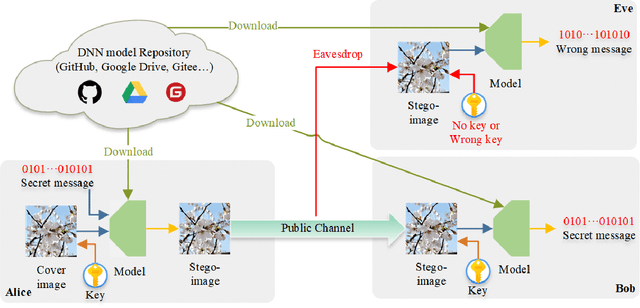
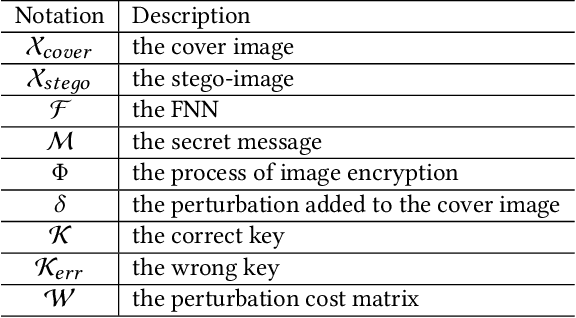
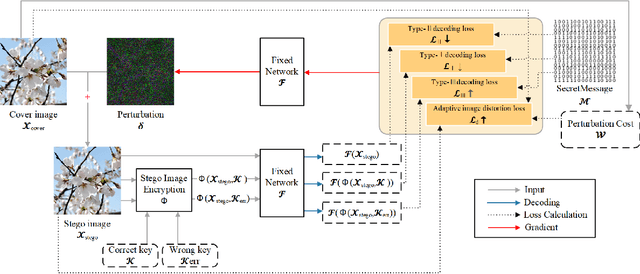
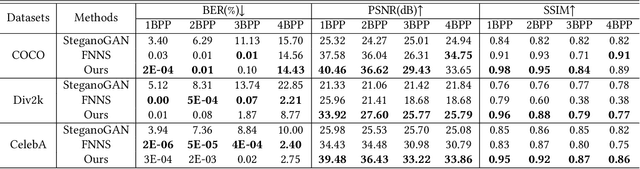
Image steganography is the art of concealing secret information in images in a way that is imperceptible to unauthorized parties. Recent advances show that is possible to use a fixed neural network (FNN) for secret embedding and extraction. Such fixed neural network steganography (FNNS) achieves high steganographic performance without training the networks, which could be more useful in real-world applications. However, the existing FNNS schemes are vulnerable in the sense that anyone can extract the secret from the stego-image. To deal with this issue, we propose a key-based FNNS scheme to improve the security of the FNNS, where we generate key-controlled perturbations from the FNN for data embedding. As such, only the receiver who possesses the key is able to correctly extract the secret from the stego-image using the FNN. In order to improve the visual quality and undetectability of the stego-image, we further propose an adaptive perturbation optimization strategy by taking the perturbation cost into account. Experimental results show that our proposed scheme is capable of preventing unauthorized secret extraction from the stego-images. Furthermore, our scheme is able to generate stego-images with higher visual quality than the state-of-the-art FNNS scheme, especially when the FNN is a neural network for ordinary learning tasks.
Salient Object Detection in Optical Remote Sensing Images Driven by Transformer
Sep 15, 2023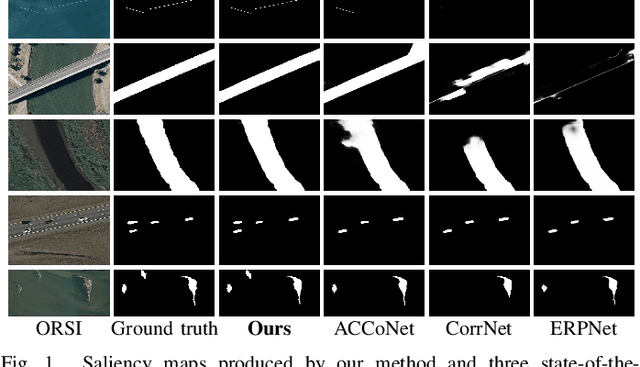
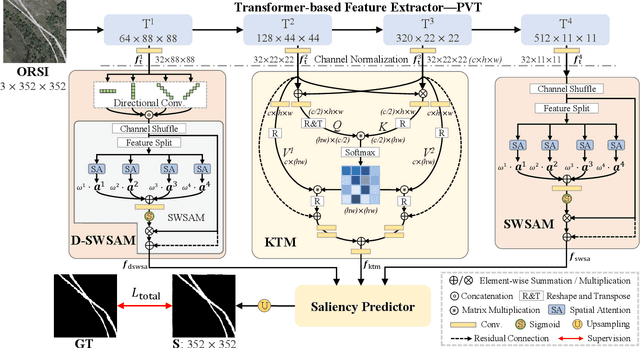
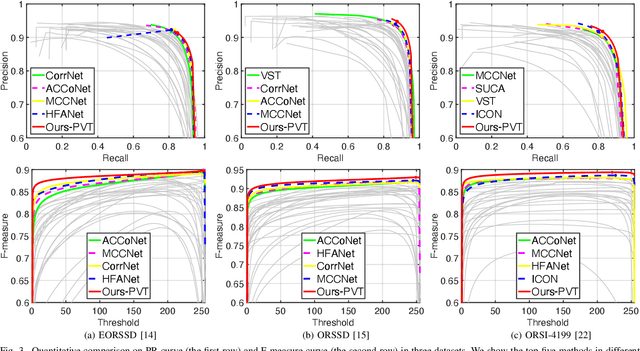
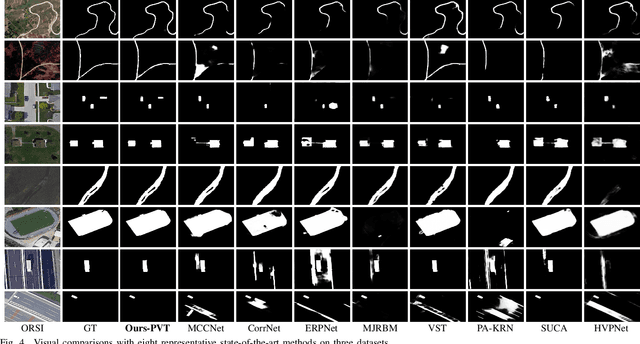
Existing methods for Salient Object Detection in Optical Remote Sensing Images (ORSI-SOD) mainly adopt Convolutional Neural Networks (CNNs) as the backbone, such as VGG and ResNet. Since CNNs can only extract features within certain receptive fields, most ORSI-SOD methods generally follow the local-to-contextual paradigm. In this paper, we propose a novel Global Extraction Local Exploration Network (GeleNet) for ORSI-SOD following the global-to-local paradigm. Specifically, GeleNet first adopts a transformer backbone to generate four-level feature embeddings with global long-range dependencies. Then, GeleNet employs a Direction-aware Shuffle Weighted Spatial Attention Module (D-SWSAM) and its simplified version (SWSAM) to enhance local interactions, and a Knowledge Transfer Module (KTM) to further enhance cross-level contextual interactions. D-SWSAM comprehensively perceives the orientation information in the lowest-level features through directional convolutions to adapt to various orientations of salient objects in ORSIs, and effectively enhances the details of salient objects with an improved attention mechanism. SWSAM discards the direction-aware part of D-SWSAM to focus on localizing salient objects in the highest-level features. KTM models the contextual correlation knowledge of two middle-level features of different scales based on the self-attention mechanism, and transfers the knowledge to the raw features to generate more discriminative features. Finally, a saliency predictor is used to generate the saliency map based on the outputs of the above three modules. Extensive experiments on three public datasets demonstrate that the proposed GeleNet outperforms relevant state-of-the-art methods. The code and results of our method are available at https://github.com/MathLee/GeleNet.
Physical Invisible Backdoor Based on Camera Imaging
Sep 14, 2023Backdoor attack aims to compromise a model, which returns an adversary-wanted output when a specific trigger pattern appears yet behaves normally for clean inputs. Current backdoor attacks require changing pixels of clean images, which results in poor stealthiness of attacks and increases the difficulty of the physical implementation. This paper proposes a novel physical invisible backdoor based on camera imaging without changing nature image pixels. Specifically, a compromised model returns a target label for images taken by a particular camera, while it returns correct results for other images. To implement and evaluate the proposed backdoor, we take shots of different objects from multi-angles using multiple smartphones to build a new dataset of 21,500 images. Conventional backdoor attacks work ineffectively with some classical models, such as ResNet18, over the above-mentioned dataset. Therefore, we propose a three-step training strategy to mount the backdoor attack. First, we design and train a camera identification model with the phone IDs to extract the camera fingerprint feature. Subsequently, we elaborate a special network architecture, which is easily compromised by our backdoor attack, by leveraging the attributes of the CFA interpolation algorithm and combining it with the feature extraction block in the camera identification model. Finally, we transfer the backdoor from the elaborated special network architecture to the classical architecture model via teacher-student distillation learning. Since the trigger of our method is related to the specific phone, our attack works effectively in the physical world. Experiment results demonstrate the feasibility of our proposed approach and robustness against various backdoor defenses.
DRAW: Defending Camera-shooted RAW against Image Manipulation
Jul 31, 2023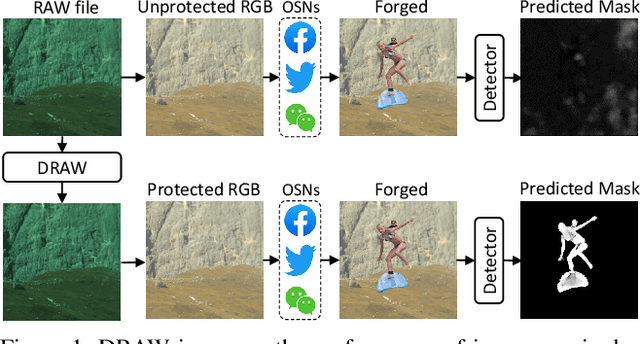
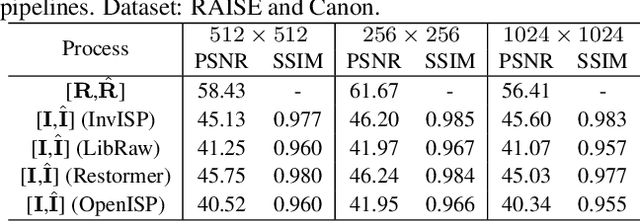
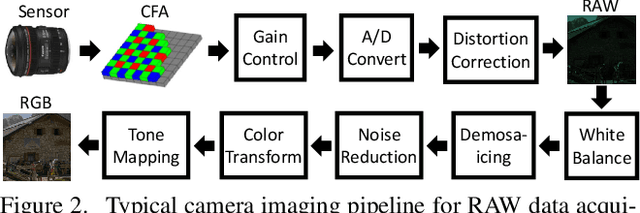
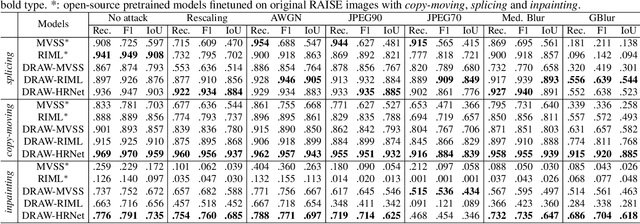
RAW files are the initial measurement of scene radiance widely used in most cameras, and the ubiquitously-used RGB images are converted from RAW data through Image Signal Processing (ISP) pipelines. Nowadays, digital images are risky of being nefariously manipulated. Inspired by the fact that innate immunity is the first line of body defense, we propose DRAW, a novel scheme of defending images against manipulation by protecting their sources, i.e., camera-shooted RAWs. Specifically, we design a lightweight Multi-frequency Partial Fusion Network (MPF-Net) friendly to devices with limited computing resources by frequency learning and partial feature fusion. It introduces invisible watermarks as protective signal into the RAW data. The protection capability can not only be transferred into the rendered RGB images regardless of the applied ISP pipeline, but also is resilient to post-processing operations such as blurring or compression. Once the image is manipulated, we can accurately identify the forged areas with a localization network. Extensive experiments on several famous RAW datasets, e.g., RAISE, FiveK and SIDD, indicate the effectiveness of our method. We hope that this technique can be used in future cameras as an option for image protection, which could effectively restrict image manipulation at the source.
RetouchingFFHQ: A Large-scale Dataset for Fine-grained Face Retouching Detection
Jul 20, 2023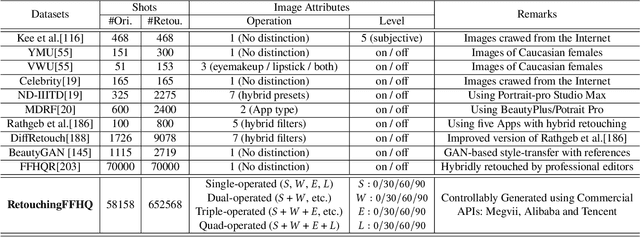
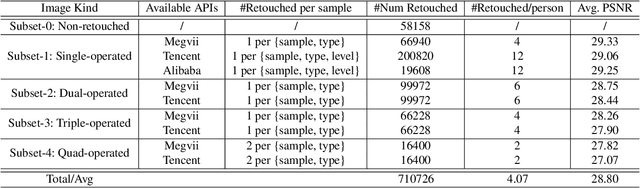
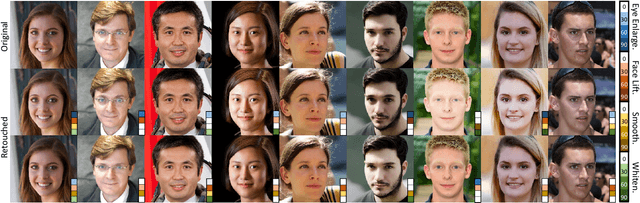
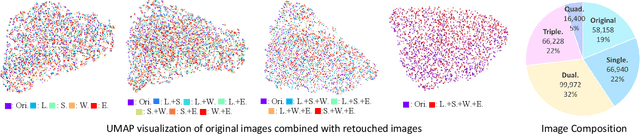
The widespread use of face retouching filters on short-video platforms has raised concerns about the authenticity of digital appearances and the impact of deceptive advertising. To address these issues, there is a pressing need to develop advanced face retouching techniques. However, the lack of large-scale and fine-grained face retouching datasets has been a major obstacle to progress in this field. In this paper, we introduce RetouchingFFHQ, a large-scale and fine-grained face retouching dataset that contains over half a million conditionally-retouched images. RetouchingFFHQ stands out from previous datasets due to its large scale, high quality, fine-grainedness, and customization. By including four typical types of face retouching operations and different retouching levels, we extend the binary face retouching detection into a fine-grained, multi-retouching type, and multi-retouching level estimation problem. Additionally, we propose a Multi-granularity Attention Module (MAM) as a plugin for CNN backbones for enhanced cross-scale representation learning. Extensive experiments using different baselines as well as our proposed method on RetouchingFFHQ show decent performance on face retouching detection. With the proposed new dataset, we believe there is great potential for future work to tackle the challenging problem of real-world fine-grained face retouching detection.
Towards Deep Network Steganography: From Networks to Networks
Jul 07, 2023With the widespread applications of the deep neural network (DNN), how to covertly transmit the DNN models in public channels brings us the attention, especially for those trained for secret-learning tasks. In this paper, we propose deep network steganography for the covert communication of DNN models. Unlike the existing steganography schemes which focus on the subtle modification of the cover data to accommodate the secrets, our scheme is learning task oriented, where the learning task of the secret DNN model (termed as secret-learning task) is disguised into another ordinary learning task conducted in a stego DNN model (termed as stego-learning task). To this end, we propose a gradient-based filter insertion scheme to insert interference filters into the important positions in the secret DNN model to form a stego DNN model. These positions are then embedded into the stego DNN model using a key by side information hiding. Finally, we activate the interference filters by a partial optimization strategy, such that the generated stego DNN model works on the stego-learning task. We conduct the experiments on both the intra-task steganography and inter-task steganography (i.e., the secret and stego-learning tasks belong to the same and different categories), both of which demonstrate the effectiveness of our proposed method for covert communication of DNN models.
StyleStegan: Leak-free Style Transfer Based on Feature Steganography
Jul 01, 2023


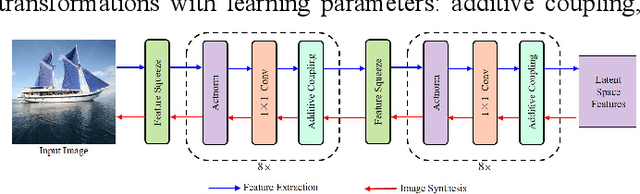
In modern social networks, existing style transfer methods suffer from a serious content leakage issue, which hampers the ability to achieve serial and reversible stylization, thereby hindering the further propagation of stylized images in social networks. To address this problem, we propose a leak-free style transfer method based on feature steganography. Our method consists of two main components: a style transfer method that accomplishes artistic stylization on the original image and an image steganography method that embeds content feature secrets on the stylized image. The main contributions of our work are as follows: 1) We identify and explain the phenomenon of content leakage and its underlying causes, which arise from content inconsistencies between the original image and its subsequent stylized image. 2) We design a neural flow model for achieving loss-free and biased-free style transfer. 3) We introduce steganography to hide content feature information on the stylized image and control the subsequent usage rights. 4) We conduct comprehensive experimental validation using publicly available datasets MS-COCO and Wikiart. The results demonstrate that StyleStegan successfully mitigates the content leakage issue in serial and reversible style transfer tasks. The SSIM performance metrics for these tasks are 14.98% and 7.28% higher, respectively, compared to a suboptimal baseline model.
Decision-based iterative fragile watermarking for model integrity verification
May 13, 2023
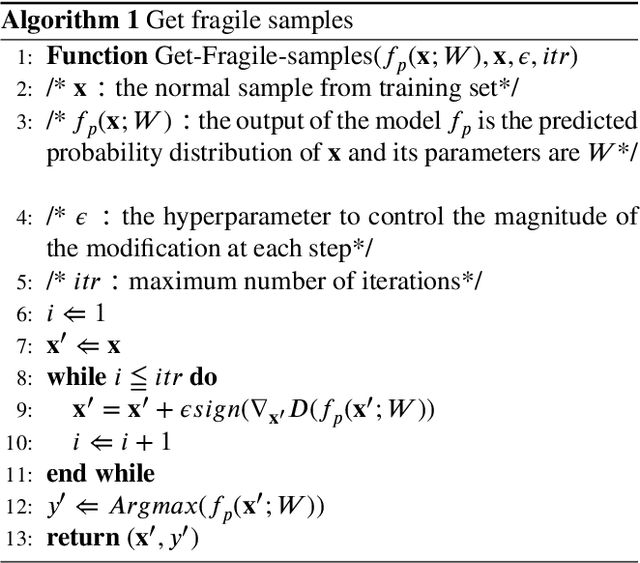
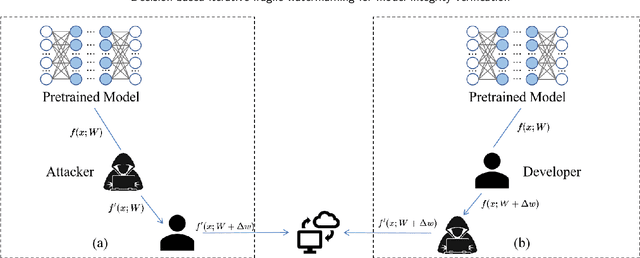
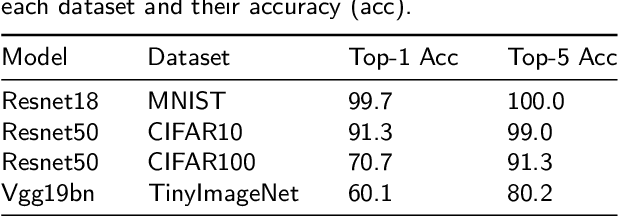
Typically, foundation models are hosted on cloud servers to meet the high demand for their services. However, this exposes them to security risks, as attackers can modify them after uploading to the cloud or transferring from a local system. To address this issue, we propose an iterative decision-based fragile watermarking algorithm that transforms normal training samples into fragile samples that are sensitive to model changes. We then compare the output of sensitive samples from the original model to that of the compromised model during validation to assess the model's completeness.The proposed fragile watermarking algorithm is an optimization problem that aims to minimize the variance of the predicted probability distribution outputed by the target model when fed with the converted sample.We convert normal samples to fragile samples through multiple iterations. Our method has some advantages: (1) the iterative update of samples is done in a decision-based black-box manner, relying solely on the predicted probability distribution of the target model, which reduces the risk of exposure to adversarial attacks, (2) the small-amplitude multiple iterations approach allows the fragile samples to perform well visually, with a PSNR of 55 dB in TinyImageNet compared to the original samples, (3) even with changes in the overall parameters of the model of magnitude 1e-4, the fragile samples can detect such changes, and (4) the method is independent of the specific model structure and dataset. We demonstrate the effectiveness of our method on multiple models and datasets, and show that it outperforms the current state-of-the-art.