 Add to Chrome
 Add to Firefox
 Add to Edge
Sparse Evidence Can Suffice: Agentic Evidence Seeking for Multimodal Video Misinformation Detection
Jul 20, 2026
Multimodal video misinformation detection is commonly formulated as a holistic video-understanding task, where the entire video and its associated content are processed and judged in a single pass. However, real-world misinformation often exhibits a sparse and compositional evidence structure: a reliable decision may depend on only a few coupled clues, while most video content contributes limited additional information. Exhaustive multimodal reasoning may therefore introduce substantial redundancy and obscure decisive evidence. This motivates decoupling evidence acquisition from verification: first identifying sparse, decision-relevant clues and then judging veracity based on the acquired evidence. Accordingly, we propose SIEVE, a framework for Sparse Interactive Evidence Verification via Extraction in multimodal video misinformation detection. An evidence-seeking agent actively explores the available multimodal evidence and constructs a compact evidence package, which is then used by a verifier to determine veracity. The agent is trained with supervised evidence-seeking trajectories and an evidence-aware reinforcement learning objective that promotes informative evidence acquisition while discouraging unnecessary or invalid interactions. Experiments on multiple video misinformation benchmarks show that SIEVE consistently outperforms the evaluated baselines and supports reliable verification using compact evidence packages. Moreover, the resulting acquisition process provides an explicit and inspectable evidence trail, improving the transparency and groundedness of multimodal misinformation detection.

From Agnostic to Specific: Latent Preference Diffusion for Multi-Behavior Sequential Recommendation
Feb 26, 2026Multi-behavior sequential recommendation (MBSR) aims to learn the dynamic and heterogeneous interactions of users' multi-behavior sequences, so as to capture user preferences under target behavior for the next interacted item prediction. Unlike previous methods that adopt unidirectional modeling by mapping auxiliary behaviors to target behavior, recent concerns are shifting from behavior-fixed to behavior-specific recommendation. However, these methods still ignore the user's latent preference that underlying decision-making, leading to suboptimal solutions. Meanwhile, due to the asymmetric deterministic between items and behaviors, discriminative paradigm based on preference scoring is unsuitable to capture the uncertainty from low-entropy behaviors to high-entropy items, failing to provide efficient and diverse recommendation. To address these challenges, we propose \textbf{FatsMB}, a framework based diffusion model that guides preference generation \textit{\textbf{F}rom Behavior-\textbf{A}gnostic \textbf{T}o Behavior-\textbf{S}pecific} in latent spaces, enabling diverse and accurate \textit{\textbf{M}ulti-\textbf{B}ehavior Sequential Recommendation}. Specifically, we design a Multi-Behavior AutoEncoder (MBAE) to construct a unified user latent preference space, facilitating interaction and collaboration across Behaviors, within Behavior-aware RoPE (BaRoPE) employed for multiple information fusion. Subsequently, we conduct target behavior-specific preference transfer in the latent space, enriching with informative priors. A Multi-Condition Guided Layer Normalization (MCGLN) is introduced for the denoising. Extensive experiments on real-world datasets demonstrate the effectiveness of our model.
R^3: Replay, Reflection, and Ranking Rewards for LLM Reinforcement Learning
Jan 27, 2026Large reasoning models (LRMs) aim to solve diverse and complex problems through structured reasoning. Recent advances in group-based policy optimization methods have shown promise in enabling stable advantage estimation without reliance on process-level annotations. However, these methods rely on advantage gaps induced by high-quality samples within the same batch, which makes the training process fragile and inefficient when intra-group advantages collapse under challenging tasks. To address these problems, we propose a reinforcement learning mechanism named \emph{\textbf{R^3}} that along three directions: (1) a \emph{cross-context \underline{\textbf{R}}eplay} strategy that maintains the intra-group advantage by recalling valuable examples from historical trajectories of the same query, (2) an \emph{in-context self-\underline{\textbf{R}}eflection} mechanism enabling models to refine outputs by leveraging past failures, and (3) a \emph{structural entropy \underline{\textbf{R}}anking reward}, which assigns relative rewards to truncated or failed samples by ranking responses based on token-level entropy patterns, capturing both local exploration and global stability. We implement our method on Deepseek-R1-Distill-Qwen-1.5B and train it on the DeepscaleR-40k in the math domain. Experiments demonstrate our method achieves SoTA performance on several math benchmarks, representing significant improvements and fewer reasoning tokens over the base models. Code and model will be released.
REMOTE: A Unified Multimodal Relation Extraction Framework with Multilevel Optimal Transport and Mixture-of-Experts
Sep 05, 2025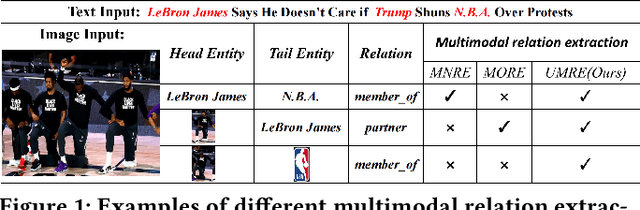
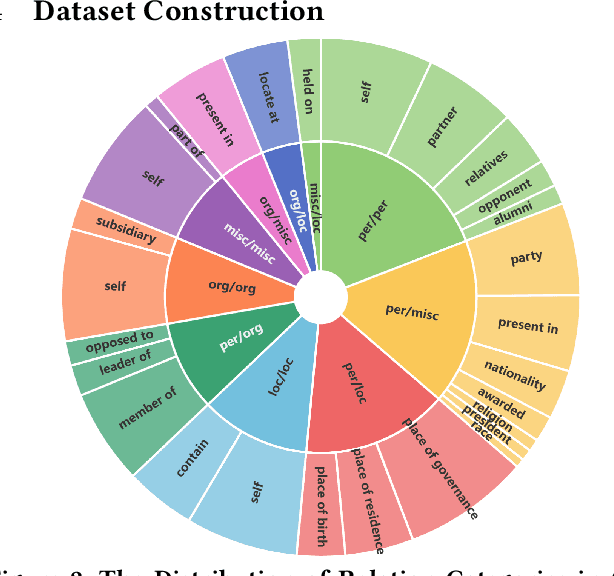
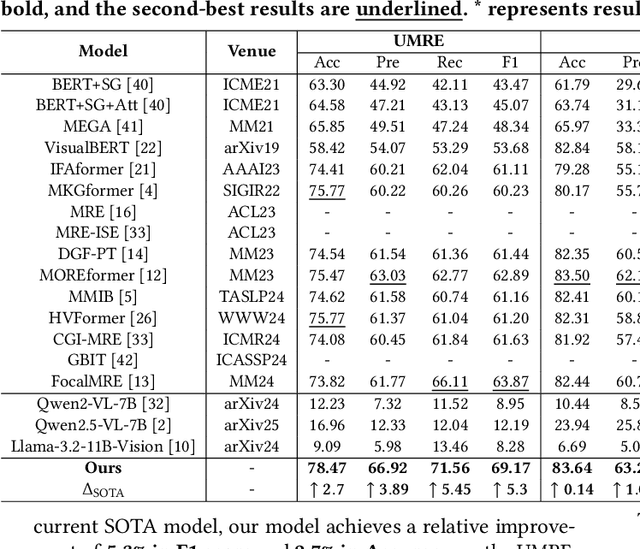
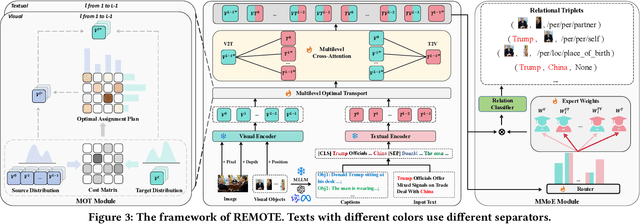
Multimodal relation extraction (MRE) is a crucial task in the fields of Knowledge Graph and Multimedia, playing a pivotal role in multimodal knowledge graph construction. However, existing methods are typically limited to extracting a single type of relational triplet, which restricts their ability to extract triplets beyond the specified types. Directly combining these methods fails to capture dynamic cross-modal interactions and introduces significant computational redundancy. Therefore, we propose a novel \textit{unified multimodal Relation Extraction framework with Multilevel Optimal Transport and mixture-of-Experts}, termed REMOTE, which can simultaneously extract intra-modal and inter-modal relations between textual entities and visual objects. To dynamically select optimal interaction features for different types of relational triplets, we introduce mixture-of-experts mechanism, ensuring the most relevant modality information is utilized. Additionally, considering that the inherent property of multilayer sequential encoding in existing encoders often leads to the loss of low-level information, we adopt a multilevel optimal transport fusion module to preserve low-level features while maintaining multilayer encoding, yielding more expressive representations. Correspondingly, we also create a Unified Multimodal Relation Extraction (UMRE) dataset to evaluate the effectiveness of our framework, encompassing diverse cases where the head and tail entities can originate from either text or image. Extensive experiments show that REMOTE effectively extracts various types of relational triplets and achieves state-of-the-art performanc on almost all metrics across two other public MRE datasets. We release our resources at https://github.com/Nikol-coder/REMOTE.