 Add to Chrome
 Add to Firefox
 Add to Edge
QAPruner: Quantization-Aware Vision Token Pruning for Multimodal Large Language Models
Apr 03, 2026
Multimodal Large Language Models (MLLMs) have shown strong reasoning ability, but their high computational and memory costs hinder deployment in resource-constrained settings. While Post-Training Quantization (PTQ) and vision token pruning are standard compression techniques, they are usually treated as independent optimizations. In this paper, we show that these two techniques are strongly coupled: naively applying semantic-based token pruning to PTQ-optimized MLLMs can discard activation outliers that are important for numerical stability and thus worsen quantization errors in low-bit regimes (\textit{e.g.}, W4A4). To address this issue, we propose a quantization-aware vision token pruning framework. Our method introduces a lightweight hybrid sensitivity metric that combines simulated group-wise quantization error with outlier intensity. By combining this metric with standard semantic relevance scores, the method retains tokens that are both semantically informative and robust to quantization. Experiments on standard LLaVA architectures show that our method consistently outperforms naive integration baselines. At an aggressive pruning ratio that retains only 12.5\% of visual tokens, our framework improves accuracy by 2.24\% over the baseline and even surpasses dense quantization without pruning. To the best of our knowledge, this is the first method that explicitly co-optimizes vision token pruning and PTQ for accurate low-bit MLLM inference.

OpenAD: Open-World Autonomous Driving Benchmark for 3D Object Detection
Nov 26, 2024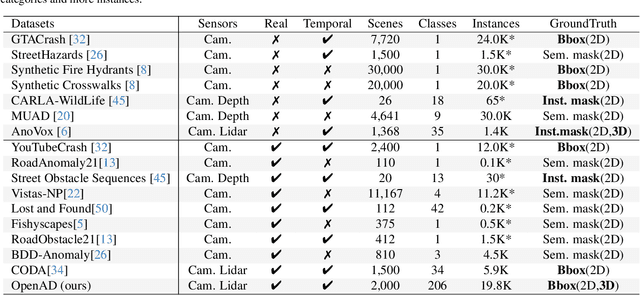


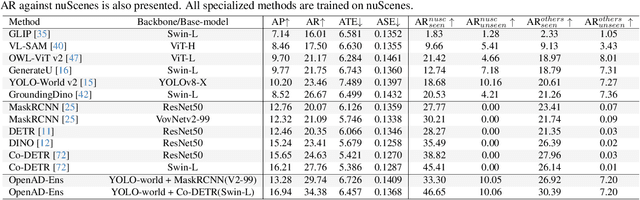
Open-world autonomous driving encompasses domain generalization and open-vocabulary. Domain generalization refers to the capabilities of autonomous driving systems across different scenarios and sensor parameter configurations. Open vocabulary pertains to the ability to recognize various semantic categories not encountered during training. In this paper, we introduce OpenAD, the first real-world open-world autonomous driving benchmark for 3D object detection. OpenAD is built on a corner case discovery and annotation pipeline integrating with a multimodal large language model (MLLM). The proposed pipeline annotates corner case objects in a unified format for five autonomous driving perception datasets with 2000 scenarios. In addition, we devise evaluation methodologies and evaluate various 2D and 3D open-world and specialized models. Moreover, we propose a vision-centric 3D open-world object detection baseline and further introduce an ensemble method by fusing general and specialized models to address the issue of lower precision in existing open-world methods for the OpenAD benchmark. Annotations, toolkit code, and all evaluation codes will be released.
HENet: Hybrid Encoding for End-to-end Multi-task 3D Perception from Multi-view Cameras
Apr 03, 2024
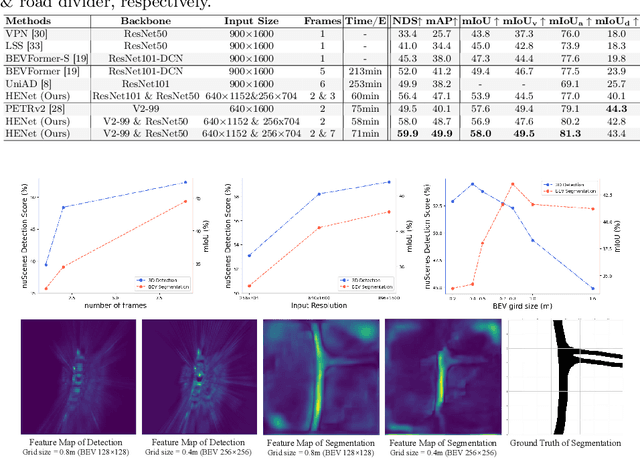
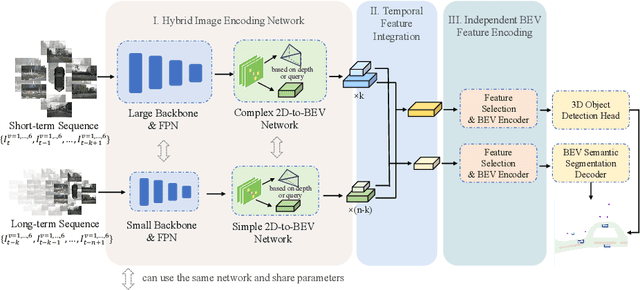
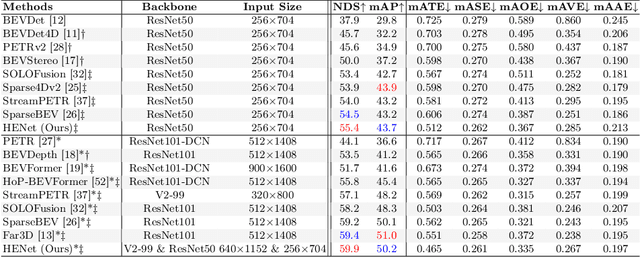
Three-dimensional perception from multi-view cameras is a crucial component in autonomous driving systems, which involves multiple tasks like 3D object detection and bird's-eye-view (BEV) semantic segmentation. To improve perception precision, large image encoders, high-resolution images, and long-term temporal inputs have been adopted in recent 3D perception models, bringing remarkable performance gains. However, these techniques are often incompatible in training and inference scenarios due to computational resource constraints. Besides, modern autonomous driving systems prefer to adopt an end-to-end framework for multi-task 3D perception, which can simplify the overall system architecture and reduce the implementation complexity. However, conflict between tasks often arises when optimizing multiple tasks jointly within an end-to-end 3D perception model. To alleviate these issues, we present an end-to-end framework named HENet for multi-task 3D perception in this paper. Specifically, we propose a hybrid image encoding network, using a large image encoder for short-term frames and a small image encoder for long-term temporal frames. Then, we introduce a temporal feature integration module based on the attention mechanism to fuse the features of different frames extracted by the two aforementioned hybrid image encoders. Finally, according to the characteristics of each perception task, we utilize BEV features of different grid sizes, independent BEV encoders, and task decoders for different tasks. Experimental results show that HENet achieves state-of-the-art end-to-end multi-task 3D perception results on the nuScenes benchmark, including 3D object detection and BEV semantic segmentation. The source code and models will be released at https://github.com/VDIGPKU/HENet.
RCBEVDet: Radar-camera Fusion in Bird's Eye View for 3D Object Detection
Mar 25, 2024
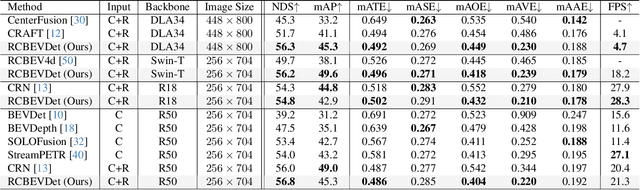
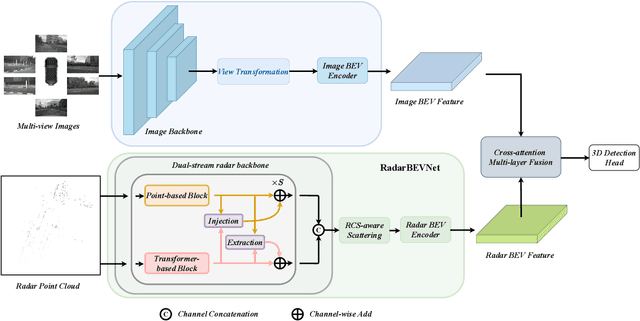

Three-dimensional object detection is one of the key tasks in autonomous driving. To reduce costs in practice, low-cost multi-view cameras for 3D object detection are proposed to replace the expansive LiDAR sensors. However, relying solely on cameras is difficult to achieve highly accurate and robust 3D object detection. An effective solution to this issue is combining multi-view cameras with the economical millimeter-wave radar sensor to achieve more reliable multi-modal 3D object detection. In this paper, we introduce RCBEVDet, a radar-camera fusion 3D object detection method in the bird's eye view (BEV). Specifically, we first design RadarBEVNet for radar BEV feature extraction. RadarBEVNet consists of a dual-stream radar backbone and a Radar Cross-Section (RCS) aware BEV encoder. In the dual-stream radar backbone, a point-based encoder and a transformer-based encoder are proposed to extract radar features, with an injection and extraction module to facilitate communication between the two encoders. The RCS-aware BEV encoder takes RCS as the object size prior to scattering the point feature in BEV. Besides, we present the Cross-Attention Multi-layer Fusion module to automatically align the multi-modal BEV feature from radar and camera with the deformable attention mechanism, and then fuse the feature with channel and spatial fusion layers. Experimental results show that RCBEVDet achieves new state-of-the-art radar-camera fusion results on nuScenes and view-of-delft (VoD) 3D object detection benchmarks. Furthermore, RCBEVDet achieves better 3D detection results than all real-time camera-only and radar-camera 3D object detectors with a faster inference speed at 21~28 FPS. The source code will be released at https://github.com/VDIGPKU/RCBEVDet.