 Add to Chrome
 Add to Firefox
 Add to Edge
DrivingAgent: Design and Scheduling Agents for Autonomous Driving Systems
Jun 11, 2026
Many autonomous driving systems are increasingly incorporating foundation models to improve generalization and handle long-tail scenarios. However, this trend introduces two key challenges: (i) the manual and labor-intensive process of designing and integrating new models, and (ii) the lack of intelligent, dynamic scheduling mechanisms to meet strict real-time constraints. While Large Language Model (LLM)-based agents offer a promising avenue for automation, existing frameworks are ill-suited for autonomous driving. Specifically, they fail to distinguish between the fundamentally different requirements of system design and real-time scheduling, treat modules as opaque black boxes, and are not designed for continuous operation. To address these limitations, we propose DrivingAgent, a novel agent framework tailored to the dual challenges of autonomous driving system design and scheduling. In the design phase, DrivingAgent automates module development by interpreting system architecture, generating code, and validating modules via super-network training. In the scheduling phase, it employs a lightweight LLM trained with reinforcement learning to dynamically orchestrate system modules in real time, supported by a structured memory that integrates long-term storage with timestamped short-term context. Experimental results demonstrate that DrivingAgent achieves a superior speed--accuracy trade-off on both the nuScenes and Bench2Drive benchmarks.

3DVLA: Enhancing Vision-Language-Action Models via 3D Spatial and Instance Understanding
May 28, 2026Vision-Language-Action models have achieved remarkable progress in robotic manipulation, yet they suffer from a critical limitation: a lack of 3D scene understanding. This deficiency manifests as three intertwined challenges: weak extraction of 3D spatial positions without enforcing multi-view consistency, inadequate 3D instance understanding, and fragile reasoning under occlusion. Although mature 3D perception methods exist, their direct integration into VLA pipelines is hindered by architectural incompatibility and by heavy reliance on costly instance-level annotations. To address the above challenges, we propose 3DVLA, a plug-and-play framework that injects robust 3D reasoning into pretrained VLAs without requiring extra manual labels or discarding VLM priors. Specifically, 3DVLA tackles the three challenges through: (1) pervasive 3D feature encoding with explicit multi-view consistency constraints across all modalities and a Spatially-Conditioned Geometry Aggregation method, (2) an instance estimation module with high-level instance tokens for 3D instance awareness, and (3) a masked self-supervised 3D encoding branch that retains its predictor for visual token completion to handle occlusions. We integrate 3DVLA with multiple VLA baselines and evaluate on LIBERO-Plus and RoboTwin 2.0. Results show consistent and significant gains in manipulation performance, validating both the effectiveness and plug-and-play compatibility of our approach.
HiDrive: A Closed-Loop Benchmark for High-Level Autonomous Driving
May 11, 2026End-to-end autonomous driving has witnessed rapid progress, yet existing benchmarks are increasingly saturated, with state-of-the-art models achieving near-perfect scores on widely used open-loop and closed-loop benchmarks. This saturation does not mean that the problem has been solved; instead, it reveals that current benchmarks remain limited in scenario diversity, object variety, and the breadth of driving capabilities they evaluate. In particular, they lack sufficient long-tail scenarios involving rare but safety-critical objects and fail to assess advanced decision-making such as legal compliance, ethical reasoning, and emergency response. To address these gaps, we propose HiDrive, a new closed-loop benchmark for end-to-end autonomous driving that emphasizes long-tail scenarios and a richer evaluation of driving capabilities. HiDrive introduces a diverse set of rare objects and uncommon traffic situations, and expands evaluation from basic driving skills to more advanced capabilities, including rule compliance, moral reasoning, and context-dependent emergency maneuvers. Correspondingly, we extend previous collision-avoidance-centered metrics into a comprehensive evaluation system that encompasses collision and braking, traffic-rule compliance, and moral-reasoning indicators. Built on a more advanced physics engine, HiDrive provides physically realistic lighting and high-fidelity visual rendering, offering a more challenging and realistic testbed for assessing whether autonomous driving systems can handle the complexity of real-world deployment. The HiDrive software, source code, digital assets, and documentation are available at https://github.com/VDIGPKU/HiDrive.
ELITE: Experiential Learning and Intent-Aware Transfer for Self-improving Embodied Agents
Mar 25, 2026Vision-language models (VLMs) have shown remarkable general capabilities, yet embodied agents built on them fail at complex tasks, often skipping critical steps, proposing invalid actions, and repeating mistakes. These failures arise from a fundamental gap between the static training data of VLMs and the physical interaction for embodied tasks. VLMs can learn rich semantic knowledge from static data but lack the ability to interact with the world. To address this issue, we introduce ELITE, an embodied agent framework with {E}xperiential {L}earning and {I}ntent-aware {T}ransfer that enables agents to continuously learn from their own environment interaction experiences, and transfer acquired knowledge to procedurally similar tasks. ELITE operates through two synergistic mechanisms, \textit{i.e.,} self-reflective knowledge construction and intent-aware retrieval. Specifically, self-reflective knowledge construction extracts reusable strategies from execution trajectories and maintains an evolving strategy pool through structured refinement operations. Then, intent-aware retrieval identifies relevant strategies from the pool and applies them to current tasks. Experiments on the EB-ALFRED and EB-Habitat benchmarks show that ELITE achieves 9\% and 5\% performance improvement over base VLMs in the online setting without any supervision. In the supervised setting, ELITE generalizes effectively to unseen task categories, achieving better performance compared to state-of-the-art training-based methods. These results demonstrate the effectiveness of ELITE for bridging the gap between semantic understanding and reliable action execution.
R4Det: 4D Radar-Camera Fusion for High-Performance 3D Object Detection
Mar 12, 20264D radar-camera sensing configuration has gained increasing importance in autonomous driving. However, existing 3D object detection methods that fuse 4D Radar and camera data confront several challenges. First, their absolute depth estimation module is not robust and accurate enough, leading to inaccurate 3D localization. Second, the performance of their temporal fusion module will degrade dramatically or even fail when the ego vehicle's pose is missing or inaccurate. Third, for some small objects, the sparse radar point clouds may completely fail to reflect from their surfaces. In such cases, detection must rely solely on visual unimodal priors. To address these limitations, we propose R4Det, which enhances depth estimation quality via the Panoramic Depth Fusion module, enabling mutual reinforcement between absolute and relative depth. For temporal fusion, we design a Deformable Gated Temporal Fusion module that does not rely on the ego vehicle's pose. In addition, we built an Instance-Guided Dynamic Refinement module that extracts semantic prototypes from 2D instance guidance. Experiments show that R4Det achieves state-of-the-art 3D object detection results on the TJ4DRadSet and VoD datasets.
KnowVal: A Knowledge-Augmented and Value-Guided Autonomous Driving System
Dec 23, 2025Visual-language reasoning, driving knowledge, and value alignment are essential for advanced autonomous driving systems. However, existing approaches largely rely on data-driven learning, making it difficult to capture the complex logic underlying decision-making through imitation or limited reinforcement rewards. To address this, we propose KnowVal, a new autonomous driving system that enables visual-language reasoning through the synergistic integration of open-world perception and knowledge retrieval. Specifically, we construct a comprehensive driving knowledge graph that encodes traffic laws, defensive driving principles, and ethical norms, complemented by an efficient LLM-based retrieval mechanism tailored for driving scenarios. Furthermore, we develop a human-preference dataset and train a Value Model to guide interpretable, value-aligned trajectory assessment. Experimental results show that our method substantially improves planning performance while remaining compatible with existing architectures. Notably, KnowVal achieves the lowest collision rate on nuScenes and state-of-the-art results on Bench2Drive.
HENet++: Hybrid Encoding and Multi-task Learning for 3D Perception and End-to-end Autonomous Driving
Nov 10, 2025Three-dimensional feature extraction is a critical component of autonomous driving systems, where perception tasks such as 3D object detection, bird's-eye-view (BEV) semantic segmentation, and occupancy prediction serve as important constraints on 3D features. While large image encoders, high-resolution images, and long-term temporal inputs can significantly enhance feature quality and deliver remarkable performance gains, these techniques are often incompatible in both training and inference due to computational resource constraints. Moreover, different tasks favor distinct feature representations, making it difficult for a single model to perform end-to-end inference across multiple tasks while maintaining accuracy comparable to that of single-task models. To alleviate these issues, we present the HENet and HENet++ framework for multi-task 3D perception and end-to-end autonomous driving. Specifically, we propose a hybrid image encoding network that uses a large image encoder for short-term frames and a small one for long-term frames. Furthermore, our framework simultaneously extracts both dense and sparse features, providing more suitable representations for different tasks, reducing cumulative errors, and delivering more comprehensive information to the planning module. The proposed architecture maintains compatibility with various existing 3D feature extraction methods and supports multimodal inputs. HENet++ achieves state-of-the-art end-to-end multi-task 3D perception results on the nuScenes benchmark, while also attaining the lowest collision rate on the nuScenes end-to-end autonomous driving benchmark.
InsFusion: Rethink Instance-level LiDAR-Camera Fusion for 3D Object Detection
Sep 10, 2025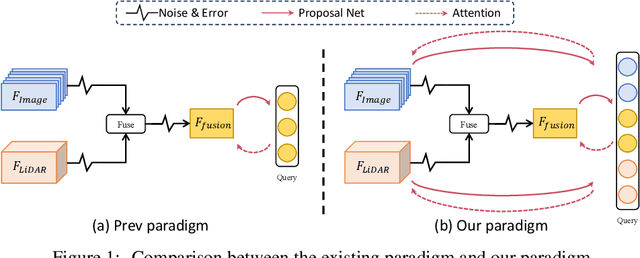
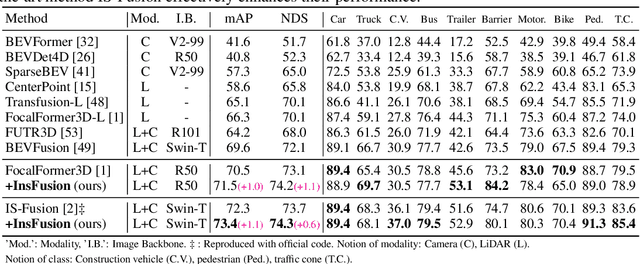
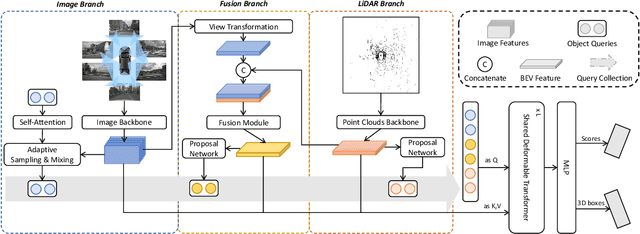
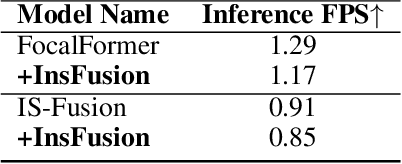
Three-dimensional Object Detection from multi-view cameras and LiDAR is a crucial component for autonomous driving and smart transportation. However, in the process of basic feature extraction, perspective transformation, and feature fusion, noise and error will gradually accumulate. To address this issue, we propose InsFusion, which can extract proposals from both raw and fused features and utilizes these proposals to query the raw features, thereby mitigating the impact of accumulated errors. Additionally, by incorporating attention mechanisms applied to the raw features, it thereby mitigates the impact of accumulated errors. Experiments on the nuScenes dataset demonstrate that InsFusion is compatible with various advanced baseline methods and delivers new state-of-the-art performance for 3D object detection.
OpenAD: Open-World Autonomous Driving Benchmark for 3D Object Detection
Nov 26, 2024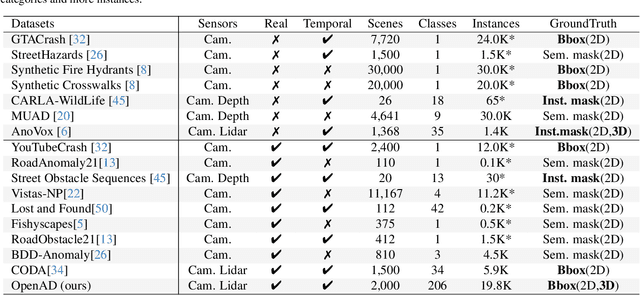


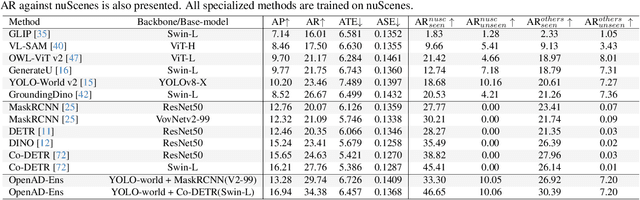
Open-world autonomous driving encompasses domain generalization and open-vocabulary. Domain generalization refers to the capabilities of autonomous driving systems across different scenarios and sensor parameter configurations. Open vocabulary pertains to the ability to recognize various semantic categories not encountered during training. In this paper, we introduce OpenAD, the first real-world open-world autonomous driving benchmark for 3D object detection. OpenAD is built on a corner case discovery and annotation pipeline integrating with a multimodal large language model (MLLM). The proposed pipeline annotates corner case objects in a unified format for five autonomous driving perception datasets with 2000 scenarios. In addition, we devise evaluation methodologies and evaluate various 2D and 3D open-world and specialized models. Moreover, we propose a vision-centric 3D open-world object detection baseline and further introduce an ensemble method by fusing general and specialized models to address the issue of lower precision in existing open-world methods for the OpenAD benchmark. Annotations, toolkit code, and all evaluation codes will be released.
HENet: Hybrid Encoding for End-to-end Multi-task 3D Perception from Multi-view Cameras
Apr 03, 2024
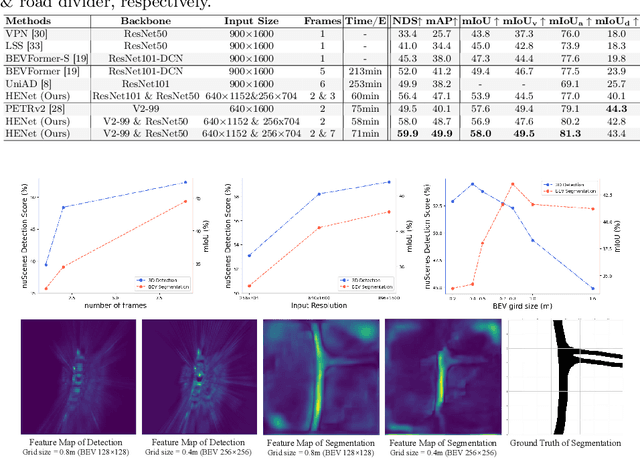
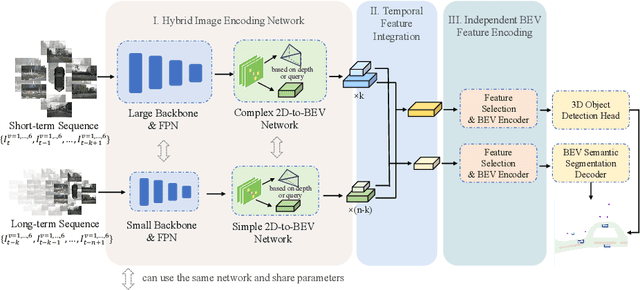
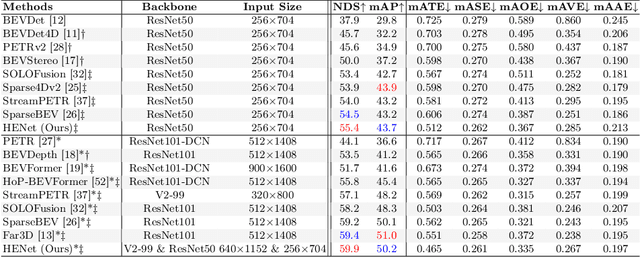
Three-dimensional perception from multi-view cameras is a crucial component in autonomous driving systems, which involves multiple tasks like 3D object detection and bird's-eye-view (BEV) semantic segmentation. To improve perception precision, large image encoders, high-resolution images, and long-term temporal inputs have been adopted in recent 3D perception models, bringing remarkable performance gains. However, these techniques are often incompatible in training and inference scenarios due to computational resource constraints. Besides, modern autonomous driving systems prefer to adopt an end-to-end framework for multi-task 3D perception, which can simplify the overall system architecture and reduce the implementation complexity. However, conflict between tasks often arises when optimizing multiple tasks jointly within an end-to-end 3D perception model. To alleviate these issues, we present an end-to-end framework named HENet for multi-task 3D perception in this paper. Specifically, we propose a hybrid image encoding network, using a large image encoder for short-term frames and a small image encoder for long-term temporal frames. Then, we introduce a temporal feature integration module based on the attention mechanism to fuse the features of different frames extracted by the two aforementioned hybrid image encoders. Finally, according to the characteristics of each perception task, we utilize BEV features of different grid sizes, independent BEV encoders, and task decoders for different tasks. Experimental results show that HENet achieves state-of-the-art end-to-end multi-task 3D perception results on the nuScenes benchmark, including 3D object detection and BEV semantic segmentation. The source code and models will be released at https://github.com/VDIGPKU/HENet.