 Add to Chrome
 Add to Firefox
 Add to Edge
WenetSpeech-Wu: Datasets, Benchmarks, and Models for a Unified Chinese Wu Dialect Speech Processing Ecosystem
Jan 16, 2026
Speech processing for low-resource dialects remains a fundamental challenge in developing inclusive and robust speech technologies. Despite its linguistic significance and large speaker population, the Wu dialect of Chinese has long been hindered by the lack of large-scale speech data, standardized evaluation benchmarks, and publicly available models. In this work, we present WenetSpeech-Wu, the first large-scale, multi-dimensionally annotated open-source speech corpus for the Wu dialect, comprising approximately 8,000 hours of diverse speech data. Building upon this dataset, we introduce WenetSpeech-Wu-Bench, the first standardized and publicly accessible benchmark for systematic evaluation of Wu dialect speech processing, covering automatic speech recognition (ASR), Wu-to-Mandarin translation, speaker attribute prediction, speech emotion recognition, text-to-speech (TTS) synthesis, and instruction-following TTS (instruct TTS). Furthermore, we release a suite of strong open-source models trained on WenetSpeech-Wu, establishing competitive performance across multiple tasks and empirically validating the effectiveness of the proposed dataset. Together, these contributions lay the foundation for a comprehensive Wu dialect speech processing ecosystem, and we open-source proposed datasets, benchmarks, and models to support future research on dialectal speech intelligence.

CJRC: A Reliable Human-Annotated Benchmark DataSet for Chinese Judicial Reading Comprehension
Dec 19, 2019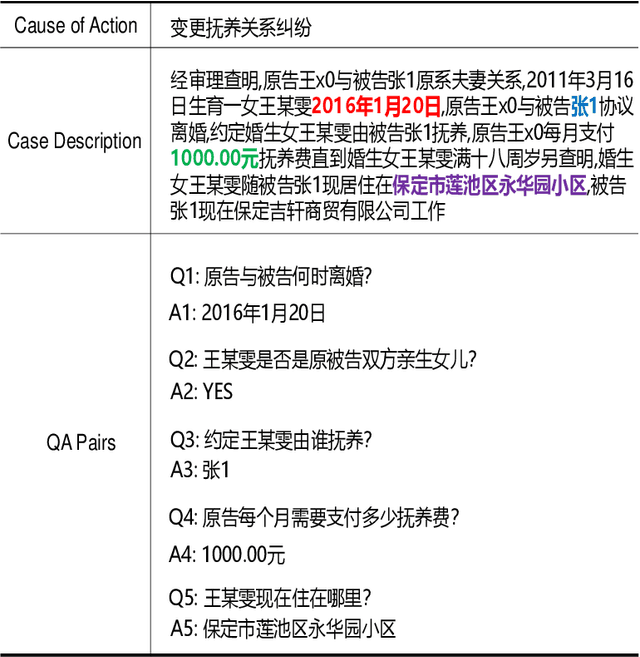
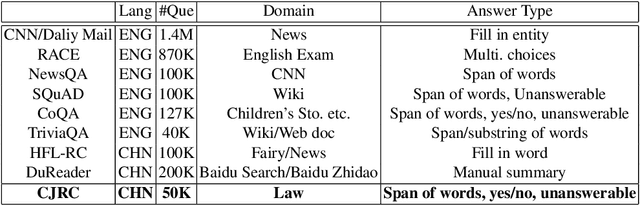
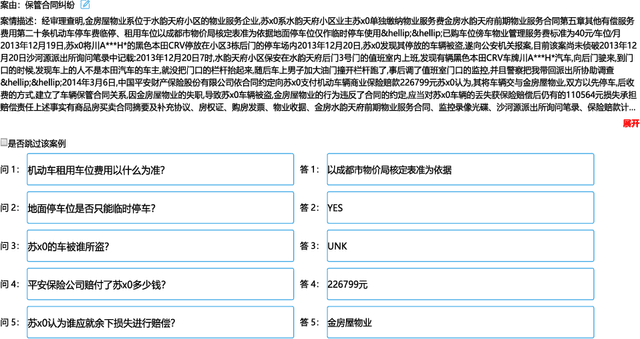
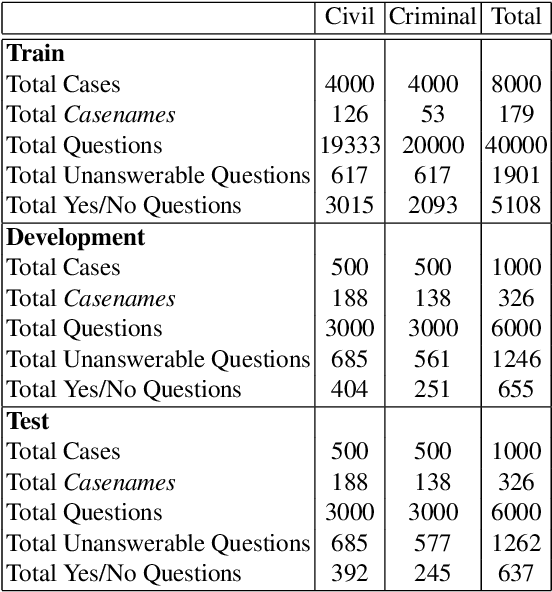
We present a Chinese judicial reading comprehension (CJRC) dataset which contains approximately 10K documents and almost 50K questions with answers. The documents come from judgment documents and the questions are annotated by law experts. The CJRC dataset can help researchers extract elements by reading comprehension technology. Element extraction is an important task in the legal field. However, it is difficult to predefine the element types completely due to the diversity of document types and causes of action. By contrast, machine reading comprehension technology can quickly extract elements by answering various questions from the long document. We build two strong baseline models based on BERT and BiDAF. The experimental results show that there is enough space for improvement compared to human annotators.