 Add to Chrome
 Add to Firefox
 Add to Edge
On Dual-Fed Pinching Antenna Systems with In-Waveguide Attenuation
Mar 05, 2026
Pinching antenna systems (PAS) have recently emerged as a promising architecture for flexible and reconfigurable wireless communications. However, their performance is fundamentally constrained by in-waveguide attenuation, which is non-negligible in practical dielectric waveguides and can severely degrade the achievable data rate, particularly for long waveguides. To overcome this limitation, we propose a dual-fed PAS (DF-PAS), in which each waveguide is equipped with two feed points located at the two ends, enabling dynamic feed-point selection based on user locations. This design effectively shortens the in-waveguide propagation distance and mitigates attenuation-induced power loss without modifying the waveguide structure or the PA actuation mechanism. We investigate the DF-PAS in both single- and multi-waveguide scenarios. For the single-waveguide case, we derive closed-form high-SNR approximations of the ergodic rate and obtain closed-form solutions for the optimal PA position and feed-point selection under time-division multiple access (TDMA). We then extend DF-PAS to a multi-waveguide scenario, where we first derive closed-form high-SNR approximations of the ergodic rate and then formulate a joint optimization problem over feed-point selection, PA placement, and beamforming under general orthogonal multiple access (OMA). To solve this problem efficiently, we develop a two-phase optimization framework that integrates greedy feed-point switching, gradient-based PA placement, and WMMSE-based beamforming. Simulation results demonstrate that the proposed DF-PAS consistently outperforms conventional single-fed PAS (SF-PAS) across various network configurations, validating its effectiveness as a practical and scalable solution for mitigating in-waveguide attenuation in PAS-enabled wireless networks.

Fairness-Oriented Optimization of NOMA-Enabled Pinching-Antenna Systems Under Blockage and Imperfect CSI
Feb 28, 2026The pinching-antenna system (PASS) has been proposed as a promising solution for mitigating line-of-sight (LoS) blockages by dynamically repositioning pinching antennas (PAs) along a dielectric waveguide. This paper develops a fairness-oriented downlink design for a non-orthogonal multiple access (NOMA)-enabled PASS, where the longitudinal placement of PAs and the NOMA power allocation coefficients are jointly optimized to maximize the minimum user signal-to-interference-plus-noise ratio (SINR) across all users under transmit power and waveguide constraints. A soft-blockage channel model incorporating waveguide attenuation and imperfect channel state information (CSI) is developed. To ensure the feasibility of successive interference cancellation under CSI uncertainty, a conservative SINR evaluation framework is proposed. The resulting non-convex max-min SINR optimization problem is efficiently solved using a tailored particle swarm optimization (PSO) algorithm. Numerical results demonstrate that the proposed design improves the minimum user SINR by approximately 7-10 dB compared with fixed-antenna systems and non-robust optimization baselines under moderate blockage and imperfect CSI.
Dynamic Antenna Placement for Mobile Users in Urban Micro Pinching-Antenna Systems
Feb 28, 2026The pinching-antenna systems (PASS) enable blockage mitigation in urban micro (UMi) networks through flexible antenna placement. However, the joint optimization of antenna positions and beamforming precoding is inherently nonconvex and becomes significantly more challenging under user mobility. To address this issue, we propose a bilevel optimization framework for dynamic antenna positioning and beamforming precoding design. In the outer level, a soft actor-critic (SAC) agent learns a continuous control policy for real-time antenna positioning, while in the inner level, zero-forcing (ZF) precoding is applied based on the instantaneous effective channel. Numerical results demonstrate that the proposed framework significantly improves spectral efficiency (SE) and enhances robustness against user mobility and random blockages.
Pinching Antennas in Blockage-Aware Environments: Modeling, Design, and Optimization
Jan 03, 2026Pinching-antenna (PA) systems have recently emerged as a promising member of the flexible-antenna family due to their ability to dynamically establish line-of-sight (LoS) links. While most existing studies assume ideal environments without obstacles, practical indoor deployments are often obstacle-rich, where LoS blockage significantly degrades performance. This paper investigates pinching-antenna systems in blockage-aware environments by developing a deterministic model for cylinder-shaped obstacles that precisely characterizes LoS conditions without relying on stochastic approximations. Based on this model, a special case is first studied where each PA serves a single user and can only be deployed at discrete positions along the waveguide. In this case, the waveguide-user assignment is obtained via the Hungarian algorithm, and PA positions are refined using a surrogate-assisted block-coordinate search. Then, a general case is considered where each PA serves all users and can be continuously placed along the waveguide. In this case, beamforming and PA positions are jointly optimized by a weighted minimum mean square error integrated deep deterministic policy gradient (WMMSE-DDPG) approach to address non-smooth LoS transitions. Simulation results demonstrate that the proposed algorithms significantly improve system throughput and LoS connectivity compared with benchmark methods. Moreover, the results reveal that pinching-antenna systems can effectively leverage obstacles to suppress co-channel interference, converting potential blockages into performance gains.
Robust and Secure Transmission for Movable-RIS Assisted ISAC with Imperfect Sense Estimation
Dec 23, 2025Reconfigurable intelligent surfaces (RISs) have been extensively applied in integrated sensing and communication (ISAC) systems due to the capability of enhancing physical layer security (PLS). However, conventional static RIS architectures lack the flexibility required for adaptive beam control in multi-user and multifunctional scenarios. To address this issue without introducing additional hardware complexity and power consumption, in this paper, we exploit a movable RIS (MRIS) architecture, which consists of a large fixed sub-surface and a smaller movable sub-surface that slides on the fixed sub-surface to achieve dynamic beam reconfiguration with static phase shifts. This paper investigates an MRIS-assisted ISAC system under imperfect sensing estimation, where dedicated radar signals serve as artificial noise to enhance secure transmission against potential eavesdroppers (Eves). The transmit beamforming vectors, MRIS phase shifts, and relative positions of the two sub-surfaces are jointly optimized to maximize the minimum secrecy rate, ensuring robust secrecy performance for the weakest user under the uncertainty of the Eves' channels. To handle the non-convexity, a convex bound is derived for the Eve channel uncertainty, and the S-procedure is employed to reformulate semi-infinite constraints as linear matrix inequalities. An efficient alternating optimization and penalty dual decomposition-based algorithm is developed. Simulation results demonstrate that the proposed MRIS architecture substantially improves secrecy performance, especially when only a small number of elements are allocated to the movable sub-surface.
A Low-Complexity Placement Design of Pinching-Antenna Systems
Feb 20, 2025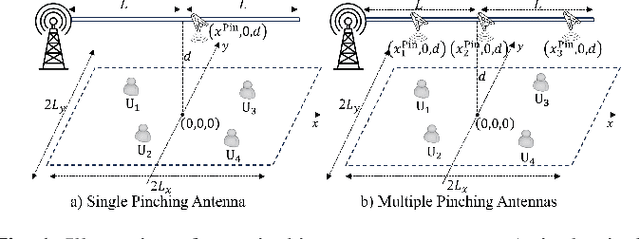
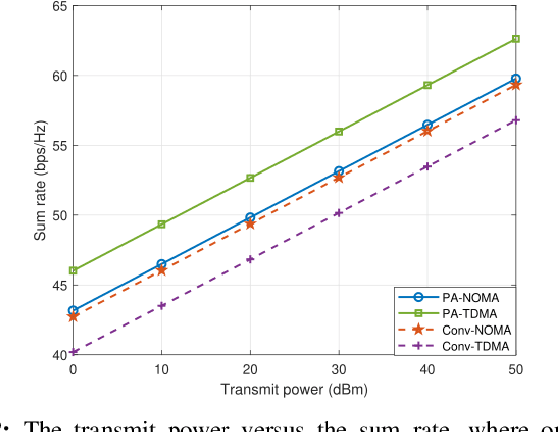
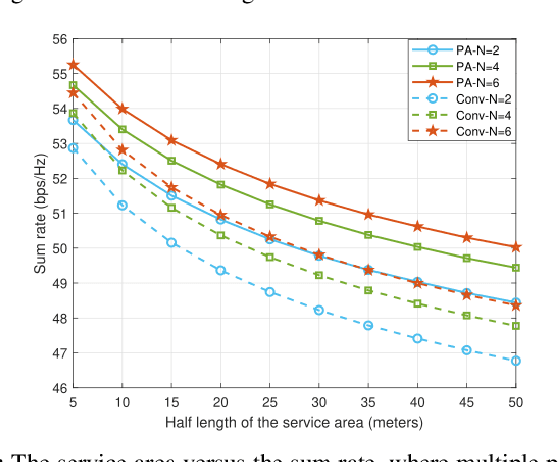
Pinching-antenna systems have recently been proposed as a new candidate for flexible-antenna systems, not only inheriting the reconfiguration capability but also offering a unique feature: establishing line-of-sight links to mitigate large-scale path loss. However, sophisticated optimization of the placement of pinching antennas has very high complexity, which is challenging for practical implementation. This paper proposes a low-complexity placement design, providing the closed-form expression of the placement of pinching antennas, to maximize the sum rate of multiple downlink users. Orthogonal multiple access (OMA) and non-orthogonal multiple access (NOMA) are both investigated when the pinching-antenna system is only equipped with a single antenna and only the OMA case is studied when there are multiple antennas equipped by the pinching-antenna system. Simulation results indicate pinching-antenna systems can outperform conventional fixed-antenna systems and are more suitable for large service areas.
Power-Efficient Optimization for Coexisting Semantic and Bit-Based Users in NOMA Networks
Jan 02, 2025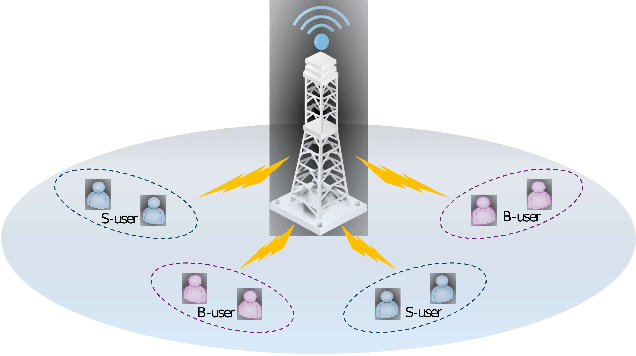
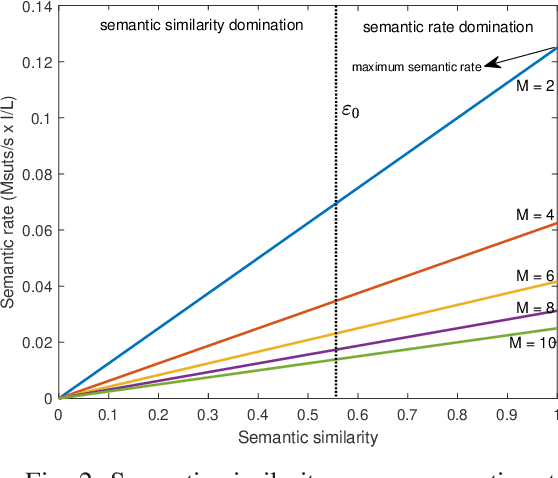
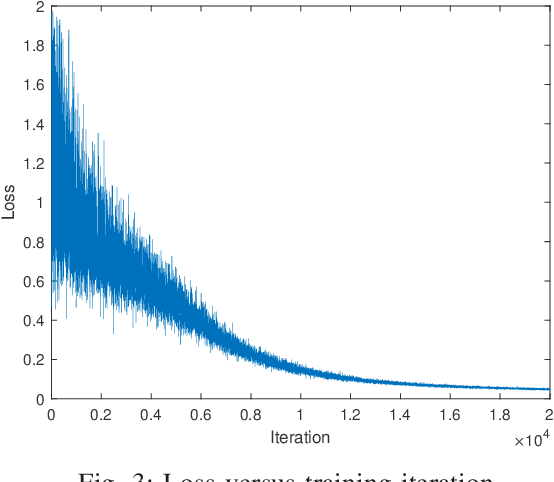
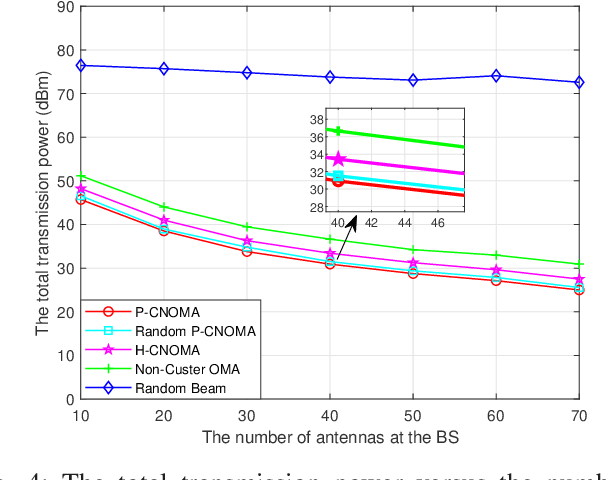
Semantic communication focuses on transmitting the meaning of data, aiming for efficient, relevant communication, while non-orthogonal multiple access (NOMA) enhances spectral efficiency by allowing multiple users to share the same spectrum. Integrating semantic users into a NOMA network with bit-based users improves both transmission and spectrum efficiency. However, the performance metric for semantic communication differs significantly from that of traditional communication, posing challenges in simultaneously meeting individual user demands and minimizing transmission power, especially in scenarios with coexisting semantic and bit-based users. Furthermore, the different hardware architectures of semantic and bit-based users complicate the implementation of successive interference cancellation (SIC). To address these challenges, in this paper, we propose a clustered framework to mitigate the complexity of SIC and two multiple access (MA) schemes, e.g., pure cluster-based NOMA (P-CNOMA) and hybrid cluster-based NOMA (H-CNOMA), to minimize the total transmission power. The P-CNOMA scheme can achieve the minimum transmission power, but may not satisfy the high quality of service (QoS) requirement. In contrast, H-CNOMA addresses these issues with a slight increase in power and a reduced semantic rate. These two schemes complement each other, enabling an adaptive MA selection mechanism that adapts to specific network conditions and user requirements.
Deep Reinforcement Learning Based Optimization for IRS Based UAV-NOMA Downlink Networks
Jun 17, 2021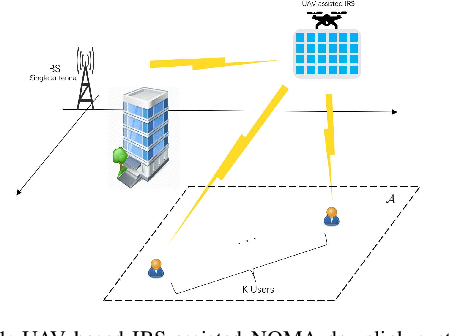
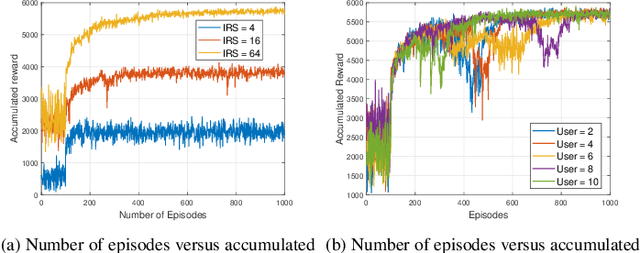
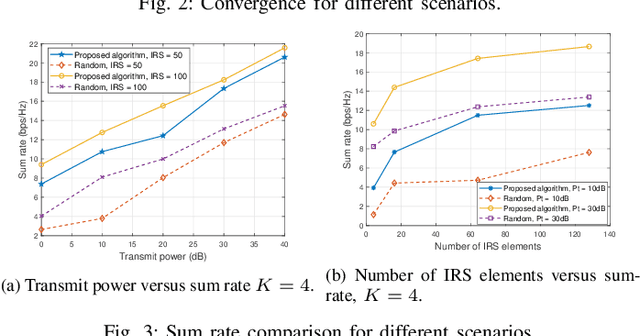
This paper investigates the application of deep deterministic policy gradient (DDPG) to intelligent reflecting surface (IRS) based unmanned aerial vehicles (UAV) assisted non-orthogonal multiple access (NOMA) downlink networks. The deployment of the UAV equipped with an IRS is important, as the UAV increases the flexibility of the IRS significantly, especially for the case of users who have no line of sight (LoS) path to the base station (BS). Therefore, the aim of this letter is to maximize the sum rate by jointly optimizing the power allocation of the BS, the phase shifting of the IRS and the horizontal position of the UAV. Because the formulated problem is not convex, the DDPG algorithm is utilized to solve it. The computer simulation results are provided to show the superior performance of the proposed DDPG based algorithm.
A Reinforcement Learning Approach for an IRS-assisted NOMA Network
Jun 17, 2021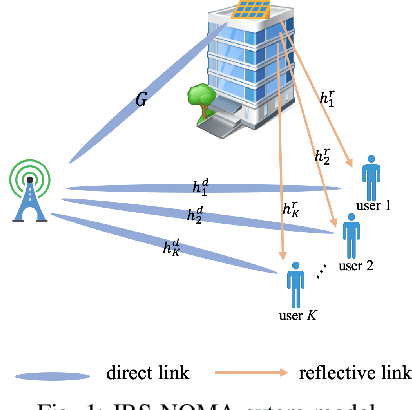
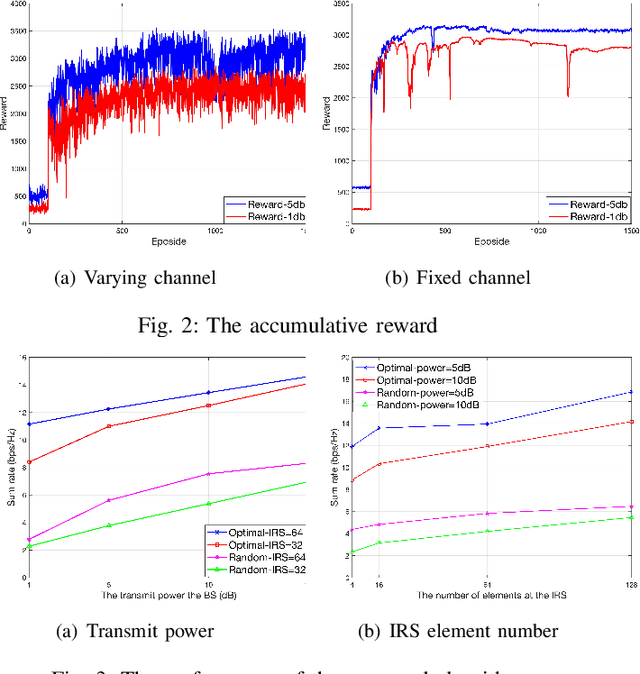
This letter investigates a sum rate maximizationproblem in an intelligent reflective surface (IRS) assisted non-orthogonal multiple access (NOMA) downlink network. Specif-ically, the sum rate of all the users is maximized by jointlyoptimizing the beams at the base station and the phase shiftat the IRS. The deep reinforcement learning (DRL), which hasachieved massive successes, is applied to solve this sum ratemaximization problem. In particular, an algorithm based on thedeep deterministic policy gradient (DDPG) is proposed. Both therandom channel case and the fixed channel case are studied inthis letter. The simulation result illustrates that the DDPG basedalgorithm has the competitive performance on both case.