 Add to Chrome
 Add to Firefox
 Add to Edge
S1-DeepResearch: Beyond Search, Toward Real-World Long-Horizon Research Agents
Jun 13, 2026
Deep research agents aim to solve complex knowledge-intensive tasks through long-horizon planning, evidence gathering, reasoning, and report generation. While recent progress in search agents has demonstrated strong capabilities in information retrieval and answer verification, most existing training datasets remain search-centric, focusing primarily on closed-ended question answering and information localization. As a result, they mainly train information-seeking behavior while providing limited coverage of key deep research capabilities, including evidence integration, knowledge synthesis, planning, file understanding, and structured report generation. In this work, we propose a unified trajectory construction paradigm for deep research agents that combines closed-ended QA and open-ended exploration. The proposed framework consists of graph-grounded task formulation, agentic trajectory rollout, and multi-dimensional trajectory verification, enabling scalable synthesis of high-quality agentic trajectories spanning long-chain complex reasoning, deep research instruction following, report writing, file understanding and generation, and skills usage. Compared with existing search-oriented datasets, our synthesized trajectories place greater emphasis on knowledge synthesis, complex reasoning, and planning. S1-DeepResearch-32B achieves state-of-the-art performance among open-source models of comparable scale across 20 benchmarks spanning five capability dimensions, including complex reasoning, instruction following, report generation, file understanding, and skills usage. On several challenging deep research benchmarks, it approaches the performance of leading proprietary frontier models. These results highlight the importance of jointly modeling information acquisition, knowledge synthesis, and planning-oriented agent behaviors for building effective deep research agents.

YAYI-UIE: A Chat-Enhanced Instruction Tuning Framework for Universal Information Extraction
Jan 08, 2024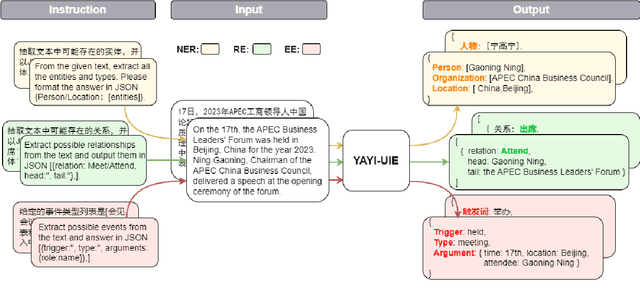
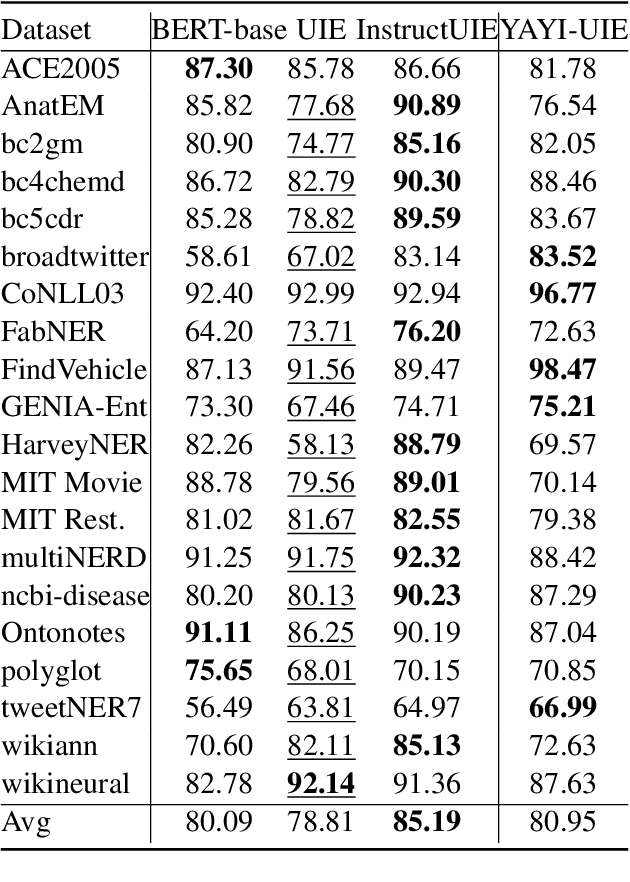
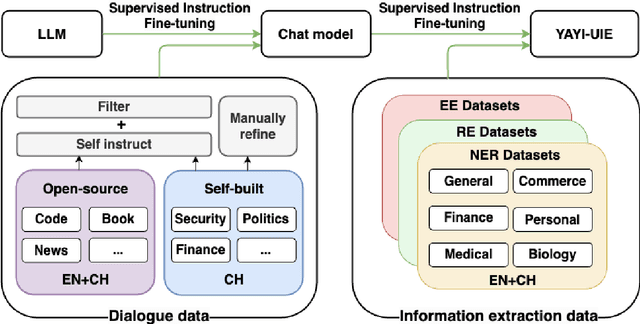
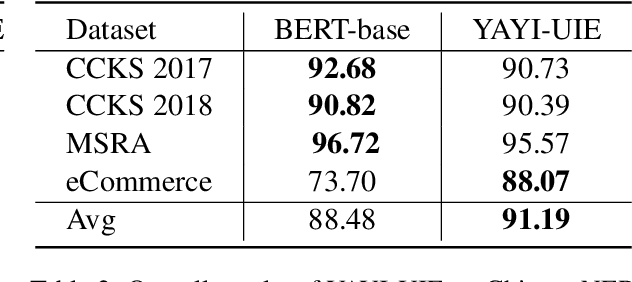
The difficulty of the information extraction task lies in dealing with the task-specific label schemas and heterogeneous data structures. Recent work has proposed methods based on large language models to uniformly model different information extraction tasks. However, these existing methods are deficient in their information extraction capabilities for Chinese languages other than English. In this paper, we propose an end-to-end chat-enhanced instruction tuning framework for universal information extraction (YAYI-UIE), which supports both Chinese and English. Specifically, we utilize dialogue data and information extraction data to enhance the information extraction performance jointly. Experimental results show that our proposed framework achieves state-of-the-art performance on Chinese datasets while also achieving comparable performance on English datasets under both supervised settings and zero-shot settings.
YAYI 2: Multilingual Open-Source Large Language Models
Dec 22, 2023As the latest advancements in natural language processing, large language models (LLMs) have achieved human-level language understanding and generation abilities in many real-world tasks, and even have been regarded as a potential path to the artificial general intelligence. To better facilitate research on LLMs, many open-source LLMs, such as Llama 2 and Falcon, have recently been proposed and gained comparable performances to proprietary models. However, these models are primarily designed for English scenarios and exhibit poor performances in Chinese contexts. In this technical report, we propose YAYI 2, including both base and chat models, with 30 billion parameters. YAYI 2 is pre-trained from scratch on a multilingual corpus which contains 2.65 trillion tokens filtered by our pre-training data processing pipeline. The base model is aligned with human values through supervised fine-tuning with millions of instructions and reinforcement learning from human feedback. Extensive experiments on multiple benchmarks, such as MMLU and CMMLU, consistently demonstrate that the proposed YAYI 2 outperforms other similar sized open-source models.