 Add to Chrome
 Add to Firefox
 Add to Edge
OSAGEN: Object-Aware Mask Priors and Multistage Decoupled Diffusion for Industrial Anomaly Generation
Jul 31, 2026
Industrial anomaly detection and localization are limited by scarce real anomalies and pixel-level annotations, a bottleneck that synthetic image-mask pairs can alleviate. However, existing few-shot mask-guided generation may over-follow mask geometry, produce weak anomalies, or use condition masks incompatible with the current object instance. We propose OSAGEN, which combines object-aware mask priors with multistage decoupled diffusion. Its three-stage adaptation sequentially learns normal appearance, defect appearance under coarse conditions, and fine-grained mask calibration, improving defect realization and local control. QBG injects object structure from a matched normal image into mask diffusion to produce object-aware priors, while ISC restricts anomaly propagation and preserves normal content during sampling. A lightweight materialization step recovers pixel-level labels aligned with the realized defects. On MVTec AD and VisA, OSAGEN achieves AP-P/F1-P scores of 88.1/82.2 and 68.5/66.1, respectively, under a unified downstream localization protocol. The code will be released upon acceptance.

Water Reflection Detection Using Symmetric Attention
Jul 12, 2026Reflections of water pose a significant challenge for computer vision systems, as standard deep learning models frequently confuse objects with their mirror images, producing spurious false positives and negatives in tasks such as object detection and semantic segmentation. As a result, detecting reflection axes in natural-water scenes is pivotal for reliable object detection and scene understanding. To mitigate this issue, we leverage the intrinsic imperfect reflective symmetry of water and introduce a Symmetry-Aware Water Reflection Detection Network, namely, SAWRD-Net, that couples dihedral group-equivariant convolutions with a matrix-decomposition decoder in an end-to-end framework. First, dihedral group convolutional layers extract geometry-consistent feature maps that explicitly encode both rotational and mirror symmetries. A Multi-scale Reflection Equivariant block then aggregates features across scales and employs a symmetric-attention mechanism to highlight reflection-relevant regions. The proposed matrix-decomposition decoder factorizes high-dimensional features into compact low-rank parameter and confidence spaces, after which the network directly regresses keypoints on the reflection axis. Then a robust principal component analysis fits the final axis. Evaluated on the largest available water reflection scene data set, SAWRD-Net achieves a true-positive rate of 0.890 against human annotations, outperforming all existing water reflection detectors.
SPDA-SAM: A Self-prompted Depth-Aware Segment Anything Model for Instance Segmentation
Feb 06, 2026Recently, Segment Anything Model (SAM) has demonstrated strong generalizability in various instance segmentation tasks. However, its performance is severely dependent on the quality of manual prompts. In addition, the RGB images that instance segmentation methods normally use inherently lack depth information. As a result, the ability of these methods to perceive spatial structures and delineate object boundaries is hindered. To address these challenges, we propose a Self-prompted Depth-Aware SAM (SPDA-SAM) for instance segmentation. Specifically, we design a Semantic-Spatial Self-prompt Module (SSSPM) which extracts the semantic and spatial prompts from the image encoder and the mask decoder of SAM, respectively. Furthermore, we introduce a Coarse-to-Fine RGB-D Fusion Module (C2FFM), in which the features extracted from a monocular RGB image and the depth map estimated from it are fused. In particular, the structural information in the depth map is used to provide coarse-grained guidance to feature fusion, while local variations in depth are encoded in order to fuse fine-grained feature representations. To our knowledge, SAM has not been explored in such self-prompted and depth-aware manners. Experimental results demonstrate that our SPDA-SAM outperforms its state-of-the-art counterparts across twelve different data sets. These promising results should be due to the guidance of the self-prompts and the compensation for the spatial information loss by the coarse-to-fine RGB-D fusion operation.
Intelligent Collaborative Optimization for Rubber Tyre Film Production Based on Multi-path Differentiated Clipping Proximal Policy Optimization
Nov 19, 2025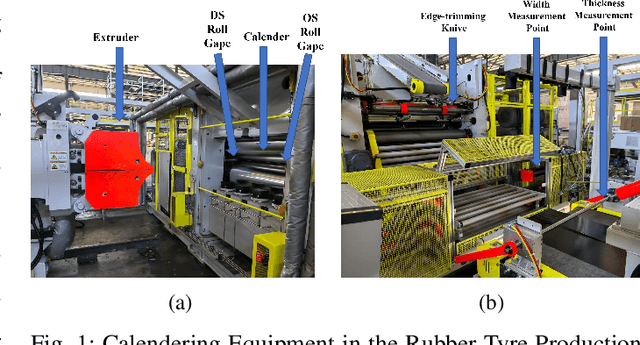
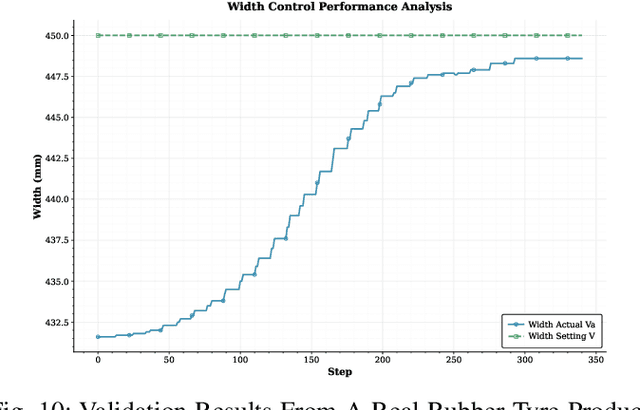
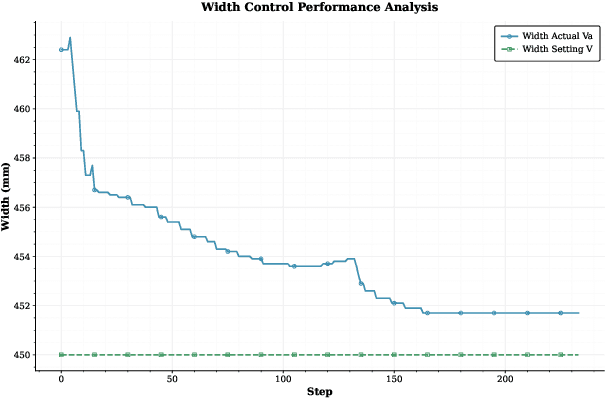
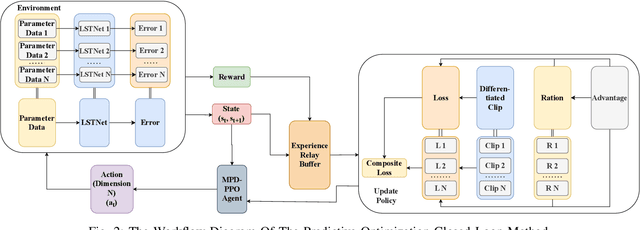
The advent of smart manufacturing is addressing the limitations of traditional centralized scheduling and inflexible production line configurations in the rubber tyre industry, especially in terms of coping with dynamic production demands. Contemporary tyre manufacturing systems form complex networks of tightly coupled subsystems pronounced nonlinear interactions and emergent dynamics. This complexity renders the effective coordination of multiple subsystems, posing an essential yet formidable task. For high-dimensional, multi-objective optimization problems in this domain, we introduce a deep reinforcement learning algorithm: Multi-path Differentiated Clipping Proximal Policy Optimization (MPD-PPO). This algorithm employs a multi-branch policy architecture with differentiated gradient clipping constraints to ensure stable and efficient high-dimensional policy updates. Validated through experiments on width and thickness control in rubber tyre film production, MPD-PPO demonstrates substantial improvements in both tuning accuracy and operational efficiency. The framework successfully tackles key challenges, including high dimensionality, multi-objective trade-offs, and dynamic adaptation, thus delivering enhanced performance and production stability for real-time industrial deployment in tyre manufacturing.
Physics-Aware Semi-Supervised Underwater Image Enhancement
Jul 21, 2023
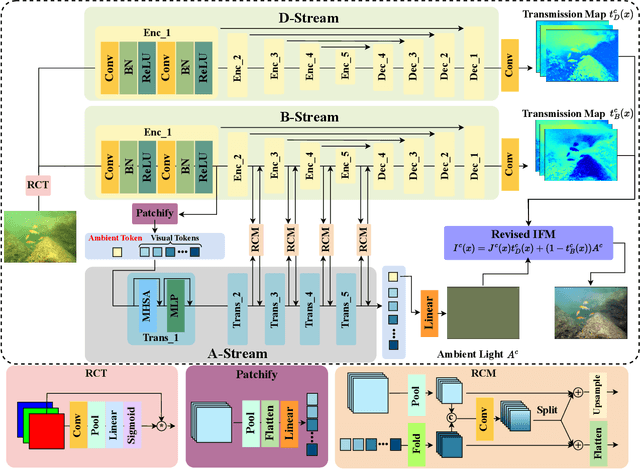
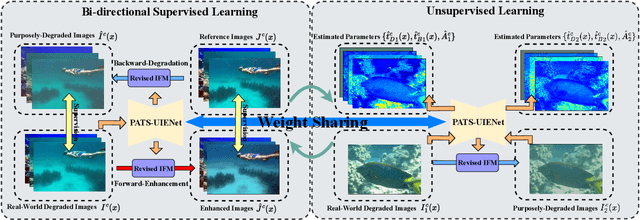

Underwater images normally suffer from degradation due to the transmission medium of water bodies. Both traditional prior-based approaches and deep learning-based methods have been used to address this problem. However, the inflexible assumption of the former often impairs their effectiveness in handling diverse underwater scenes, while the generalization of the latter to unseen images is usually weakened by insufficient data. In this study, we leverage both the physics-based underwater Image Formation Model (IFM) and deep learning techniques for Underwater Image Enhancement (UIE). To this end, we propose a novel Physics-Aware Dual-Stream Underwater Image Enhancement Network, i.e., PA-UIENet, which comprises a Transmission Estimation Steam (T-Stream) and an Ambient Light Estimation Stream (A-Stream). This network fulfills the UIE task by explicitly estimating the degradation parameters of the IFM. We also adopt an IFM-inspired semi-supervised learning framework, which exploits both the labeled and unlabeled images, to address the issue of insufficient data. Our method performs better than, or at least comparably to, eight baselines across five testing sets in the degradation estimation and UIE tasks. This should be due to the fact that it not only can model the degradation but also can learn the characteristics of diverse underwater scenes.
Learning the Precise Feature for Cluster Assignment
Jun 11, 2021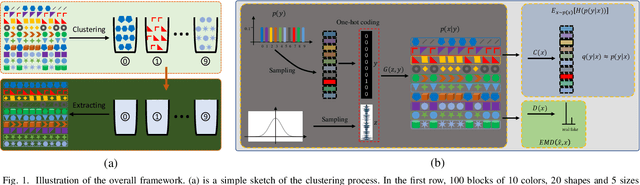
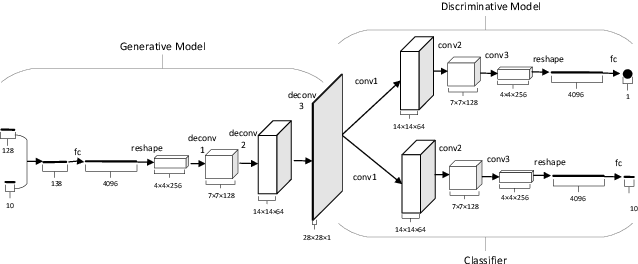
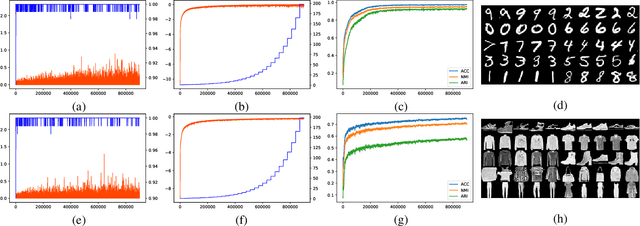
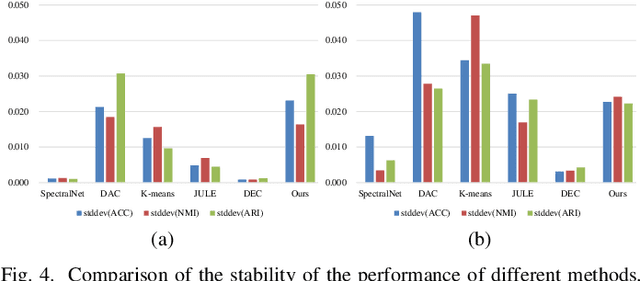
Clustering is one of the fundamental tasks in computer vision and pattern recognition. Recently, deep clustering methods (algorithms based on deep learning) have attracted wide attention with their impressive performance. Most of these algorithms combine deep unsupervised representation learning and standard clustering together. However, the separation of representation learning and clustering will lead to suboptimal solutions because the two-stage strategy prevents representation learning from adapting to subsequent tasks (e.g., clustering according to specific cues). To overcome this issue, efforts have been made in the dynamic adaption of representation and cluster assignment, whereas current state-of-the-art methods suffer from heuristically constructed objectives with representation and cluster assignment alternatively optimized. To further standardize the clustering problem, we audaciously formulate the objective of clustering as finding a precise feature as the cue for cluster assignment. Based on this, we propose a general-purpose deep clustering framework which radically integrates representation learning and clustering into a single pipeline for the first time. The proposed framework exploits the powerful ability of recently developed generative models for learning intrinsic features, and imposes an entropy minimization on the distribution of the cluster assignment by a dedicated variational algorithm. Experimental results show that the performance of the proposed method is superior, or at least comparable to, the state-of-the-art methods on the handwritten digit recognition, fashion recognition, face recognition and object recognition benchmark datasets.