 Add to Chrome
 Add to Firefox
 Add to Edge
TimeSearch-R: Adaptive Temporal Search for Long-Form Video Understanding via Self-Verification Reinforcement Learning
Nov 07, 2025
Temporal search aims to identify a minimal set of relevant frames from tens of thousands based on a given query, serving as a foundation for accurate long-form video understanding. Existing works attempt to progressively narrow the search space. However, these approaches typically rely on a hand-crafted search process, lacking end-to-end optimization for learning optimal search strategies. In this paper, we propose TimeSearch-R, which reformulates temporal search as interleaved text-video thinking, seamlessly integrating searching video clips into the reasoning process through reinforcement learning (RL). However, applying RL training methods, such as Group Relative Policy Optimization (GRPO), to video reasoning can result in unsupervised intermediate search decisions. This leads to insufficient exploration of the video content and inconsistent logical reasoning. To address these issues, we introduce GRPO with Completeness Self-Verification (GRPO-CSV), which gathers searched video frames from the interleaved reasoning process and utilizes the same policy model to verify the adequacy of searched frames, thereby improving the completeness of video reasoning. Additionally, we construct datasets specifically designed for the SFT cold-start and RL training of GRPO-CSV, filtering out samples with weak temporal dependencies to enhance task difficulty and improve temporal search capabilities. Extensive experiments demonstrate that TimeSearch-R achieves significant improvements on temporal search benchmarks such as Haystack-LVBench and Haystack-Ego4D, as well as long-form video understanding benchmarks like VideoMME and MLVU. Notably, TimeSearch-R establishes a new state-of-the-art on LongVideoBench with 4.1% improvement over the base model Qwen2.5-VL and 2.0% over the advanced video reasoning model Video-R1. Our code is available at https://github.com/Time-Search/TimeSearch-R.

TimeSearch: Hierarchical Video Search with Spotlight and Reflection for Human-like Long Video Understanding
Apr 02, 2025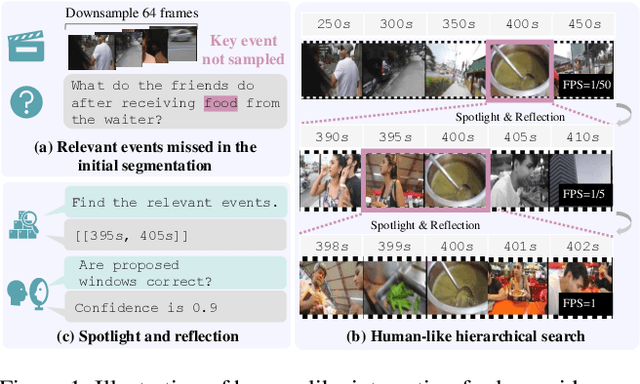
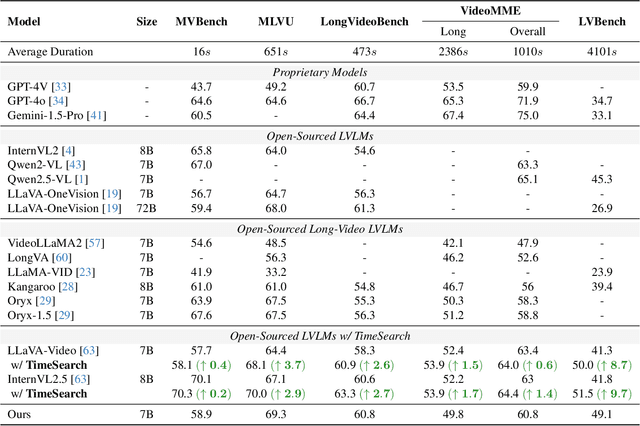
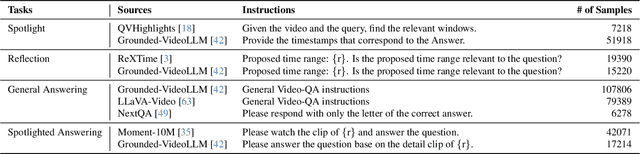
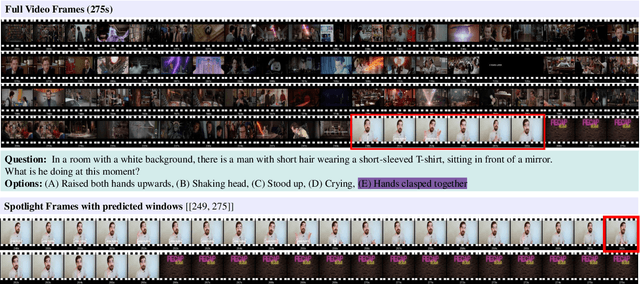
Large video-language models (LVLMs) have shown remarkable performance across various video-language tasks. However, they encounter significant challenges when processing long videos because of the large number of video frames involved. Downsampling long videos in either space or time can lead to visual hallucinations, making it difficult to accurately interpret long videos. Motivated by human hierarchical temporal search strategies, we propose \textbf{TimeSearch}, a novel framework enabling LVLMs to understand long videos in a human-like manner. TimeSearch integrates two human-like primitives into a unified autoregressive LVLM: 1) \textbf{Spotlight} efficiently identifies relevant temporal events through a Temporal-Augmented Frame Representation (TAFR), explicitly binding visual features with timestamps; 2) \textbf{Reflection} evaluates the correctness of the identified events, leveraging the inherent temporal self-reflection capabilities of LVLMs. TimeSearch progressively explores key events and prioritizes temporal search based on reflection confidence. Extensive experiments on challenging long-video benchmarks confirm that TimeSearch substantially surpasses previous state-of-the-art, improving the accuracy from 41.8\% to 51.5\% on the LVBench. Additionally, experiments on temporal grounding demonstrate that appropriate TAFR is adequate to effectively stimulate the surprising temporal grounding ability of LVLMs in a simpler yet versatile manner, which improves mIoU on Charades-STA by 11.8\%. The code will be released.
MammothModa: Multi-Modal Large Language Model
Jun 26, 2024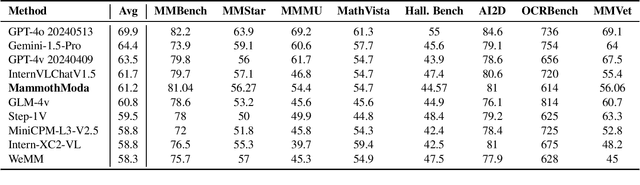
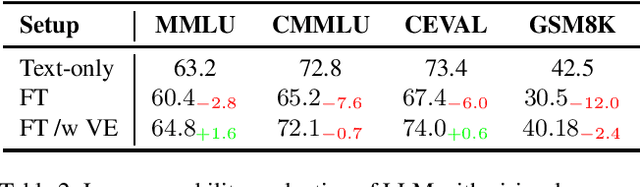


In this report, we introduce MammothModa, yet another multi-modal large language model (MLLM) designed to achieve state-of-the-art performance starting from an elementary baseline. We focus on three key design insights: (i) Integrating Visual Capabilities while Maintaining Complex Language Understanding: In addition to the vision encoder, we incorporated the Visual Attention Experts into the LLM to enhance its visual capabilities. (ii) Extending Context Window for High-Resolution and Long-Duration Visual Feature: We explore the Visual Merger Module to effectively reduce the token number of high-resolution images and incorporated frame position ids to avoid position interpolation. (iii) High-Quality Bilingual Datasets: We meticulously curated and filtered a high-quality bilingual multimodal dataset to reduce visual hallucinations. With above recipe we build MammothModa that consistently outperforms the state-of-the-art models, e.g., LLaVA-series, across main real-world visual language benchmarks without bells and whistles.