 Add to Chrome
 Add to Firefox
 Add to Edge
Artificial Intelligence Reshapes Microwave Photonics
May 20, 2026
As a rapidly emerging interdisciplinary field that intrinsically integrates microwave and photonics, microwave photonics (MWP) provides disruptive solutions to overcome the fundamental bandwidth of conventional electronic systems. By exploiting the inherently ultra-wide bandwidth and low-loss characteristics of photonic technologies, MWP enables the generation, transmission, processing, and detection of microwave, millimeter-wave, and terahertz signals. Representative breakthroughs include fully photonic microwave radar systems, photonic analog-to-digital converters with bandwidth up to 320 GHz, and photonic wireless communication systems achieving data rate as high as 616 Gbit/s. Meanwhile, the rapid growth of artificial intelligence (AI) is reshaping scientific research, engineering, and daily life in unprecedented ways, such as AI for science/engineering and AI co-scientist/assistant. Correspondingly, AI is profoundly reshaping MWP in all aspects, ranging from signal generation, transmission to signal processing and detection. AI has revolutionized the design, simulation, fabrication, testing, deployment, and maintenance of MWP systems, delivering autonomous operation and exceptional efficiency beyond traditional systems. Motivated by these developments, this Review Paper provides the first comprehensive overview of AI-enabled MWP, systematically summarizing the state-of-the-art advances and presenting insights for both the academic community and the broader public.

Millimeter-level Resolution Photonic Multiband Radar Using a Single MZM and Sub-GHz-Bandwidth Electronics
Oct 18, 2022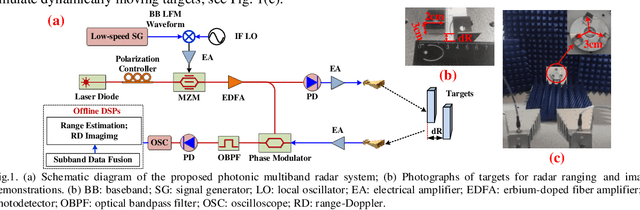
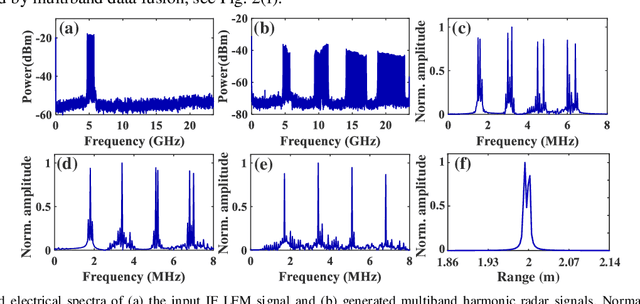
We here propose a novel cost-effective millimeter-level resolution photonic multiband radar system using a single MZM driven by a 1-GHz-bandwidth LFM signal. It experimentally shows an ~8.5-mm range resolution through coherence-processing-free multiband data fusion.
Cost-effective photonic super-resolution millimeter-wave joint radar-communication system using self-coherent detection
Oct 09, 2022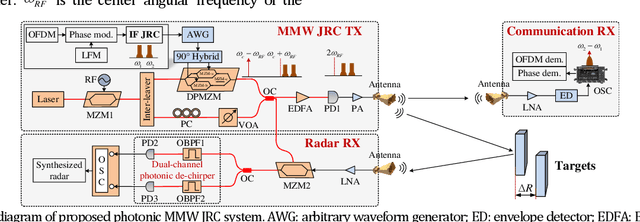
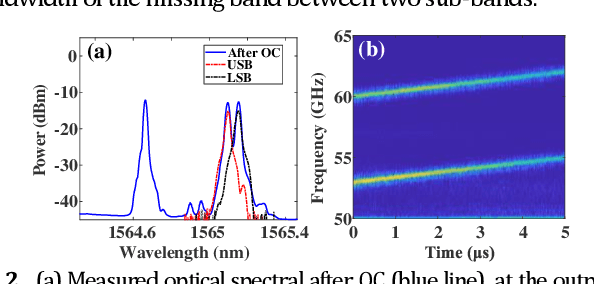
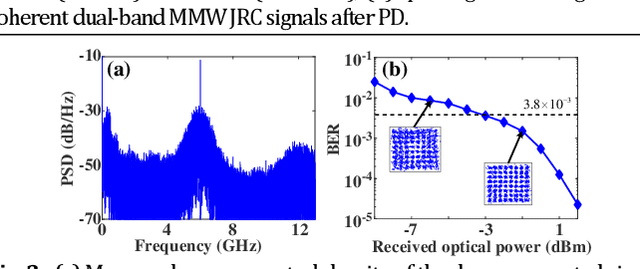
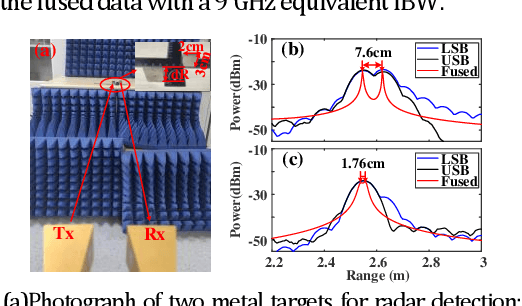
A cost-effective millimeter-wave (MMW) joint radar-communication (JRC) system with super resolution is proposed and experimentally demonstrated, using optical heterodyne up-conversion and self-coherent detection down-conversion techniques. The point lies in the designed coherent dual-band constant envelope linear frequency modulation-orthogonal frequency division multiplexing (LFM-OFDM) signal with opposite phase modulation indexes for the JRC system. Then the self-coherent detection, as a simple and low-cost means, is accordingly facilitated for both de-chirping of MMW radar and frequency down-conversion reception of MMW communication, which circumvents the costly high-speed mixers along with MMW local oscillators and more significantly achieves the real-time decomposition of radar and communication information. Furthermore, a super resolution radar range profile is realized through the coherent fusion processing of dual-band JRC signal. In experiments, a dual-band LFM-OFDM JRC signal centered at 54-GHz and 61-GHz is generated. The dual bands are featured with an identical instantaneous bandwidth of 2 GHz and carry an OFDM signal of 1 GBaud, which help to achieve a 6-Gbit/s data rate for communication and a 1.76-cm range resolution for radar.
Reciprocal phase transition-enabled electro-optic modulation
Mar 28, 2022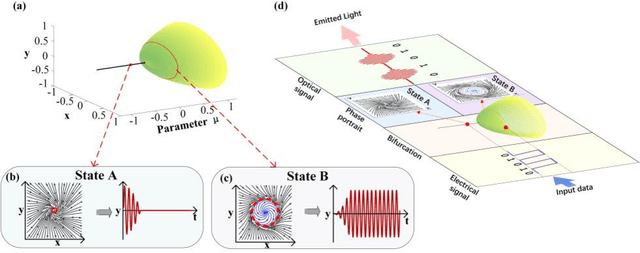
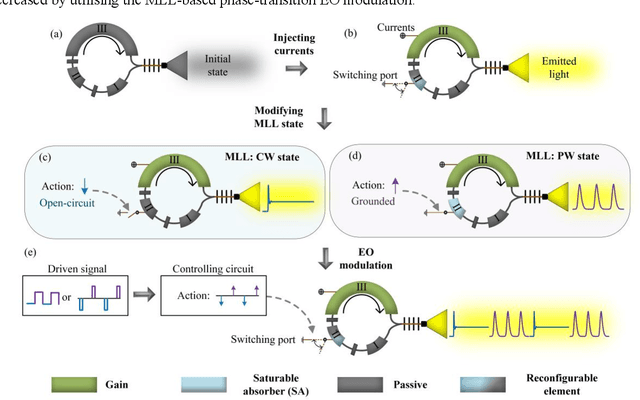
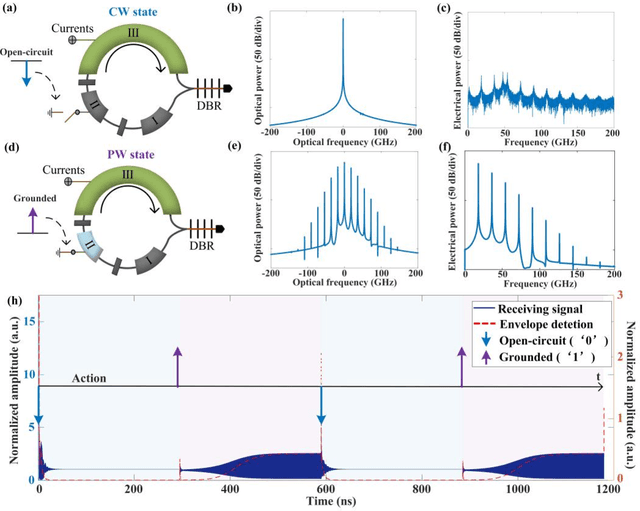
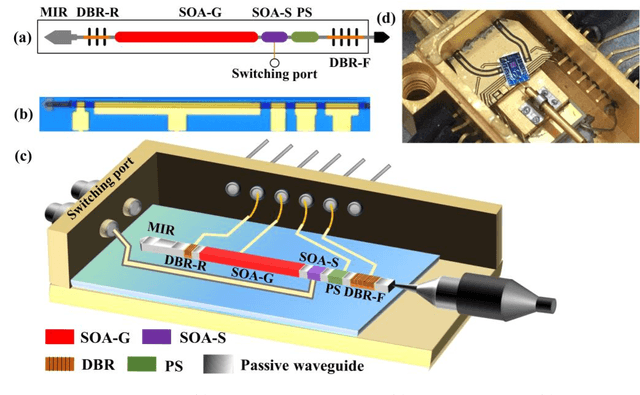
Electro-optic (EO) modulation is a well-known and essential topic in the field of communications and sensing. Its ultrahigh efficiency is unprecedentedly desired in the current green and data era. However, dramatically increasing the modulation efficiency is difficult due to the monotonic mapping relationship between the electrical signal and modulated optical signal. Here, a new mechanism termed phase-transition EO modulation is revealed from the reciprocal transition between two distinct phase planes arising from the bifurcation. Remarkably, a monolithically integrated mode-locked laser (MLL) is implemented as a prototype. A 24.8-GHz radio-frequency signal is generated and modulated, achieving a modulation energy efficiency of 3.06 fJ/bit improved by about four orders of magnitude and a contrast ratio exceeding 50 dB. Thus, MLL-based phase-transition EO modulation is characterised by ultrahigh modulation efficiency and ultrahigh contrast ratio, as experimentally proved in radio-over-fibre and underwater acoustic-sensing systems. This phase-transition EO modulation opens a new avenue for green communication and ubiquitous connections.