 Add to Chrome
 Add to Firefox
 Add to Edge
Can Trustless Agents Be Trusted? An Empirical Study of the ERC-8004 Decentralized AI Agent Ecosystem
Jun 24, 2026
As autonomous AI agents increasingly transact across organizational boundaries, a fundamental trust challenge emerges: how can an agent assess whether an unknown counterpart is trustworthy? The ERC-8004 protocol addresses this challenge with the first permissionless trust layer for AI agent economies, built around three on-chain registries for Identity, Reputation, and Validation. Despite its rapid adoption, the protocol has not been studied empirically, leaving it unclear whether the information it records provides a trustworthy basis for decision-making. To address this gap, we present the first empirical study of ERC-8004 across three chains: Ethereum, BNB Smart Chain (BSC), and Base, covering the period from protocol deployment through May 13, 2026. We crawl on-chain Identity and Reputation events, off-chain files, and x402 payment transactions. On the identity side, we find that most registrations are placeholders rather than active agents, with only a small fraction (3%, 4%, and 15% across Ethereum, BSC, and Base) exposing a valid ERC-8004 registration file with at least one live service endpoint. On the reputation side, we show that the Registry, as currently deployed, cannot function as a trust signal: values are not commensurable, feedback records are rarely grounded in verifiable interactions, and reputation can be manipulated at minimal cost. Consistent with these design weaknesses, we find that a substantial fraction of reviewers (73.6%, 59.2%, and 90.6% across Ethereum, BSC, and Base) exhibit coordinated Sybil behavior. After removing Sybil-flagged feedback, 15.5%, 72.3%, and 89.4% of rated agents, respectively, are left with no valid feedback. We then turn these findings into concrete recommendations for future revisions of ERC-8004. Our study yields actionable protocol-design implications and establishes an empirical baseline for research on AI agent markets.

SoK: Decentralized AI (DeAI)
Nov 26, 2024The centralization of Artificial Intelligence (AI) poses significant challenges, including single points of failure, inherent biases, data privacy concerns, and scalability issues. These problems are especially prevalent in closed-source large language models (LLMs), where user data is collected and used without transparency. To mitigate these issues, blockchain-based decentralized AI (DeAI) has emerged as a promising solution. DeAI combines the strengths of both blockchain and AI technologies to enhance the transparency, security, decentralization, and trustworthiness of AI systems. However, a comprehensive understanding of state-of-the-art DeAI development, particularly for active industry solutions, is still lacking. In this work, we present a Systematization of Knowledge (SoK) for blockchain-based DeAI solutions. We propose a taxonomy to classify existing DeAI protocols based on the model lifecycle. Based on this taxonomy, we provide a structured way to clarify the landscape of DeAI protocols and identify their similarities and differences. We analyze the functionalities of blockchain in DeAI, investigating how blockchain features contribute to enhancing the security, transparency, and trustworthiness of AI processes, while also ensuring fair incentives for AI data and model contributors. In addition, we identify key insights and research gaps in developing DeAI protocols, highlighting several critical avenues for future research.
Decoding SEC Actions: Enforcement Trends through Analyzing Blockchain litigation using LLM-based Thematic Factor Mapping
Aug 21, 2024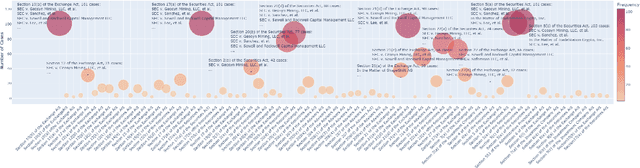
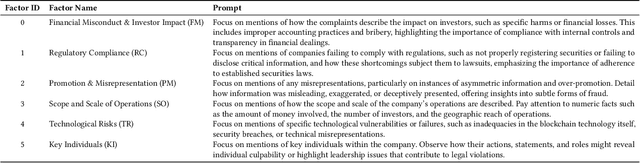
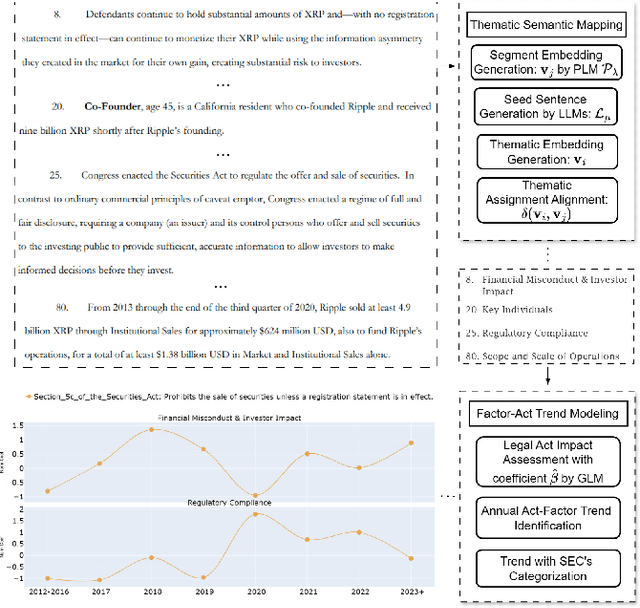

The proliferation of blockchain entities (persons or enterprises) exposes them to potential regulatory actions (e.g., being litigated) by regulatory authorities. Regulatory frameworks for crypto assets are actively being developed and refined, increasing the likelihood of such actions. The lack of systematic analysis of the factors driving litigation against blockchain entities leaves companies in need of clarity to navigate compliance risks. This absence of insight also deprives investors of the information for informed decision-making. This study focuses on U.S. litigation against blockchain entities, particularly by the U.S. Securities and Exchange Commission (SEC) given its influence on global crypto regulation. Utilizing frontier pretrained language models and large language models, we systematically map all SEC complaints against blockchain companies from 2012 to 2024 to thematic factors conceptualized by our study to delineate the factors driving SEC actions. We quantify the thematic factors and assess their influence on specific legal Acts cited within the complaints on an annual basis, allowing us to discern the regulatory emphasis, patterns and conduct trend analysis.