 Add to Chrome
 Add to Firefox
 Add to Edge
Profit is the Red Team: Stress-Testing Agents in Strategic Economic Interactions
Mar 21, 2026
As agentic systems move into real-world deployments, their decisions increasingly depend on external inputs such as retrieved content, tool outputs, and information provided by other actors. When these inputs can be strategically shaped by adversaries, the relevant security risk extends beyond a fixed library of prompt attacks to adaptive strategies that steer agents toward unfavorable outcomes. We propose profit-driven red teaming, a stress-testing protocol that replaces handcrafted attacks with a learned opponent trained to maximize its profit using only scalar outcome feedback. The protocol requires no LLM-as-judge scoring, attack labels, or attack taxonomy, and is designed for structured settings with auditable outcomes. We instantiate it in a lean arena of four canonical economic interactions, which provide a controlled testbed for adaptive exploitability. In controlled experiments, agents that appear strong against static baselines become consistently exploitable under profit-optimized pressure, and the learned opponent discovers probing, anchoring, and deceptive commitments without explicit instruction. We then distill exploit episodes into concise prompt rules for the agent, which make most previously observed failures ineffective and substantially improve target performance. These results suggest that profit-driven red-team data can provide a practical route to improving robustness in structured agent settings with auditable outcomes.

GOD model: Privacy Preserved AI School for Personal Assistant
Feb 24, 2025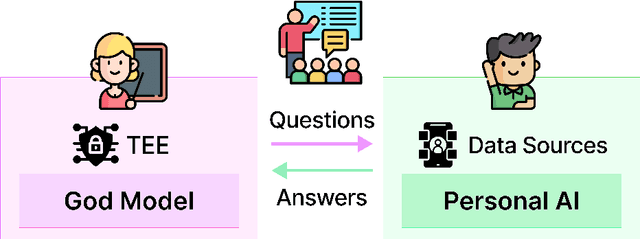
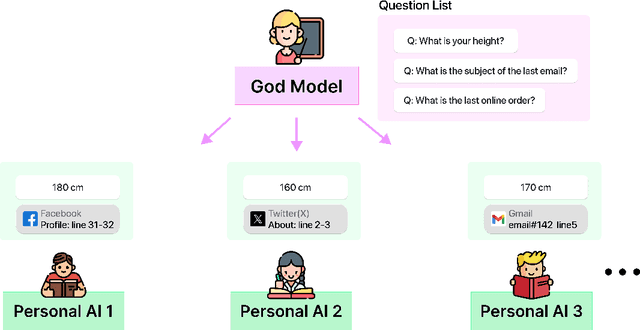
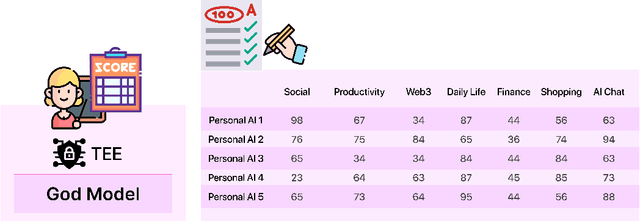
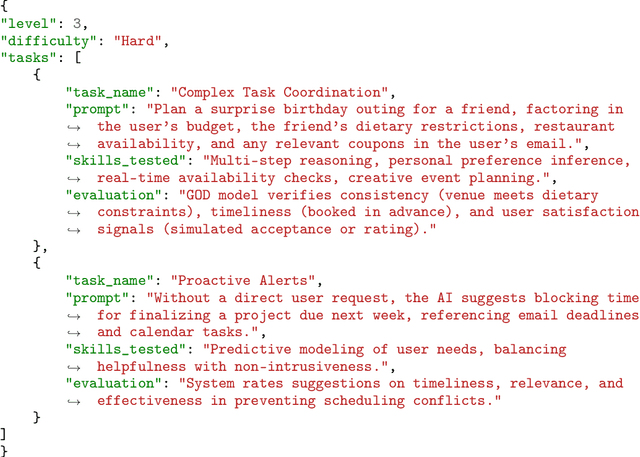
Personal AI assistants (e.g., Apple Intelligence, Meta AI) offer proactive recommendations that simplify everyday tasks, but their reliance on sensitive user data raises concerns about privacy and trust. To address these challenges, we introduce the Guardian of Data (GOD), a secure, privacy-preserving framework for training and evaluating AI assistants directly on-device. Unlike traditional benchmarks, the GOD model measures how well assistants can anticipate user needs-such as suggesting gifts-while protecting user data and autonomy. Functioning like an AI school, it addresses the cold start problem by simulating user queries and employing a curriculum-based approach to refine the performance of each assistant. Running within a Trusted Execution Environment (TEE), it safeguards user data while applying reinforcement and imitation learning to refine AI recommendations. A token-based incentive system encourages users to share data securely, creating a data flywheel that drives continuous improvement. By integrating privacy, personalization, and trust, the GOD model provides a scalable, responsible path for advancing personal AI assistants. For community collaboration, part of the framework is open-sourced at https://github.com/PIN-AI/God-Model.
SoK: Decentralized AI (DeAI)
Nov 26, 2024The centralization of Artificial Intelligence (AI) poses significant challenges, including single points of failure, inherent biases, data privacy concerns, and scalability issues. These problems are especially prevalent in closed-source large language models (LLMs), where user data is collected and used without transparency. To mitigate these issues, blockchain-based decentralized AI (DeAI) has emerged as a promising solution. DeAI combines the strengths of both blockchain and AI technologies to enhance the transparency, security, decentralization, and trustworthiness of AI systems. However, a comprehensive understanding of state-of-the-art DeAI development, particularly for active industry solutions, is still lacking. In this work, we present a Systematization of Knowledge (SoK) for blockchain-based DeAI solutions. We propose a taxonomy to classify existing DeAI protocols based on the model lifecycle. Based on this taxonomy, we provide a structured way to clarify the landscape of DeAI protocols and identify their similarities and differences. We analyze the functionalities of blockchain in DeAI, investigating how blockchain features contribute to enhancing the security, transparency, and trustworthiness of AI processes, while also ensuring fair incentives for AI data and model contributors. In addition, we identify key insights and research gaps in developing DeAI protocols, highlighting several critical avenues for future research.
Cooperative AI via Decentralized Commitment Devices
Nov 14, 2023Credible commitment devices have been a popular approach for robust multi-agent coordination. However, existing commitment mechanisms face limitations like privacy, integrity, and susceptibility to mediator or user strategic behavior. It is unclear if the cooperative AI techniques we study are robust to real-world incentives and attack vectors. However, decentralized commitment devices that utilize cryptography have been deployed in the wild, and numerous studies have shown their ability to coordinate algorithmic agents facing adversarial opponents with significant economic incentives, currently in the order of several million to billions of dollars. In this paper, we use examples in the decentralization and, in particular, Maximal Extractable Value (MEV) (arXiv:1904.05234) literature to illustrate the potential security issues in cooperative AI. We call for expanded research into decentralized commitments to advance cooperative AI capabilities for secure coordination in open environments and empirical testing frameworks to evaluate multi-agent coordination ability given real-world commitment constraints.
Optimal Dynamic Fees for Blockchain Resources
Sep 22, 2023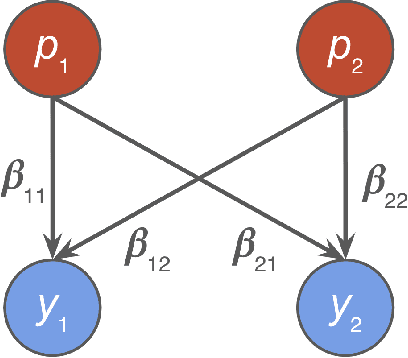
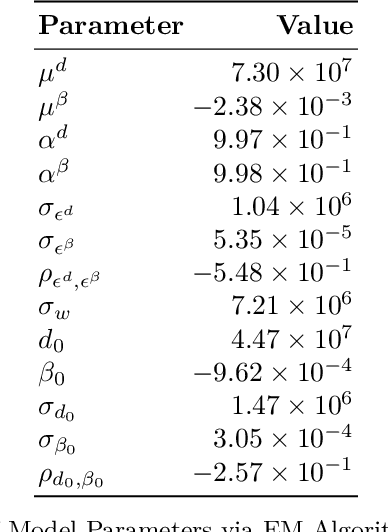
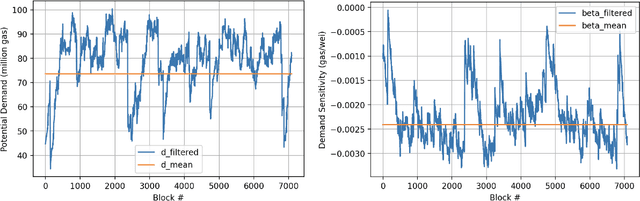
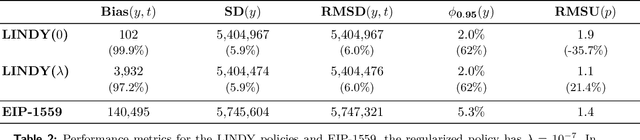
We develop a general and practical framework to address the problem of the optimal design of dynamic fee mechanisms for multiple blockchain resources. Our framework allows to compute policies that optimally trade-off between adjusting resource prices to handle persistent demand shifts versus being robust to local noise in the observed block demand. In the general case with more than one resource, our optimal policies correctly handle cross-effects (complementarity and substitutability) in resource demands. We also show how these cross-effects can be used to inform resource design, i.e. combining resources into bundles that have low demand-side cross-effects can yield simpler and more efficient price-update rules. Our framework is also practical, we demonstrate how it can be used to refine or inform the design of heuristic fee update rules such as EIP-1559 or EIP-4844 with two case studies. We then estimate a uni-dimensional version of our model using real market data from the Ethereum blockchain and empirically compare the performance of our optimal policies to EIP-1559.