 Add to Chrome
 Add to Firefox
 Add to Edge
Project and Generate: Divergence-Free Neural Operators for Incompressible Flows
Mar 25, 2026
Learning-based models for fluid dynamics often operate in unconstrained function spaces, leading to physically inadmissible, unstable simulations. While penalty-based methods offer soft regularization, they provide no structural guarantees, resulting in spurious divergence and long-term collapse. In this work, we introduce a unified framework that enforces the incompressible continuity equation as a hard, intrinsic constraint for both deterministic and generative modeling. First, to project deterministic models onto the divergence-free subspace, we integrate a differentiable spectral Leray projection grounded in the Helmholtz-Hodge decomposition, which restricts the regression hypothesis space to physically admissible velocity fields. Second, to generate physically consistent distributions, we show that simply projecting model outputs is insufficient when the prior is incompatible. To address this, we construct a divergence-free Gaussian reference measure via a curl-based pushforward, ensuring the entire probability flow remains subspace-consistent by construction. Experiments on 2D Navier-Stokes equations demonstrate exact incompressibility up to discretization error and substantially improved stability and physical consistency.

Aneumo: A Large-Scale Comprehensive Synthetic Dataset of Aneurysm Hemodynamics
Jan 17, 2025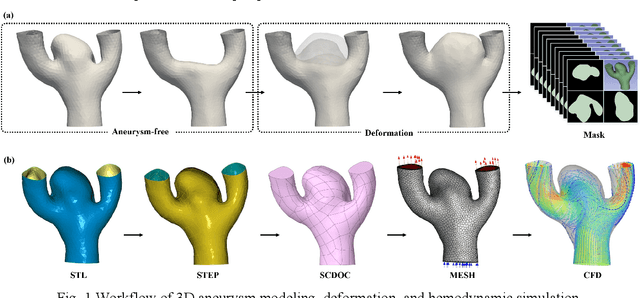
Intracranial aneurysm (IA) is a common cerebrovascular disease that is usually asymptomatic but may cause severe subarachnoid hemorrhage (SAH) if ruptured. Although clinical practice is usually based on individual factors and morphological features of the aneurysm, its pathophysiology and hemodynamic mechanisms remain controversial. To address the limitations of current research, this study constructed a comprehensive hemodynamic dataset of intracranial aneurysms. The dataset is based on 466 real aneurysm models, and 10,000 synthetic models were generated by resection and deformation operations, including 466 aneurysm-free models and 9,534 deformed aneurysm models. The dataset also provides medical image-like segmentation mask files to support insightful analysis. In addition, the dataset contains hemodynamic data measured at eight steady-state flow rates (0.001 to 0.004 kg/s), including critical parameters such as flow velocity, pressure, and wall shear stress, providing a valuable resource for investigating aneurysm pathogenesis and clinical prediction. This dataset will help advance the understanding of the pathologic features and hemodynamic mechanisms of intracranial aneurysms and support in-depth research in related fields. Dataset hosted at https://github.com/Xigui-Li/Aneumo.