 Add to Chrome
 Add to Firefox
 Add to Edge
Planning Oriented Integrated Sensing and Communication
Oct 27, 2025
Integrated sensing and communication (ISAC) enables simultaneous localization, environment perception, and data exchange for connected autonomous vehicles. However, most existing ISAC designs prioritize sensing accuracy and communication throughput, treating all targets uniformly and overlooking the impact of critical obstacles on motion efficiency. To overcome this limitation, we propose a planning-oriented ISAC (PISAC) framework that reduces the sensing uncertainty of planning-bottleneck obstacles and expands the safe navigable path for the ego-vehicle, thereby bridging the gap between physical-layer optimization and motion-level planning. The core of PISAC lies in deriving a closed-form safety bound that explicitly links ISAC transmit power to sensing uncertainty, based on the Cram\'er-Rao Bound and occupancy inflation principles. Using this model, we formulate a bilevel power allocation and motion planning (PAMP) problem, where the inner layer optimizes the ISAC beam power distribution and the outer layer computes a collision-free trajectory under uncertainty-aware safety constraints. Comprehensive simulations in high-fidelity urban driving environments demonstrate that PISAC achieves up to 40% higher success rates and over 5% shorter traversal times than existing ISAC-based and communication-oriented benchmarks, validating its effectiveness in enhancing both safety and efficiency.

Integrated Sensing and Communication for Edge Inference with End-to-End Multi-View Fusion
Apr 16, 2024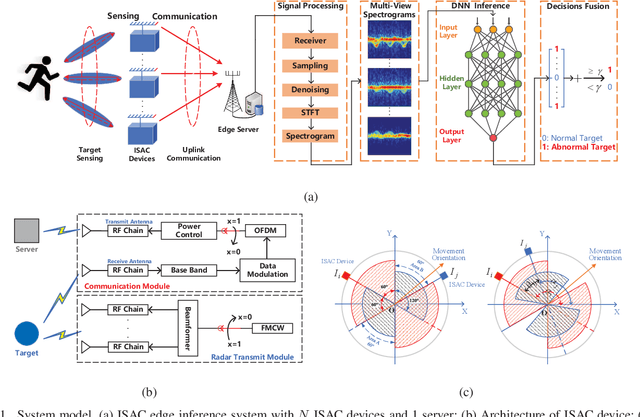
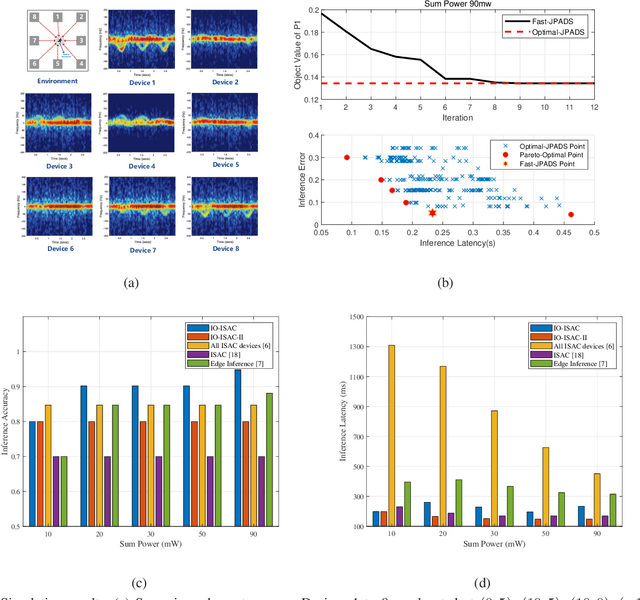
Integrated sensing and communication (ISAC) is a promising solution to accelerate edge inference via the dual use of wireless signals. However, this paradigm needs to minimize the inference error and latency under ISAC co-functionality interference, for which the existing ISAC or edge resource allocation algorithms become inefficient, as they ignore the inter-dependency between low-level ISAC designs and high-level inference services. This letter proposes an inference-oriented ISAC (IO-ISAC) scheme, which minimizes upper bounds on end-to-end inference error and latency using multi-objective optimization. The key to our approach is to derive a multi-view inference model that accounts for both the number of observations and the angles of observations, by integrating a half-voting fusion rule and an angle-aware sensing model. Simulation results show that the proposed IO-ISAC outperforms other benchmarks in terms of both accuracy and latency.