 Add to Chrome
 Add to Firefox
 Add to Edge
ShopX: A Foundation Model for Intent-to-Item Fulfillment in Agentic Shopping
Jun 30, 2026
The wave of AI-native applications is moving shopping beyond page- and feed-based browsing toward intent-driven experiences orchestrated by LLM agents. A common design wraps an LLM around existing search and recommendation pipelines, forcing complex intents through low-bandwidth retrieval or ranking interfaces and leaving a gap between language understanding and item-space fulfillment. Generative recommendation gives LLMs a direct item-space interface through semantic IDs (SIDs), but existing models mainly generate candidates for retrieval rather than translate flexible intents into item-space outcomes. We propose ShopX to address this bottleneck by unifying intent understanding, execution planning, and flexible SID-native item-space operations into a single foundation model. We deploy ShopX in agentic shopping workflows through a model-native item-fulfillment framework with a serving harness that defines a model-facing action protocol and exposes support surfaces for context access, catalog grounding, and state management. Within this framework, ShopX plans and composes SID-based item-space operations such as SID beam-search retrieval, listwise ranking, or product bundling. This model-centric design reduces lossy hand-offs between agent orchestration and item-space execution. To build ShopX, we design semantically recoverable, LLM-operable SIDs and a training recipe that equips a general LLM for flexible multi-turn item-space fulfillment while retaining the knowledge and instruction-following abilities needed by a shopping agent. We evaluate the ShopX framework against tool-mediated agentic systems on single- and multi-turn fulfillment tasks derived from anonymized Taobao production logs, showing that model-native fulfillment improves overall framework behavior, especially on complex or ambiguous requests.

Fast Text-to-3D-Aware Face Generation and Manipulation via Direct Cross-modal Mapping and Geometric Regularization
Mar 11, 2024


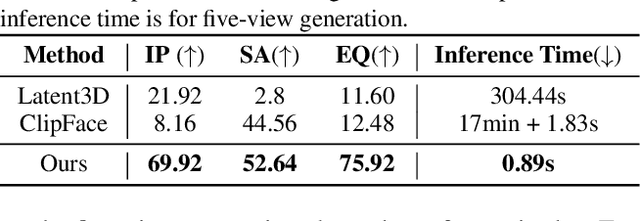
Text-to-3D-aware face (T3D Face) generation and manipulation is an emerging research hot spot in machine learning, which still suffers from low efficiency and poor quality. In this paper, we propose an End-to-End Efficient and Effective network for fast and accurate T3D face generation and manipulation, termed $E^3$-FaceNet. Different from existing complex generation paradigms, $E^3$-FaceNet resorts to a direct mapping from text instructions to 3D-aware visual space. We introduce a novel Style Code Enhancer to enhance cross-modal semantic alignment, alongside an innovative Geometric Regularization objective to maintain consistency across multi-view generations. Extensive experiments on three benchmark datasets demonstrate that $E^3$-FaceNet can not only achieve picture-like 3D face generation and manipulation, but also improve inference speed by orders of magnitudes. For instance, compared with Latent3D, $E^3$-FaceNet speeds up the five-view generations by almost 470 times, while still exceeding in generation quality. Our code are released at https://github.com/Aria-Zhangjl/E3-FaceNet.