 Add to Chrome
 Add to Firefox
 Add to Edge
Meta-Black-Box Optimization Can Do Search Guidance for Expensive Constrained Multi-Objective Optimization
May 11, 2026
Existing Meta-Black-Box Optimization (MetaBBO) methods focus on how to search when controlling optimizers, but largely overlook where to search. We propose MetaSG-SAEA, a bi-level MetaBBO framework for expensive constrained multi-objective optimization problems (ECMOPs), in which a meta-policy provides search guidance to the low-level Surrogate-Assisted Evolutionary Algorithm (SAEA). To achieve this, we introduce Max-Min Constraint-Calibrated Inequality (MM-CCI), a compact, problem-agnostic region abstraction that maps heterogeneous constraint evaluations to an ordered scalar level; we further provide a theoretical analysis of its fundamental properties. Building on this region abstraction, we adopt diffusion-based population initialization to translate the meta-policy's region-level guidance into solution-level priors for the SAEA. To make MetaSG-SAEA scalable, we construct an attention-based state representation across varying problem dimensions, population sizes, and numbers of objectives and constraints. Experimental results demonstrate that MetaSG-SAEA outperforms state-of-the-art baselines across diverse benchmarks and exhibits the ability to generalize across problem distributions.

Attention Residuals
Mar 16, 2026Residual connections with PreNorm are standard in modern LLMs, yet they accumulate all layer outputs with fixed unit weights. This uniform aggregation causes uncontrolled hidden-state growth with depth, progressively diluting each layer's contribution. We propose Attention Residuals (AttnRes), which replaces this fixed accumulation with softmax attention over preceding layer outputs, allowing each layer to selectively aggregate earlier representations with learned, input-dependent weights. To address the memory and communication overhead of attending over all preceding layer outputs for large-scale model training, we introduce Block AttnRes, which partitions layers into blocks and attends over block-level representations, reducing the memory footprint while preserving most of the gains of full AttnRes. Combined with cache-based pipeline communication and a two-phase computation strategy, Block AttnRes becomes a practical drop-in replacement for standard residual connections with minimal overhead. Scaling law experiments confirm that the improvement is consistent across model sizes, and ablations validate the benefit of content-dependent depth-wise selection. We further integrate AttnRes into the Kimi Linear architecture (48B total / 3B activated parameters) and pre-train on 1.4T tokens, where AttnRes mitigates PreNorm dilution, yielding more uniform output magnitudes and gradient distribution across depth, and improves downstream performance across all evaluated tasks.
Kimi K2.5: Visual Agentic Intelligence
Feb 02, 2026We introduce Kimi K2.5, an open-source multimodal agentic model designed to advance general agentic intelligence. K2.5 emphasizes the joint optimization of text and vision so that two modalities enhance each other. This includes a series of techniques such as joint text-vision pre-training, zero-vision SFT, and joint text-vision reinforcement learning. Building on this multimodal foundation, K2.5 introduces Agent Swarm, a self-directed parallel agent orchestration framework that dynamically decomposes complex tasks into heterogeneous sub-problems and executes them concurrently. Extensive evaluations show that Kimi K2.5 achieves state-of-the-art results across various domains including coding, vision, reasoning, and agentic tasks. Agent Swarm also reduces latency by up to $4.5\times$ over single-agent baselines. We release the post-trained Kimi K2.5 model checkpoint to facilitate future research and real-world applications of agentic intelligence.
Meta-Black-Box Optimization with Bi-Space Landscape Analysis and Dual-Control Mechanism for SAEA
Nov 19, 2025Surrogate-Assisted Evolutionary Algorithms (SAEAs) are widely used for expensive Black-Box Optimization. However, their reliance on rigid, manually designed components such as infill criteria and evolutionary strategies during the search process limits their flexibility across tasks. To address these limitations, we propose Dual-Control Bi-Space Surrogate-Assisted Evolutionary Algorithm (DB-SAEA), a Meta-Black-Box Optimization (MetaBBO) framework tailored for multi-objective problems. DB-SAEA learns a meta-policy that jointly regulates candidate generation and infill criterion selection, enabling dual control. The bi-space Exploratory Landscape Analysis (ELA) module in DB-SAEA adopts an attention-based architecture to capture optimization states from both true and surrogate evaluation spaces, while ensuring scalability across problem dimensions, population sizes, and objectives. Additionally, we integrate TabPFN as the surrogate model for accurate and efficient prediction with uncertainty estimation. The framework is trained via reinforcement learning, leveraging parallel sampling and centralized training to enhance efficiency and transferability across tasks. Experimental results demonstrate that DB-SAEA not only outperforms state-of-the-art baselines across diverse benchmarks, but also exhibits strong zero-shot transfer to unseen tasks with higher-dimensional settings. This work introduces the first MetaBBO framework with dual-level control over SAEAs and a bi-space ELA that captures surrogate model information.
Kimi K2: Open Agentic Intelligence
Jul 28, 2025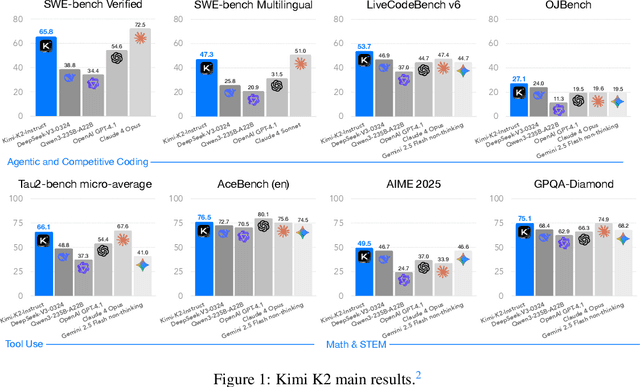
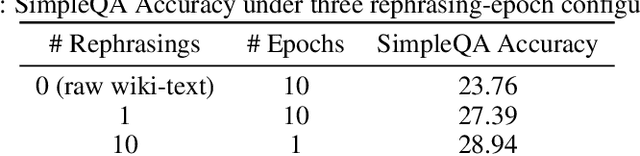
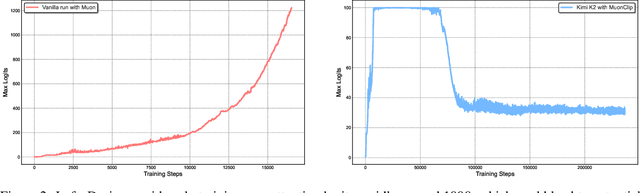
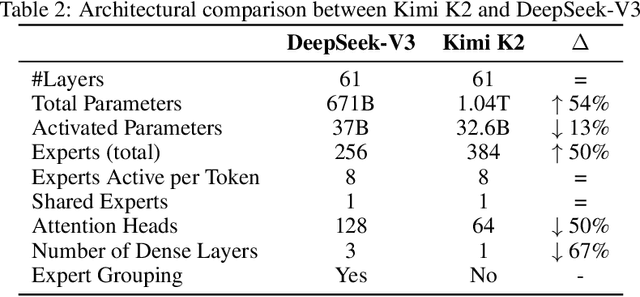
We introduce Kimi K2, a Mixture-of-Experts (MoE) large language model with 32 billion activated parameters and 1 trillion total parameters. We propose the MuonClip optimizer, which improves upon Muon with a novel QK-clip technique to address training instability while enjoying the advanced token efficiency of Muon. Based on MuonClip, K2 was pre-trained on 15.5 trillion tokens with zero loss spike. During post-training, K2 undergoes a multi-stage post-training process, highlighted by a large-scale agentic data synthesis pipeline and a joint reinforcement learning (RL) stage, where the model improves its capabilities through interactions with real and synthetic environments. Kimi K2 achieves state-of-the-art performance among open-source non-thinking models, with strengths in agentic capabilities. Notably, K2 obtains 66.1 on Tau2-Bench, 76.5 on ACEBench (En), 65.8 on SWE-Bench Verified, and 47.3 on SWE-Bench Multilingual -- surpassing most open and closed-sourced baselines in non-thinking settings. It also exhibits strong capabilities in coding, mathematics, and reasoning tasks, with a score of 53.7 on LiveCodeBench v6, 49.5 on AIME 2025, 75.1 on GPQA-Diamond, and 27.1 on OJBench, all without extended thinking. These results position Kimi K2 as one of the most capable open-source large language models to date, particularly in software engineering and agentic tasks. We release our base and post-trained model checkpoints to facilitate future research and applications of agentic intelligence.