 Add to Chrome
 Add to Firefox
 Add to Edge
GeoFusion-CAD: Structure-Aware Diffusion with Geometric State Space for Parametric 3D Design
Mar 23, 2026
Parametric Computer-Aided Design (CAD) is fundamental to modern 3D modeling, yet existing methods struggle to generate long command sequences, especially under complex geometric and topological dependencies. Transformer-based architectures dominate CAD sequence generation due to their strong dependency modeling, but their quadratic attention cost and limited context windowing hinder scalability to long programs. We propose GeoFusion-CAD, an end-to-end diffusion framework for scalable and structure-aware generation. Our proposal encodes CAD programs as hierarchical trees, jointly capturing geometry and topology within a state-space diffusion process. Specifically, a lightweight C-Mamba block models long-range structural dependencies through selective state transitions, enabling coherent generation across extended command sequences. To support long-sequence evaluation, we introduce DeepCAD-240, an extended benchmark that increases the sequence length ranging from 40 to 240 while preserving sketch-extrusion semantics from the ABC dataset. Extensive experiments demonstrate that GeoFusion-CAD achieves superior performance on both short and long command ranges, maintaining high geometric fidelity and topological consistency where Transformer-based models degrade. Our approach sets new state-of-the-art scores for long-sequence parametric CAD generation, establishing a scalable foundation for next-generation CAD modeling systems. Code and datasets are available at GitHub.

CausalTAD: Causal Implicit Generative Model for Debiased Online Trajectory Anomaly Detection
Dec 25, 2024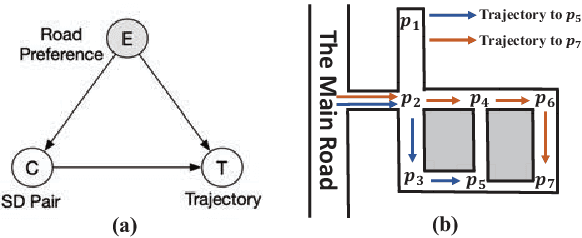
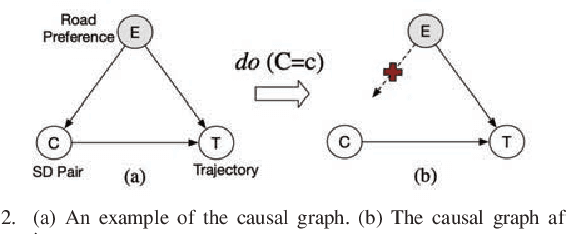
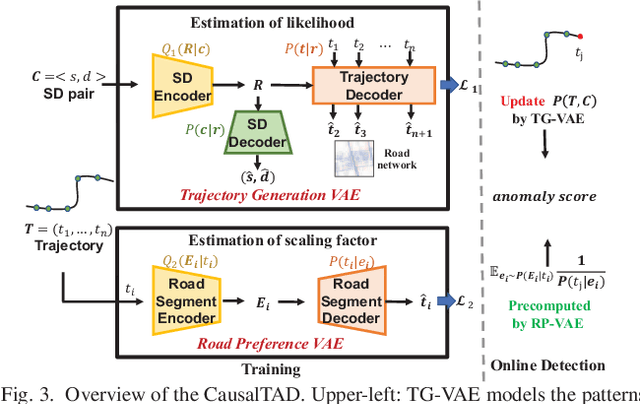
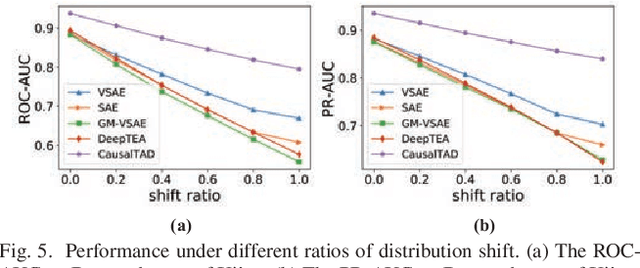
Trajectory anomaly detection, aiming to estimate the anomaly risk of trajectories given the Source-Destination (SD) pairs, has become a critical problem for many real-world applications. Existing solutions directly train a generative model for observed trajectories and calculate the conditional generative probability $P({T}|{C})$ as the anomaly risk, where ${T}$ and ${C}$ represent the trajectory and SD pair respectively. However, we argue that the observed trajectories are confounded by road network preference which is a common cause of both SD distribution and trajectories. Existing methods ignore this issue limiting their generalization ability on out-of-distribution trajectories. In this paper, we define the debiased trajectory anomaly detection problem and propose a causal implicit generative model, namely CausalTAD, to solve it. CausalTAD adopts do-calculus to eliminate the confounding bias of road network preference and estimates $P({T}|do({C}))$ as the anomaly criterion. Extensive experiments show that CausalTAD can not only achieve superior performance on trained trajectories but also generally improve the performance of out-of-distribution data, with improvements of $2.1\% \sim 5.7\%$ and $10.6\% \sim 32.7\%$ respectively.
Multi-Modal Coreference Resolution with the Correlation between Space Structures
Sep 01, 2018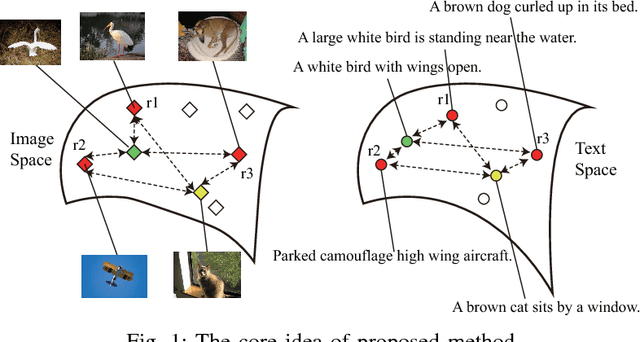
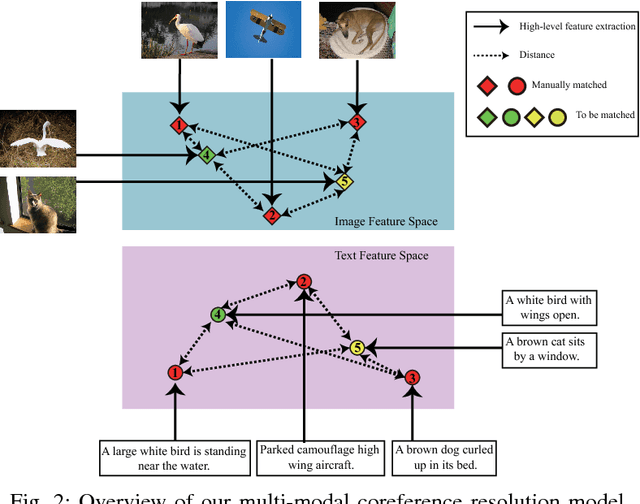
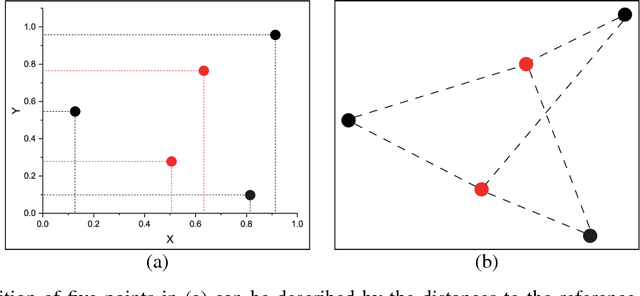
Multi-modal data is becoming more common in big data background. Finding the semantically similar objects from different modality is one of the heart problems of multi-modal learning. Most of the current methods try to learn the inter-modal correlation with extrinsic supervised information, while intrinsic structural information of each modality is neglected. The performance of these methods heavily depends on the richness of training samples. However, obtaining the multi-modal training samples is still a labor and cost intensive work. In this paper, we bring a extrinsic correlation between the space structures of each modalities in coreference resolution. With this correlation, a semi-supervised learning model for multi-modal coreference resolution is proposed. We firstly extract high-level features of images and text, then compute the distances of each object from some reference points to build the space structure of each modality. With a shared reference point set, the space structures of each modality are correlated. We employ the correlation to build a commonly shared space that the semantic distance between multi-modal objects can be computed directly. The experiments on two multi-modal datasets show that our model performs better than the existing methods with insufficient training data.