 Add to Chrome
 Add to Firefox
 Add to Edge
VGER: Voxel-Guided Global Event Ranking for Event Cloud Attribution
Aug 02, 2026
Event cameras produce sparse and asynchronous event streams that provide rich spatio-temporal information for efficient perception. Recent advances in event-based models have demonstrated strong performance by directly modeling asynchronous events without dense frame reconstruction. However, identifying the event-level evidence behind their predictions is crucial for improving model transparency and reliability. Directly adapting point-level saliency methods from point clouds provides fine-grained attribution but overlooks event-specific spatio-temporal structures. To address this limitation, we propose Voxel-Guided Global Event Ranking (VGER), a training-free attribution framework for point-based event cloud networks. VGER combines event-level gradient evidence with task-aware voxel perturbation evidence, transferring regional contribution into event-level attribution scores while preserving fine-grained resolution. Furthermore, VGER introduces a unified event ranking strategy, where high-ranked events are expected to be prediction-critical and low-ranked events are expected to have limited influence on predictions. We evaluate VGER on three event-based benchmarks with PointNet, PointNet++, and EventMamba. Across nine dataset-backbone settings, VGER consistently improves both high-tail and low-tail deletion performance over point-level saliency baselines.

TVTA: Trajectory-Aware Viseme-Guided Temporal Aggregation for Event-Based Lip Reading
Jul 09, 2026Event-based lip reading has recently emerged as a promising direction for visual speech recognition, benefiting from the high temporal resolution and motion sensitivity of event cameras. However, existing methods typically perform spatial compression before sufficient temporal modeling, which may suppress sparse and localized motion trajectories that are crucial for distinguishing similar lip movements. Moreover, most current approaches optimize temporal representations mainly at the word-classification level, leaving the underlying articulatory structure weakly constrained. To address these limitations, we propose a temporally enhanced framework for event-based lip reading. First, we introduce Trajectory-Aware Differential Aggregation (TDA), which performs local temporal modeling at each spatial location before adaptive spatial aggregation. Second, we propose Viseme-Guided Aggregation (VGA), a unified temporal module composed of a CTC decoder and a viseme-guided gated aggregation branch, which injects viseme-aware sequence supervision and improves final temporal aggregation for word recognition. Third, we incorporate an EMA teacher--student training strategy to enhance robustness under strong event perturbations. Experiments on the DVS-Lip benchmark verify the effectiveness of the proposed design, and extensive ablation studies further validate the contributions of TDA, VGA, and teacher--student consistency. Qualitative decoding results also demonstrate that the proposed CTC-based temporal modeling learns meaningful viseme-aware structure from event streams.
A Systematic Survey on Event Camera Representation Learning
Jun 22, 2026Event cameras offer distinctive advantages, including microsecond-level latency and high dynamic range, rendering them promising for challenging perception tasks. Inspired by biological vision, they output asynchronous and sparse event streams rather than dense image frames, creating a fundamental mismatch with mainstream neural networks. This survey reviews recent advances in event camera representation learning from the perspective of converting raw event streams into learnable representations. We organize existing methods into two main categories: (1) dense-based representations, which transform raw event streams into regular grid-like structures to leverage mature RGB backbones and multimodal fusion pipelines, and (2) sparse-based representations, which retain events as discrete spatio-temporal structures to preserve fine-grained temporal dynamics and data sparsity. This representation-centric organization clarifies how different representations balance structural regularity, temporal fidelity, sparsity preservation, and architectural compatibility. For each category, we examine the underlying design choices, modeling principles, and task-level implications.We further summarize standard benchmarks and evaluation settings across representative high-level perception and low-level vision tasks. Finally, we discuss open problems and outline future research directions toward more efficient, scalable, and robust event-based perception systems.
Gaze into the Details: Locality-Sensitive Enhancement for OCTA Retinal Vessel Segmentation
May 20, 2026Existing deep learning frameworks for Optical Coherence Tomography Angiography (OCTA) vessel segmentation are largely derived from the U-Net architecture, which serves as the foundation for most current designs. However, most of these methods focus only on holistic representation, struggling to address the problem of low local contrast unique to OCTA, which leads to vessel discontinuities and loss of detail. To address these problems, we propose LSENet, which builds upon the U-Net architecture by introducing three core innovative modules: To address vessel discontinuities, we introduce the Patch Information Enhance module (PIE), which replaces standard skip connections to execute patch-wise attention. To mitigate detail loss, the Multiscale Feature Fusion module (MFF) is proposed to feed the PIE module rich, multi-scale information by extracting visually interpretable features from both the original input and preceding layers. Finally, the Connectivity Refinement Decoder (CRD) is designed to refine features from all levels and utilize a large kernel in the final convolutional layer to reduce fragmentation. Experiments on three public datasets (OCTA-500, ROSE-1, and ROSSA) demonstrate that our proposed LSENet achieves state-of-the-art performance while requiring fewer parameters.
Generating Adversarial Events: A Motion-Aware Point Cloud Framework
Feb 09, 2026Event cameras have been widely adopted in safety-critical domains such as autonomous driving, robotics, and human-computer interaction. A pressing challenge arises from the vulnerability of deep neural networks to adversarial examples, which poses a significant threat to the reliability of event-based systems. Nevertheless, research into adversarial attacks on events is scarce. This is primarily due to the non-differentiable nature of mainstream event representations, which hinders the extension of gradient-based attack methods. In this paper, we propose MA-ADV, a novel \textbf{M}otion-\textbf{A}ware \textbf{Adv}ersarial framework. To the best of our knowledge, this is the first work to generate adversarial events by leveraging point cloud representations. MA-ADV accounts for high-frequency noise in events and employs a diffusion-based approach to smooth perturbations, while fully leveraging the spatial and temporal relationships among events. Finally, MA-ADV identifies the minimal-cost perturbation through a combination of sample-wise Adam optimization, iterative refinement, and binary search. Extensive experimental results validate that MA-ADV ensures a 100\% attack success rate with minimal perturbation cost, and also demonstrate enhanced robustness against defenses, underscoring the critical security challenges facing future event-based perception systems.
Multi-View Learning with Context-Guided Receptance for Image Denoising
May 05, 2025Image denoising is essential in low-level vision applications such as photography and automated driving. Existing methods struggle with distinguishing complex noise patterns in real-world scenes and consume significant computational resources due to reliance on Transformer-based models. In this work, the Context-guided Receptance Weighted Key-Value (\M) model is proposed, combining enhanced multi-view feature integration with efficient sequence modeling. Our approach introduces the Context-guided Token Shift (CTS) paradigm, which effectively captures local spatial dependencies and enhance the model's ability to model real-world noise distributions. Additionally, the Frequency Mix (FMix) module extracting frequency-domain features is designed to isolate noise in high-frequency spectra, and is integrated with spatial representations through a multi-view learning process. To improve computational efficiency, the Bidirectional WKV (BiWKV) mechanism is adopted, enabling full pixel-sequence interaction with linear complexity while overcoming the causal selection constraints. The model is validated on multiple real-world image denoising datasets, outperforming the existing state-of-the-art methods quantitatively and reducing inference time up to 40\%. Qualitative results further demonstrate the ability of our model to restore fine details in various scenes.
OpFlowTalker: Realistic and Natural Talking Face Generation via Optical Flow Guidance
May 23, 2024
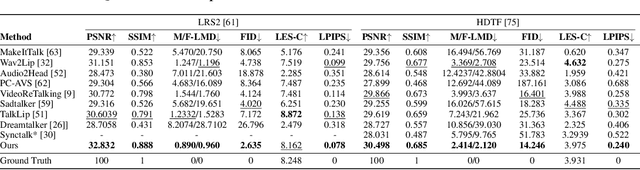
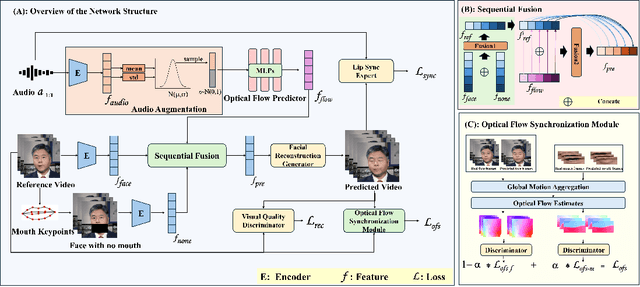
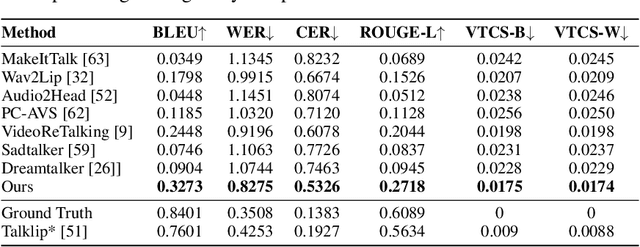
Creating realistic, natural, and lip-readable talking face videos remains a formidable challenge. Previous research primarily concentrated on generating and aligning single-frame images while overlooking the smoothness of frame-to-frame transitions and temporal dependencies. This often compromised visual quality and effects in practical settings, particularly when handling complex facial data and audio content, which frequently led to semantically incongruent visual illusions. Specifically, synthesized videos commonly featured disorganized lip movements, making them difficult to understand and recognize. To overcome these limitations, this paper introduces the application of optical flow to guide facial image generation, enhancing inter-frame continuity and semantic consistency. We propose "OpFlowTalker", a novel approach that utilizes predicted optical flow changes from audio inputs rather than direct image predictions. This method smooths image transitions and aligns changes with semantic content. Moreover, it employs a sequence fusion technique to replace the independent generation of single frames, thus preserving contextual information and maintaining temporal coherence. We also developed an optical flow synchronization module that regulates both full-face and lip movements, optimizing visual synthesis by balancing regional dynamics. Furthermore, we introduce a Visual Text Consistency Score (VTCS) that accurately measures lip-readability in synthesized videos. Extensive empirical evidence validates the effectiveness of our approach.
VTQA: Visual Text Question Answering via Entity Alignment and Cross-Media Reasoning
Mar 05, 2023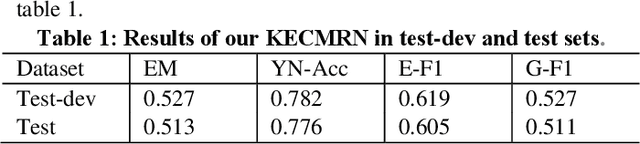
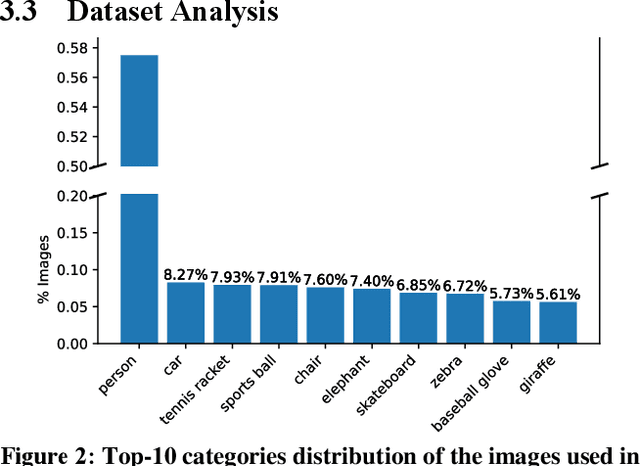
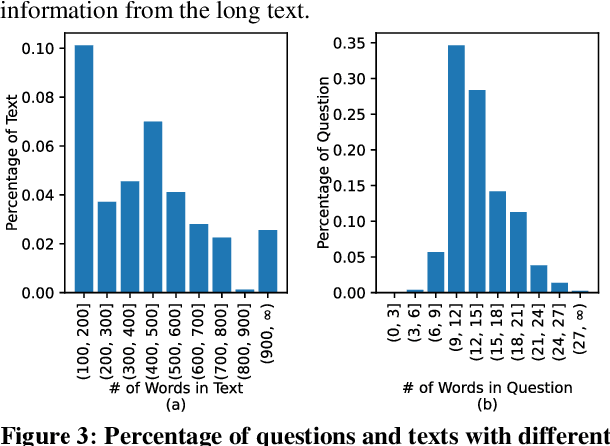
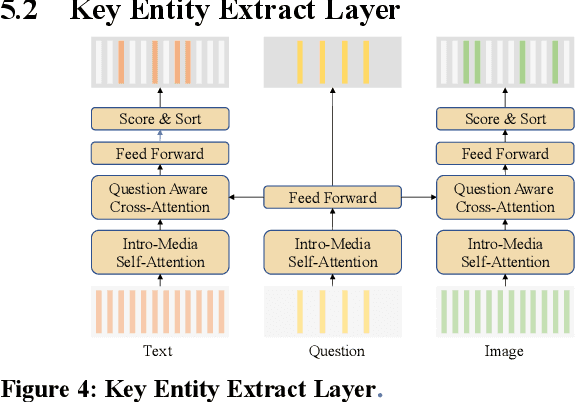
The ideal form of Visual Question Answering requires understanding, grounding and reasoning in the joint space of vision and language and serves as a proxy for the AI task of scene understanding. However, most existing VQA benchmarks are limited to just picking the answer from a pre-defined set of options and lack attention to text. We present a new challenge with a dataset that contains 23,781 questions based on 10124 image-text pairs. Specifically, the task requires the model to align multimedia representations of the same entity to implement multi-hop reasoning between image and text and finally use natural language to answer the question. The aim of this challenge is to develop and benchmark models that are capable of multimedia entity alignment, multi-step reasoning and open-ended answer generation.
Pyramid Feature Attention Network for Saliency detection
Apr 04, 2019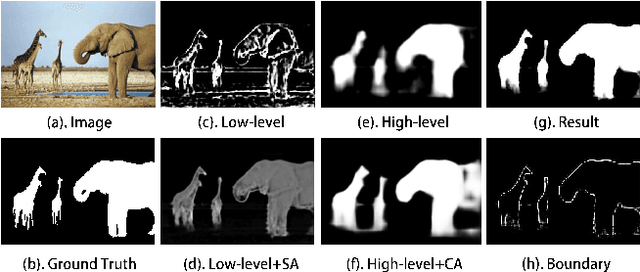
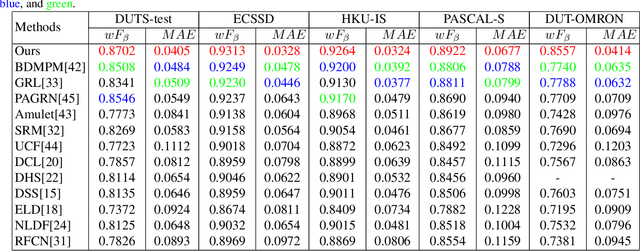
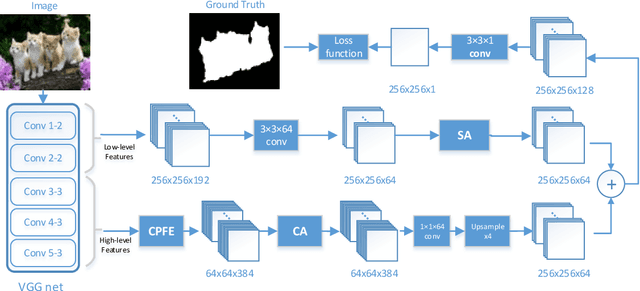
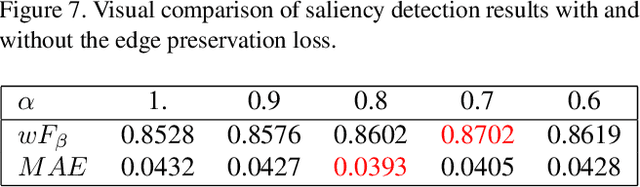
Saliency detection is one of the basic challenges in computer vision. How to extract effective features is a critical point for saliency detection. Recent methods mainly adopt integrating multi-scale convolutional features indiscriminately. However, not all features are useful for saliency detection and some even cause interferences. To solve this problem, we propose Pyramid Feature Attention network to focus on effective high-level context features and low-level spatial structural features. First, we design Context-aware Pyramid Feature Extraction (CPFE) module for multi-scale high-level feature maps to capture rich context features. Second, we adopt channel-wise attention (CA) after CPFE feature maps and spatial attention (SA) after low-level feature maps, then fuse outputs of CA & SA together. Finally, we propose an edge preservation loss to guide network to learn more detailed information in boundary localization. Extensive evaluations on five benchmark datasets demonstrate that the proposed method outperforms the state-of-the-art approaches under different evaluation metrics.
TCDCaps: Visual Tracking via Cascaded Dense Capsules
Feb 26, 2019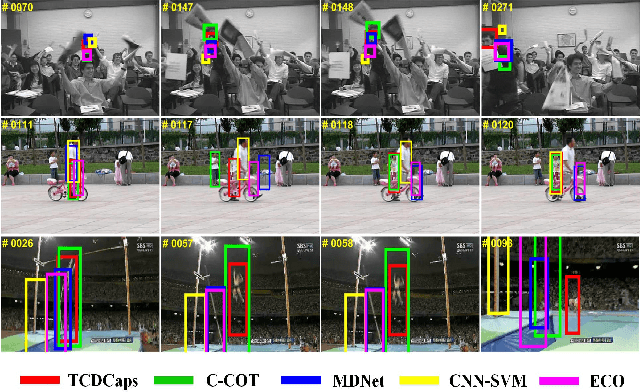
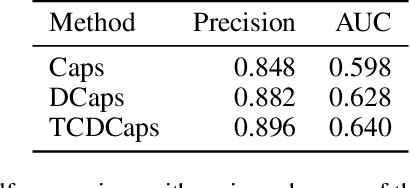
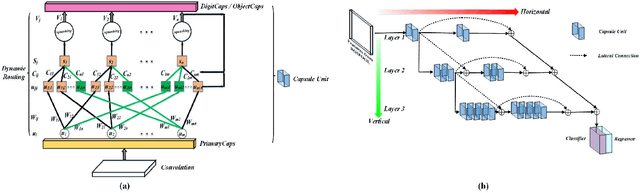
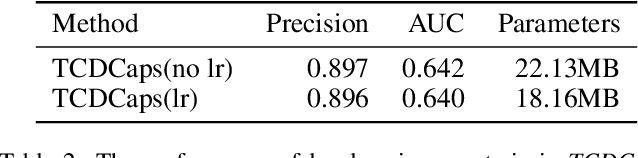
The critical challenge in tracking-by-detection framework is how to avoid drift problem during online learning, where the robust features for a variety of appearance changes are difficult to be learned and a reasonable intersection over union (IoU) threshold that defines the true/false positives is hard to set. This paper presents the TCDCaps method to address the problems above via a cascaded dense capsule architecture. To get robust features, we extend original capsules with dense-connected routing, which are referred as DCaps. Depending on the preservation of part-whole relationships in the Capsule Networks, our dense-connected capsules can capture a variety of appearance variations. In addition, to handle the issue of IoU threshold, a cascaded DCaps model (CDCaps) is proposed to improve the quality of candidates, it consists of sequential DCaps trained with increasing IoU thresholds so as to sequentially improve the quality of candidates. Extensive experiments on 3 popular benchmarks demonstrate the robustness of the proposed TCDCaps.