 Add to Chrome
 Add to Firefox
 Add to Edge
Compress, Cross and Scale: Multi-Level Compression Cross Networks for Efficient Scaling in Recommender Systems
Feb 12, 2026
Modeling high-order feature interactions efficiently is a central challenge in click-through rate and conversion rate prediction. Modern industrial recommender systems are predominantly built upon deep learning recommendation models, where the interaction backbone plays a critical role in determining both predictive performance and system efficiency. However, existing interaction modules often struggle to simultaneously achieve strong interaction capacity, high computational efficiency, and good scalability, resulting in limited ROI when models are scaled under strict production constraints. In this work, we propose MLCC, a structured feature interaction architecture that organizes feature crosses through hierarchical compression and dynamic composition, which can efficiently capture high-order feature dependencies while maintaining favorable computational complexity. We further introduce MC-MLCC, a Multi-Channel extension that decomposes feature interactions into parallel subspaces, enabling efficient horizontal scaling with improved representation capacity and significantly reduced parameter growth. Extensive experiments on three public benchmarks and a large-scale industrial dataset show that our proposed models consistently outperform strong DLRM-style baselines by up to 0.52 AUC, while reducing model parameters and FLOPs by up to 26$\times$ under comparable performance. Comprehensive scaling analyses demonstrate stable and predictable scaling behavior across embedding dimension, head number, and channel count, with channel-based scaling achieving substantially better efficiency than conventional embedding inflation. Finally, online A/B testing on a real-world advertising platform validates the practical effectiveness of our approach, which has been widely adopted in Bilibili advertising system under strict latency and resource constraints.

FreshRetailNet-50K: A Stockout-Annotated Censored Demand Dataset for Latent Demand Recovery and Forecasting in Fresh Retail
May 22, 2025
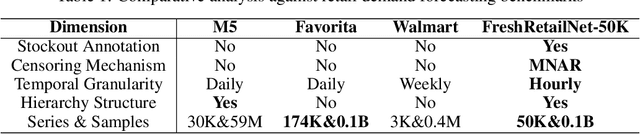
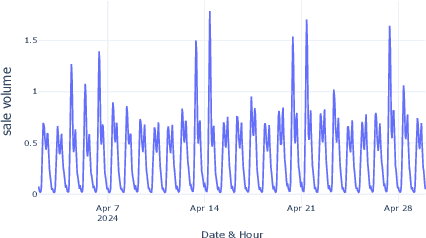

Accurate demand estimation is critical for the retail business in guiding the inventory and pricing policies of perishable products. However, it faces fundamental challenges from censored sales data during stockouts, where unobserved demand creates systemic policy biases. Existing datasets lack the temporal resolution and annotations needed to address this censoring effect. To fill this gap, we present FreshRetailNet-50K, the first large-scale benchmark for censored demand estimation. It comprises 50,000 store-product time series of detailed hourly sales data from 898 stores in 18 major cities, encompassing 863 perishable SKUs meticulously annotated for stockout events. The hourly stock status records unique to this dataset, combined with rich contextual covariates, including promotional discounts, precipitation, and temporal features, enable innovative research beyond existing solutions. We demonstrate one such use case of two-stage demand modeling: first, we reconstruct the latent demand during stockouts using precise hourly annotations. We then leverage the recovered demand to train robust demand forecasting models in the second stage. Experimental results show that this approach achieves a 2.73\% improvement in prediction accuracy while reducing the systematic demand underestimation from 7.37\% to near-zero bias. With unprecedented temporal granularity and comprehensive real-world information, FreshRetailNet-50K opens new research directions in demand imputation, perishable inventory optimization, and causal retail analytics. The unique annotation quality and scale of the dataset address long-standing limitations in retail AI, providing immediate solutions and a platform for future methodological innovation. The data (https://huggingface.co/datasets/Dingdong-Inc/FreshRetailNet-50K) and code (https://github.com/Dingdong-Inc/frn-50k-baseline}) are openly released.