 Add to Chrome
 Add to Firefox
 Add to Edge
A Survey on the Green Development of Large Models: From Resource-Efficient Architectures to Hardware-Software Co-Design
Jul 10, 2026
The rapid expansion of large-scale AI models has led to significant performance breakthroughs across diverse domains, yet it has also raised critical concerns regarding computational costs, energy consumption, and environmental sustainability. This survey provides a comprehensive overview of the green development of large models, emphasizing resource-efficient architectures and full-stack hardware-software co-design. We systematically review recent advances in efficient model construction, including attention operator optimization, linear-complexity architectures, and model sparsification and merging, as well as training and deployment strategies such as data-efficient learning, parameter-efficient fine-tuning, and computational compression. Beyond algorithmic improvements, we explore energy-efficient AI hardware, including mainstream AI chips, memory optimization, cross-platform deployment, and sustainable infrastructure. Furthermore, we examine how large models are being applied to sustainability-critical domains such as DeepSeek, remote sensing interpretation, national-scale infrastructure, and global initiatives. Finally, we discuss key challenges and future directions, highlighting the need for continual learning paradigms, memory-centric hardware, and standardized evaluation protocols. This survey aims to offer a holistic roadmap toward sustainable, scalable, and socially responsible development of large models. Paper homepage: https://cje.ejournal.org.cn/article/doi/10.23919/cje.2025.00.438
* This paper has been accepted by CJE (2026), paper homepage: https://cje.ejournal.org.cn/article/doi/10.23919/cje.2025.00.438

AGFT: Alignment-Guided Fine-Tuning for Zero-Shot Adversarial Robustness of Vision-Language Models
Mar 31, 2026Pre-trained vision-language models (VLMs) exhibit strong zero-shot generalization but remain vulnerable to adversarial perturbations. Existing classification-guided adversarial fine-tuning methods often disrupt pre-trained cross-modal alignment, weakening visual-textual correspondence and degrading zero-shot performance. In this paper, we propose an Alignment-Guided Fine-Tuning (AGFT) framework that enhances zero-shot adversarial robustness while preserving the cross-modal semantic structure. Unlike label-based methods that rely on hard labels and fail to maintain the relative relationships between image and text, AGFT leverages the probabilistic predictions of the original model for text-guided adversarial training, which aligns adversarial visual features with textual embeddings via soft alignment distributions, improving zero-shot adversarial robustness. To address structural discrepancies introduced by fine-tuning, we introduce a distribution consistency calibration mechanism that adjusts the robust model output to match a temperature-scaled version of the pre-trained model predictions. Extensive experiments across multiple zero-shot benchmarks demonstrate that AGFT outperforms state-of-the-art methods while significantly improving zero-shot adversarial robustness.
A Semantically Enhanced Generative Foundation Model Improves Pathological Image Synthesis
Dec 16, 2025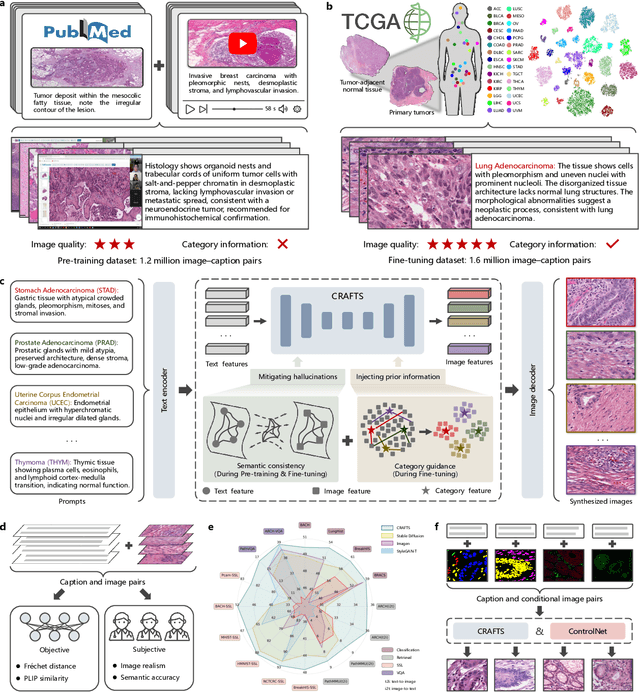
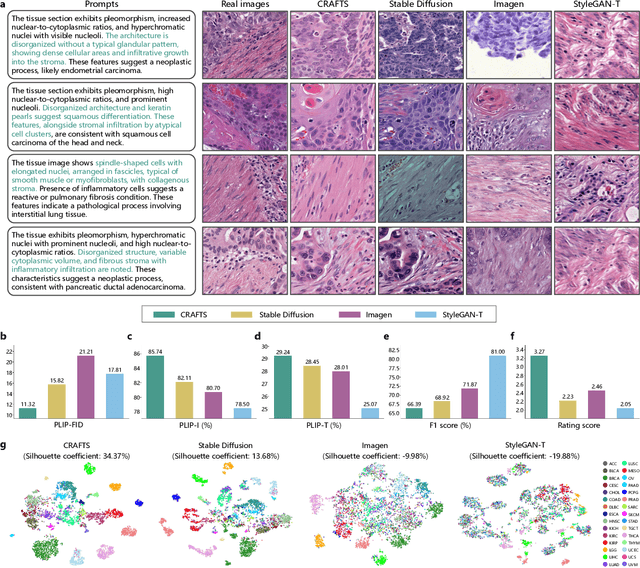
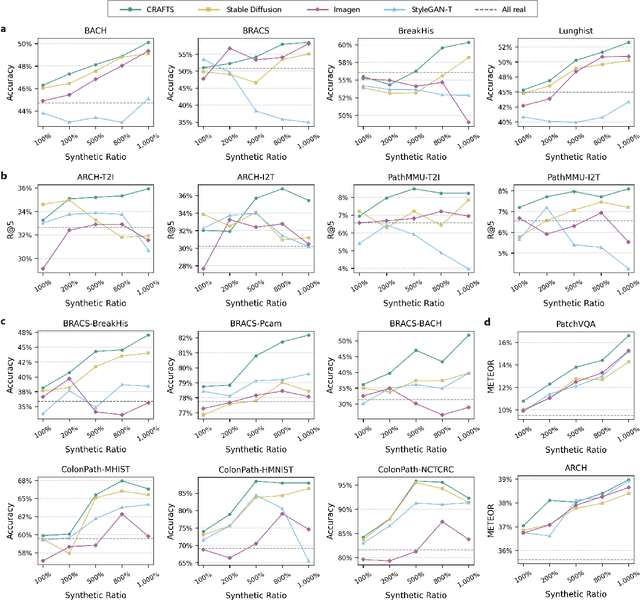
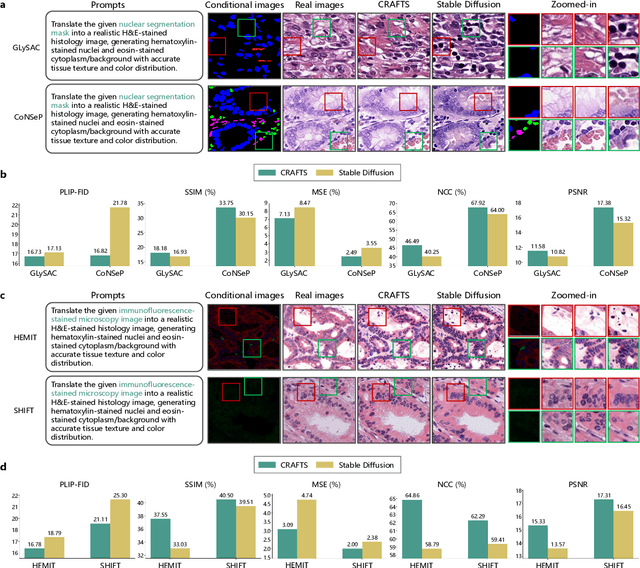
The development of clinical-grade artificial intelligence in pathology is limited by the scarcity of diverse, high-quality annotated datasets. Generative models offer a potential solution but suffer from semantic instability and morphological hallucinations that compromise diagnostic reliability. To address this challenge, we introduce a Correlation-Regulated Alignment Framework for Tissue Synthesis (CRAFTS), the first generative foundation model for pathology-specific text-to-image synthesis. By leveraging a dual-stage training strategy on approximately 2.8 million image-caption pairs, CRAFTS incorporates a novel alignment mechanism that suppresses semantic drift to ensure biological accuracy. This model generates diverse pathological images spanning 30 cancer types, with quality rigorously validated by objective metrics and pathologist evaluations. Furthermore, CRAFTS-augmented datasets enhance the performance across various clinical tasks, including classification, cross-modal retrieval, self-supervised learning, and visual question answering. In addition, coupling CRAFTS with ControlNet enables precise control over tissue architecture from inputs such as nuclear segmentation masks and fluorescence images. By overcoming the critical barriers of data scarcity and privacy concerns, CRAFTS provides a limitless source of diverse, annotated histology data, effectively unlocking the creation of robust diagnostic tools for rare and complex cancer phenotypes.
Category Prompt Mamba Network for Nuclei Segmentation and Classification
Mar 13, 2025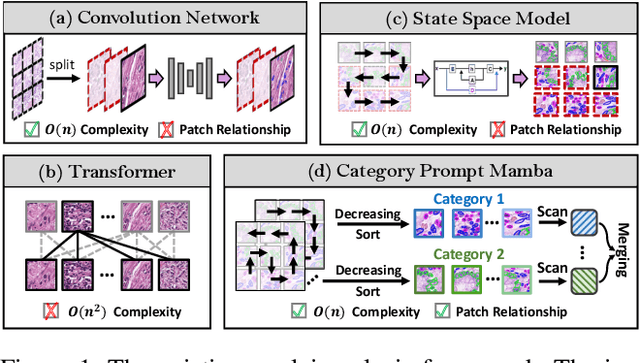
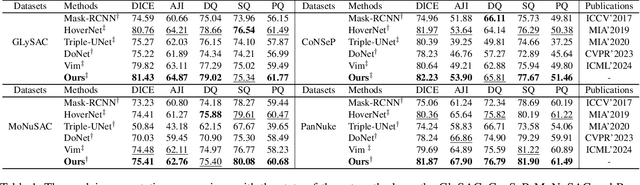
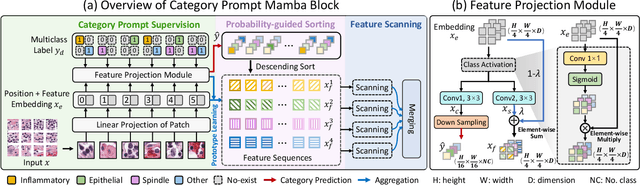
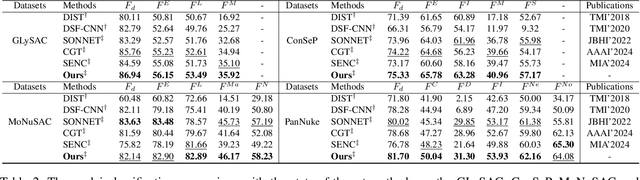
Nuclei segmentation and classification provide an essential basis for tumor immune microenvironment analysis. The previous nuclei segmentation and classification models require splitting large images into smaller patches for training, leading to two significant issues. First, nuclei at the borders of adjacent patches often misalign during inference. Second, this patch-based approach significantly increases the model's training and inference time. Recently, Mamba has garnered attention for its ability to model large-scale images with linear time complexity and low memory consumption. It offers a promising solution for training nuclei segmentation and classification models on full-sized images. However, the Mamba orientation-based scanning method lacks account for category-specific features, resulting in sub-optimal performance in scenarios with imbalanced class distributions. To address these challenges, this paper introduces a novel scanning strategy based on category probability sorting, which independently ranks and scans features for each category according to confidence from high to low. This approach enhances the feature representation of uncertain samples and mitigates the issues caused by imbalanced distributions. Extensive experiments conducted on four public datasets demonstrate that our method outperforms state-of-the-art approaches, delivering superior performance in nuclei segmentation and classification tasks.
Breast Cancer Immunohistochemical Image Generation: a Benchmark Dataset and Challenge Review
May 05, 2023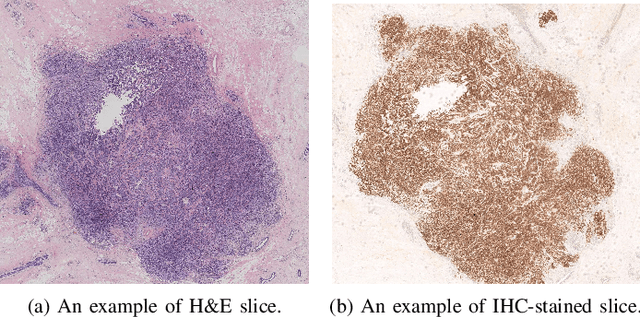
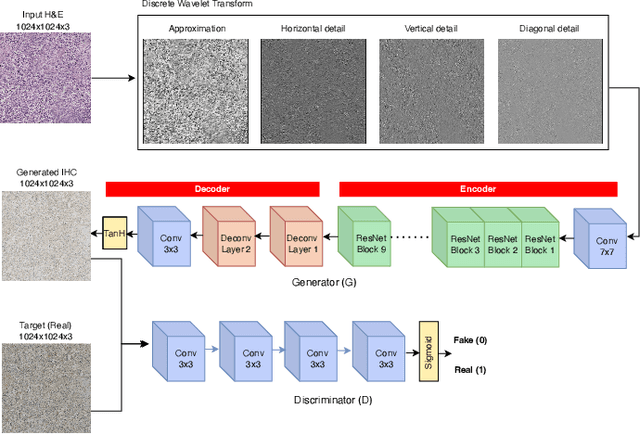
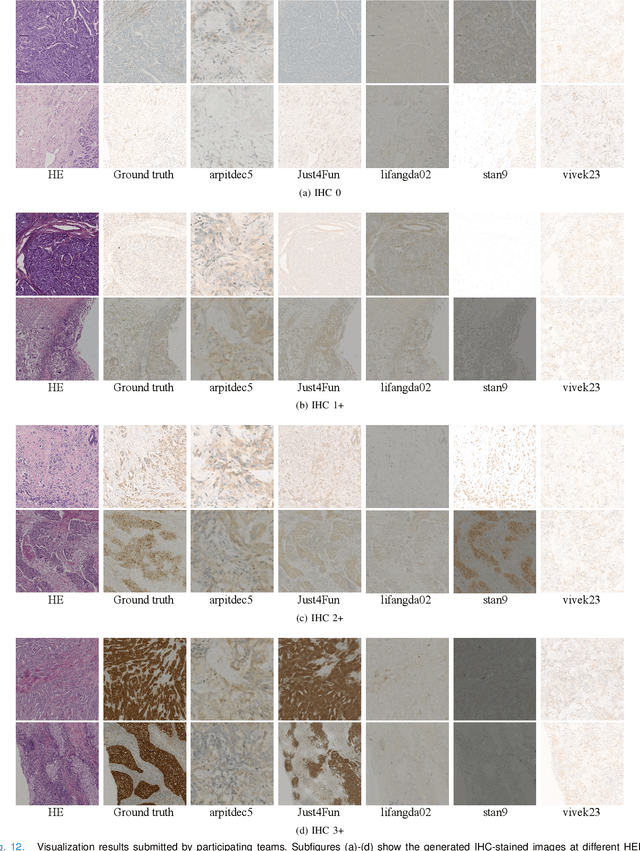
For invasive breast cancer, immunohistochemical (IHC) techniques are often used to detect the expression level of human epidermal growth factor receptor-2 (HER2) in breast tissue to formulate a precise treatment plan. From the perspective of saving manpower, material and time costs, directly generating IHC-stained images from hematoxylin and eosin (H&E) stained images is a valuable research direction. Therefore, we held the breast cancer immunohistochemical image generation challenge, aiming to explore novel ideas of deep learning technology in pathological image generation and promote research in this field. The challenge provided registered H&E and IHC-stained image pairs, and participants were required to use these images to train a model that can directly generate IHC-stained images from corresponding H&E-stained images. We selected and reviewed the five highest-ranking methods based on their PSNR and SSIM metrics, while also providing overviews of the corresponding pipelines and implementations. In this paper, we further analyze the current limitations in the field of breast cancer immunohistochemical image generation and forecast the future development of this field. We hope that the released dataset and the challenge will inspire more scholars to jointly study higher-quality IHC-stained image generation.