 Add to Chrome
 Add to Firefox
 Add to Edge
Kimi K3: Open Frontier Intelligence
Jul 27, 2026
We introduce Kimi K3, a 2.8T parameter Mixture-of-Experts model with 104 billion activated parameters, native vision capabilities, and a 1-million-token context window. Kimi K3 is built on Kimi Delta Attention and Attention Residuals, which improve information flow across sequence length and model depth. Together with Stable LatentMoE, which effectively activates 16 of 896 routed experts per token, and refined training and data recipes, these advances yield an approximately 2.5x improvement in overall scaling efficiency over Kimi K2. Post-training highlights reinforcement learning across general, agentic, and coding domains and multiple reasoning-effort levels, enabling compositional generalization and robust long-horizon execution. At 2.8T scale, Kimi K3 is supported by infrastructure advances in multiple areas: algorithm-system co-design for KDA, perfectly balanced expert-parallel training with efficient memory management, million-token agentic RL with persistent rollout and sandbox states, and deployment innovations. Extensive evaluations show that Kimi K3 achieves frontier-level performance across long-horizon coding, agentic, knowledge, reasoning, and vision tasks. While its overall performance still trails the most powerful proprietary models, namely Claude Fable 5 and GPT-5.6 Sol, Kimi K3 consistently outperforms other open and proprietary models evaluated in our suite. We release the full Kimi K3 model weights to facilitate future research and accelerate the broader deployment and adoption of frontier intelligence.

AD-AGENT: A Multi-agent Framework for End-to-end Anomaly Detection
May 19, 2025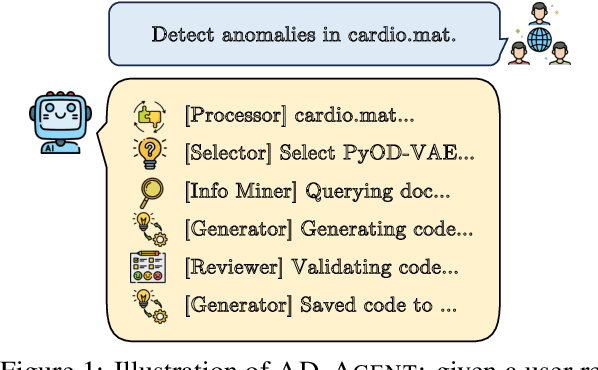
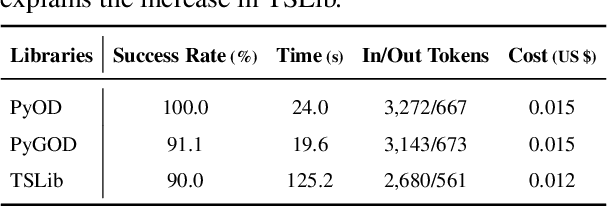
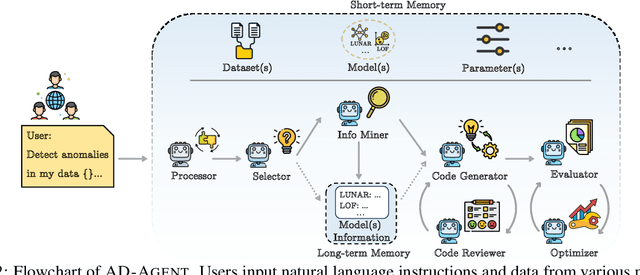
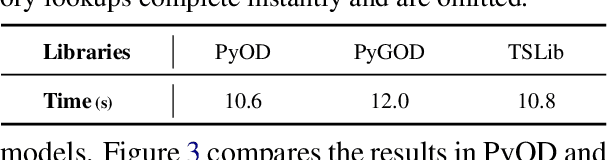
Anomaly detection (AD) is essential in areas such as fraud detection, network monitoring, and scientific research. However, the diversity of data modalities and the increasing number of specialized AD libraries pose challenges for non-expert users who lack in-depth library-specific knowledge and advanced programming skills. To tackle this, we present AD-AGENT, an LLM-driven multi-agent framework that turns natural-language instructions into fully executable AD pipelines. AD-AGENT coordinates specialized agents for intent parsing, data preparation, library and model selection, documentation mining, and iterative code generation and debugging. Using a shared short-term workspace and a long-term cache, the agents integrate popular AD libraries like PyOD, PyGOD, and TSLib into a unified workflow. Experiments demonstrate that AD-AGENT produces reliable scripts and recommends competitive models across libraries. The system is open-sourced to support further research and practical applications in AD.
PyOD 2: A Python Library for Outlier Detection with LLM-powered Model Selection
Dec 11, 2024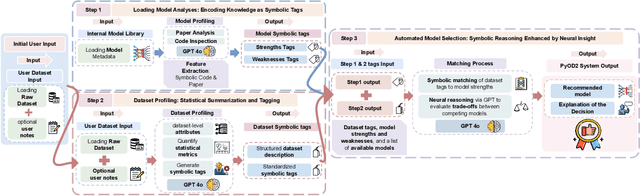
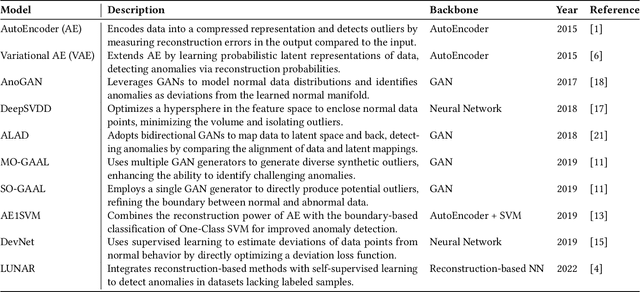

Outlier detection (OD), also known as anomaly detection, is a critical machine learning (ML) task with applications in fraud detection, network intrusion detection, clickstream analysis, recommendation systems, and social network moderation. Among open-source libraries for outlier detection, the Python Outlier Detection (PyOD) library is the most widely adopted, with over 8,500 GitHub stars, 25 million downloads, and diverse industry usage. However, PyOD currently faces three limitations: (1) insufficient coverage of modern deep learning algorithms, (2) fragmented implementations across PyTorch and TensorFlow, and (3) no automated model selection, making it hard for non-experts. To address these issues, we present PyOD Version 2 (PyOD 2), which integrates 12 state-of-the-art deep learning models into a unified PyTorch framework and introduces a large language model (LLM)-based pipeline for automated OD model selection. These improvements simplify OD workflows, provide access to 45 algorithms, and deliver robust performance on various datasets. In this paper, we demonstrate how PyOD 2 streamlines the deployment and automation of OD models and sets a new standard in both research and industry. PyOD 2 is accessible at [https://github.com/yzhao062/pyod](https://github.com/yzhao062/pyod). This study aligns with the Web Mining and Content Analysis track, addressing topics such as the robustness of Web mining methods and the quality of algorithmically-generated Web data.