 Add to Chrome
 Add to Firefox
 Add to Edge
CodegenBench: Can LLMs Write Efficient Code Across Architectures?
Jun 01, 2026
While large language models (LLMs) have been extensively evaluated on code generation tasks for general-purpose programming and GPU-accelerated environments (e.g., PyTorch, CUDA), their capabilities in CPU-oriented high-performance computing (HPC) across diverse architectures remain underexplored. To bridge this gap, we introduce CodegenBench, a comprehensive benchmark suite designed to evaluate the generation of efficient parallel code across three distinct hardware platforms: x86_64, Sunway, and Kunpeng. Our benchmark comprises 106 standard Basic Linear Algebra Subprograms (BLAS) routines establishing a fundamental baseline, alongside 20 specialized computational kernels adapted for each of the unique supercomputing architectures (LeetSunway and LeetKunpeng). Our extensive evaluation reveals that while state-of-the-art LLMs can generate optimized code for ubiquitous architectures like x86_64, they exhibit significant performance degradation on domain-specific architectures with limited public documentation and training data, highlighting critical limitations in cross-platform generalization. Furthermore, our analysis of factors influencing code quality such as implementation length and task complexity indicates that current LLMs are most effective for moderately difficult problems requiring concise code snippets. We open-source our dataset and automated evaluation infrastructure to facilitate future research in LLM-driven high-performance code generation. The resources are available at https://anonymous.4open.science/r/CodegenBench-EDE1/ and https://anonymous.4open.science/r/CodegenBenchDataset-2551.

Detecting Non-Optimal Decisions of Embodied Agents via Diversity-Guided Metamorphic Testing
Dec 23, 2025As embodied agents advance toward real-world deployment, ensuring optimal decisions becomes critical for resource-constrained applications. Current evaluation methods focus primarily on functional correctness, overlooking the non-functional optimality of generated plans. This gap can lead to significant performance degradation and resource waste. We identify and formalize the problem of Non-optimal Decisions (NoDs), where agents complete tasks successfully but inefficiently. We present NoD-DGMT, a systematic framework for detecting NoDs in embodied agent task planning via diversity-guided metamorphic testing. Our key insight is that optimal planners should exhibit invariant behavioral properties under specific transformations. We design four novel metamorphic relations capturing fundamental optimality properties: position detour suboptimality, action optimality completeness, condition refinement monotonicity, and scene perturbation invariance. To maximize detection efficiency, we introduce a diversity-guided selection strategy that actively selects test cases exploring different violation categories, avoiding redundant evaluations while ensuring comprehensive diversity coverage. Extensive experiments on the AI2-THOR simulator with four state-of-the-art planning models demonstrate that NoD-DGMT achieves violation detection rates of 31.9% on average, with our diversity-guided filter improving rates by 4.3% and diversity scores by 3.3 on average. NoD-DGMT significantly outperforms six baseline methods, with 16.8% relative improvement over the best baseline, and demonstrates consistent superiority across different model architectures and task complexities.
Cross-regional oil palm tree counting and detection via multi-level attention domain adaptation network
Aug 26, 2020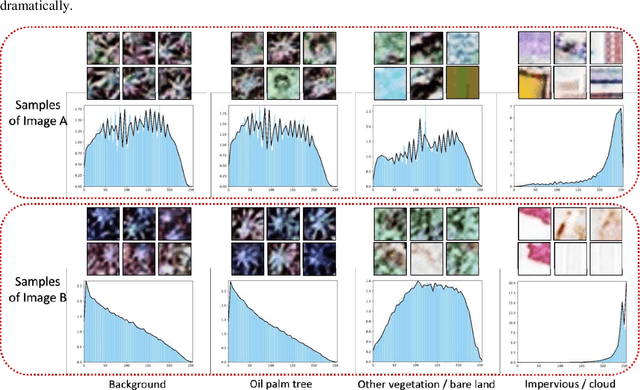
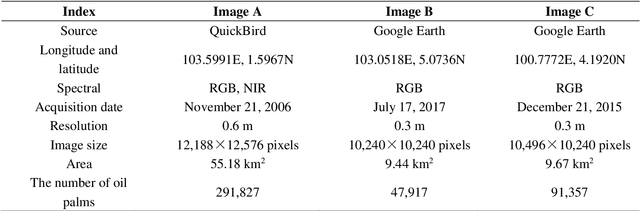
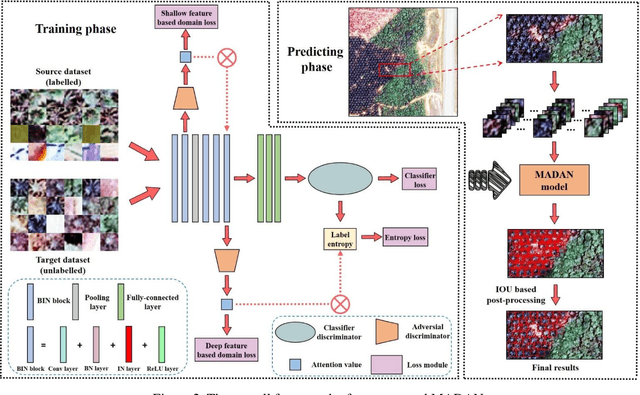
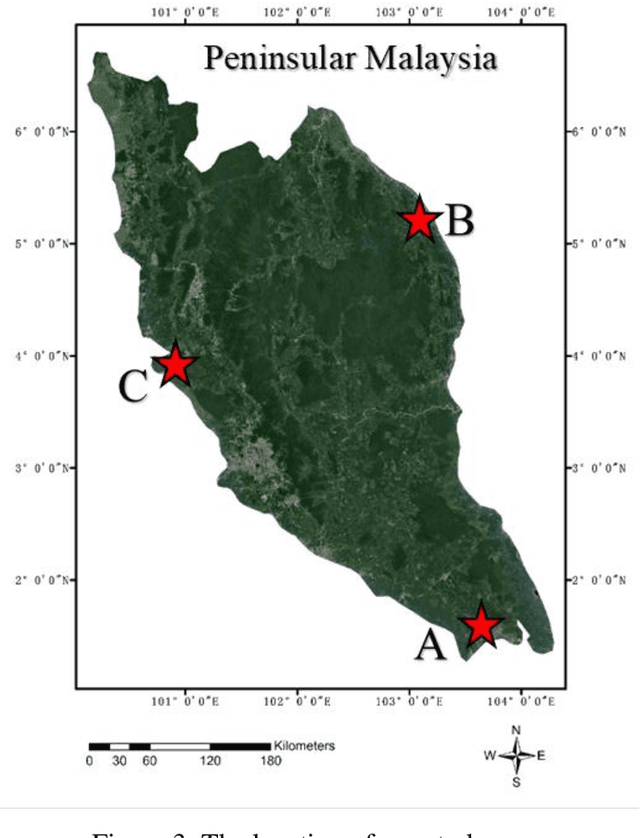
Providing an accurate evaluation of palm tree plantation in a large region can bring meaningful impacts in both economic and ecological aspects. However, the enormous spatial scale and the variety of geological features across regions has made it a grand challenge with limited solutions based on manual human monitoring efforts. Although deep learning based algorithms have demonstrated potential in forming an automated approach in recent years, the labelling efforts needed for covering different features in different regions largely constrain its effectiveness in large-scale problems. In this paper, we propose a novel domain adaptive oil palm tree detection method, i.e., a Multi-level Attention Domain Adaptation Network (MADAN) to reap cross-regional oil palm tree counting and detection. MADAN consists of 4 procedures: First, we adopted a batch-instance normalization network (BIN) based feature extractor for improving the generalization ability of the model, integrating batch normalization and instance normalization. Second, we embedded a multi-level attention mechanism (MLA) into our architecture for enhancing the transferability, including a feature level attention and an entropy level attention. Then we designed a minimum entropy regularization (MER) to increase the confidence of the classifier predictions through assigning the entropy level attention value to the entropy penalty. Finally, we employed a sliding window-based prediction and an IOU based post-processing approach to attain the final detection results. We conducted comprehensive ablation experiments using three different satellite images of large-scale oil palm plantation area with six transfer tasks. MADAN improves the detection accuracy by 14.98% in terms of average F1-score compared with the Baseline method (without DA), and performs 3.55%-14.49% better than existing domain adaptation methods.
* 39 pages, 13 figures, accepted by ISPRS PG&RS