 Add to Chrome
 Add to Firefox
 Add to Edge
Uncovering and Mitigating Positional Blind Spots in Vision-Language-Action Models
Aug 03, 2026
Recent Vision-Language-Action (VLA) models achieve promising performance in robotic manipulation, typically measured by success rates aggregated over predefined object configurations, an evaluation that implicitly assumes spatially uniform competence across the workspace. However, this assumption does not hold: even with the instruction and every other scene factor held fixed, merely relocating a task-irrelevant distractor can sharply raise the failure probability within localized, spatially coherent regions, which we term Positional Blind Spots (PBS). In this paper, we propose a two-stage black-box framework to uncover and mitigate PBS. During the uncovering stage, we grid the workspace and apply a one-sided log-likelihood-ratio test to localize PBS cells with significantly elevated risk. During the mitigation stage, we fine-tune the policy via LoRA on demonstrations collected from these PBS regions, improving competence there while largely preserving performance across the rest of the workspace. We evaluate our framework on five state-of-the-art VLA policies across two benchmarks, and find that PBS are pervasive and spatially concentrated in all of them, with failure rates up to 0.58. Our search strategy achieves an average F1-score of 0.678, outperforming random search and adaptive sampling baselines by 0.268 and 0.178, respectively. Guided by the discovered regions, targeted fine-tuning reduces the overall failure rate by 40.00%--85.19%.

Detecting Non-Optimal Decisions of Embodied Agents via Diversity-Guided Metamorphic Testing
Dec 23, 2025As embodied agents advance toward real-world deployment, ensuring optimal decisions becomes critical for resource-constrained applications. Current evaluation methods focus primarily on functional correctness, overlooking the non-functional optimality of generated plans. This gap can lead to significant performance degradation and resource waste. We identify and formalize the problem of Non-optimal Decisions (NoDs), where agents complete tasks successfully but inefficiently. We present NoD-DGMT, a systematic framework for detecting NoDs in embodied agent task planning via diversity-guided metamorphic testing. Our key insight is that optimal planners should exhibit invariant behavioral properties under specific transformations. We design four novel metamorphic relations capturing fundamental optimality properties: position detour suboptimality, action optimality completeness, condition refinement monotonicity, and scene perturbation invariance. To maximize detection efficiency, we introduce a diversity-guided selection strategy that actively selects test cases exploring different violation categories, avoiding redundant evaluations while ensuring comprehensive diversity coverage. Extensive experiments on the AI2-THOR simulator with four state-of-the-art planning models demonstrate that NoD-DGMT achieves violation detection rates of 31.9% on average, with our diversity-guided filter improving rates by 4.3% and diversity scores by 3.3 on average. NoD-DGMT significantly outperforms six baseline methods, with 16.8% relative improvement over the best baseline, and demonstrates consistent superiority across different model architectures and task complexities.
Shedding Light on VLN Robustness: A Black-box Framework for Indoor Lighting-based Adversarial Attack
Nov 17, 2025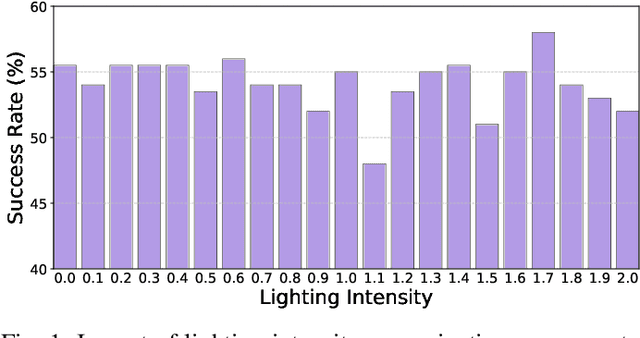
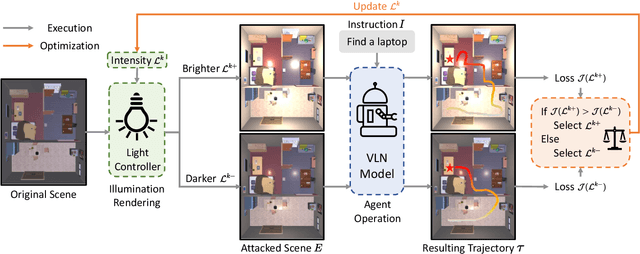
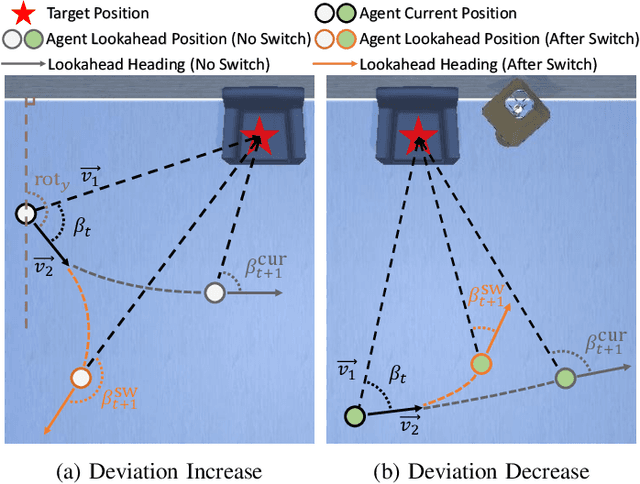

Vision-and-Language Navigation (VLN) agents have made remarkable progress, but their robustness remains insufficiently studied. Existing adversarial evaluations often rely on perturbations that manifest as unusual textures rarely encountered in everyday indoor environments. Errors under such contrived conditions have limited practical relevance, as real-world agents are unlikely to encounter such artificial patterns. In this work, we focus on indoor lighting, an intrinsic yet largely overlooked scene attribute that strongly influences navigation. We propose Indoor Lighting-based Adversarial Attack (ILA), a black-box framework that manipulates global illumination to disrupt VLN agents. Motivated by typical household lighting usage, we design two attack modes: Static Indoor Lighting-based Attack (SILA), where the lighting intensity remains constant throughout an episode, and Dynamic Indoor Lighting-based Attack (DILA), where lights are switched on or off at critical moments to induce abrupt illumination changes. We evaluate ILA on two state-of-the-art VLN models across three navigation tasks. Results show that ILA significantly increases failure rates while reducing trajectory efficiency, revealing previously unrecognized vulnerabilities of VLN agents to realistic indoor lighting variations.