 Add to Chrome
 Add to Firefox
 Add to Edge
EXACT-MPPI: Exact Signed-Distance Navigation for Arbitrary-Footprint Robots from Point Clouds via Path Integral Control
May 28, 2026
Ground robots often carry payloads, implements, or other attachments that turn their effective footprint into complex, non-convex shapes. Navigating safely through clutter then requires reasoning about this true geometry, yet most local planners simplify it with convex or inflated proxies and rasterize sensor data into occupancy grids or distance fields. Both choices eliminate feasible motions when clearance is comparable to the footprint geometry. We present EXACT-MPPI, a training-free local navigation framework that maps local point-cloud observations and sparse guidance directly to motion commands, without any intermediate map representation. The framework embeds an analytic, exact signed-distance evaluator into a Model Predictive Path Integral (MPPI) controller. The footprint is represented as a simple polygon for general convex or concave planar shapes, with a rectangle-cover specialization for faster evaluation of rectilinear footprints, enabling footprint-aware collision costs without convex decomposition, inflation, or learned encoders. During each MPPI rollout, observed obstacle points are transformed into the predicted body frame and evaluated against the footprint. All operations are batched in JAX, leveraging GPU parallelism for real-time receding-horizon control. Experiments show that EXACT-MPPI accelerates batched distance evaluation over a learned point-to-robot baseline, preserves feasible motion where convex-footprint planners fail, and remains robust under dense static and moving obstacles. The same framework deploys on differential-drive, Ackermann, omnidirectional, and hybrid-mode platforms by changing only the footprint description and motion model without per-platform training. Pairing exact footprint geometry with sampling-based predictive control thus offers a practical, training-free path to footprint-aware local navigation across diverse robots.

Learning to Pick: A Visuomotor Policy for Clustered Strawberry Picking
Sep 18, 2025Strawberries naturally grow in clusters, interwoven with leaves, stems, and other fruits, which frequently leads to occlusion. This inherent growth habit presents a significant challenge for robotic picking, as traditional percept-plan-control systems struggle to reach fruits amid the clutter. Effectively picking an occluded strawberry demands dexterous manipulation to carefully bypass or gently move the surrounding soft objects and precisely access the ideal picking point located at the stem just above the calyx. To address this challenge, we introduce a strawberry-picking robotic system that learns from human demonstrations. Our system features a 4-DoF SCARA arm paired with a human teleoperation interface for efficient data collection and leverages an End Pose Assisted Action Chunking Transformer (ACT) to develop a fine-grained visuomotor picking policy. Experiments under various occlusion scenarios demonstrate that our modified approach significantly outperforms the direct implementation of ACT, underscoring its potential for practical application in occluded strawberry picking.
Strawberry Robotic Operation Interface: An Open-Source Device for Collecting Dexterous Manipulation Data in Robotic Strawberry Farming
Jan 28, 2025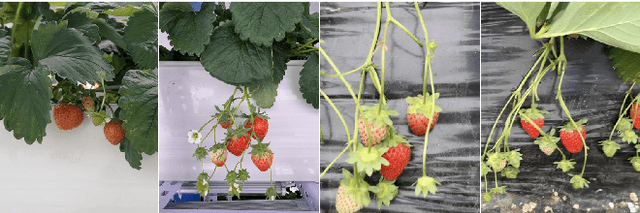
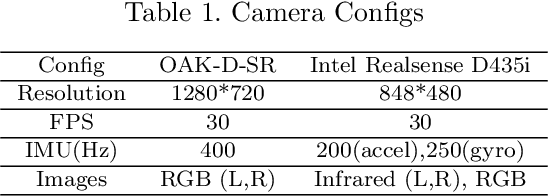
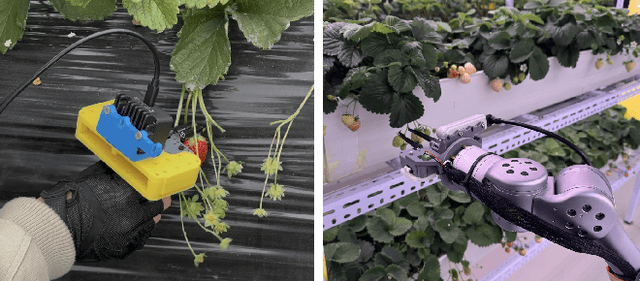
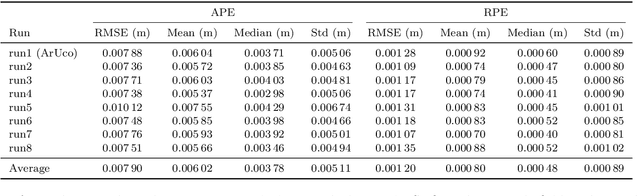
The strawberry farming is labor-intensive, particularly in tasks requiring dexterous manipulation such as picking occluded strawberries. To address this challenge, we present the Strawberry Robotic Operation Interface (SROI), an open-source device designed for collecting dexterous manipulation data in robotic strawberry farming. The SROI features a handheld unit with a modular end effector, a stereo robotic camera, enabling the easy collection of demonstration data in field environments. A data post-processing pipeline is introduced to extract spatial trajectories and gripper states from the collected data. Additionally, we release an open-source dataset of strawberry picking demonstrations to facilitate research in dexterous robotic manipulation. The SROI represents a step toward automating complex strawberry farming tasks, reducing reliance on manual labor.
Efficient and Safe Trajectory Planning for Autonomous Agricultural Vehicle Headland Turning in Cluttered Orchard Environments
Jan 18, 2025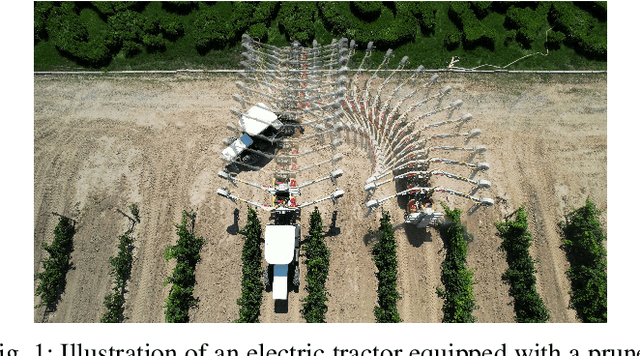
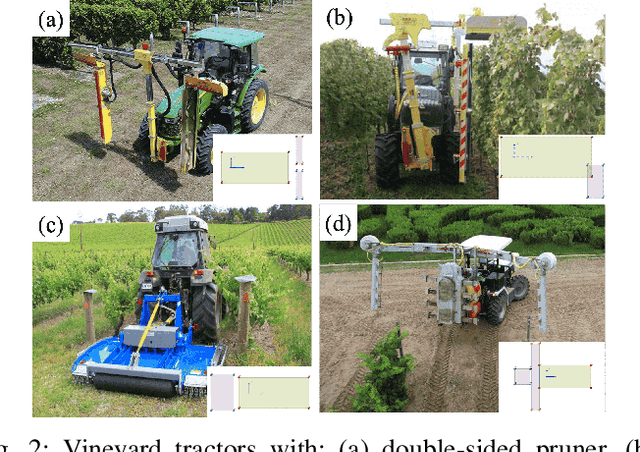
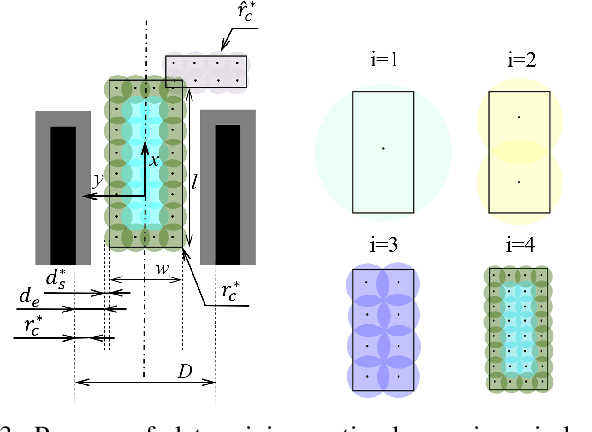
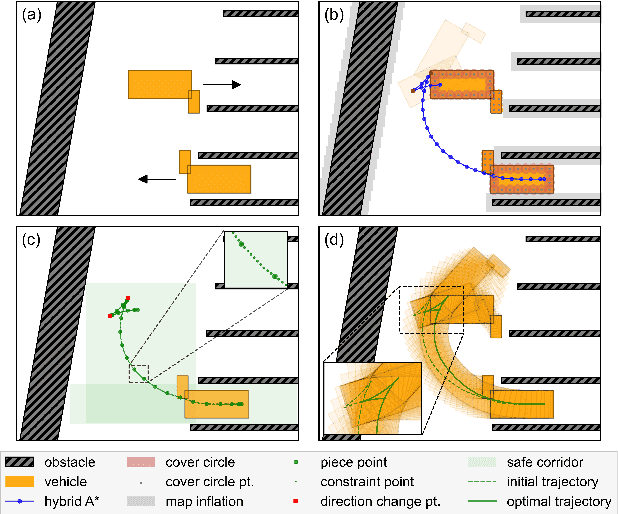
Autonomous agricultural vehicles (AAVs), including field robots and autonomous tractors, are becoming essential in modern farming by improving efficiency and reducing labor costs. A critical task in AAV operations is headland turning between crop rows. This task is challenging in orchards with limited headland space, irregular boundaries, operational constraints, and static obstacles. While traditional trajectory planning methods work well in arable farming, they often fail in cluttered orchard environments. This letter presents a novel trajectory planner that enhances the safety and efficiency of AAV headland maneuvers, leveraging advancements in autonomous driving. Our approach includes an efficient front-end algorithm and a high-performance back-end optimization. Applied to vehicles with various implements, it outperforms state-of-the-art methods in both standard and challenging orchard fields. This work bridges agricultural and autonomous driving technologies, facilitating a broader adoption of AAVs in complex orchards.