 Add to Chrome
 Add to Firefox
 Add to Edge
RealCam: Real-Time Novel-View Video Generation with Interactive Camera Control
May 07, 2026
Camera-controlled video-to-video (V2V) generation enables dynamic viewpoint synthesis from monocular footage, holding immense potential for interactive filmmaking and live broadcasting. However, existing implicit synthesis methods fundamentally rely on non-causal, full-sequence processing and rigid prefix-style temporal concatenation. This architectural paradigm mandates bidirectional attention, resulting in prohibitive computational latency, quadratic complexity scaling, and inherent incompatibility with real-time streaming or variable-length inputs. To overcome these limitations, we introduce \texttt{RealCam}, a novel autoregressive framework for interactive, real-time camera-controlled V2V generation. We first design a high-fidelity teacher model grounded in a \textbf{Cross-frame In-context Learning} paradigm. By interleaving source and target frames into synchronized contextual pairs, our design inherently enables length-agnostic generalization and naturally facilitates causal adaptation, breaking the rigid prefix bottleneck. We then distill this teacher into a few-step causal student via Self-Forcing with Distribution Matching Distillation, enabling efficient, on-the-fly streaming synthesis. Furthermore, to mitigate severe loop inconsistency in closed-loop trajectories, we propose \textbf{Loop-Closed Data Augmentation (LoopAug)}, a novel paradigm that synthesizes globally consistent loop sequences from existing multiview datasets. Extensive experiments demonstrate that \texttt{RealCam} achieves state-of-the-art visual fidelity and temporal consistency while enabling truly interactive camera control with orders-of-magnitude faster inference than existing paradigms. Our project page is at https://xyc-fly.github.io/RealCam/.

UniGeo: Unifying Geometric Guidance for Camera-Controllable Image Editing via Video Models
Apr 19, 2026Camera-controllable image editing aims to synthesize novel views of a given scene under varying camera poses while strictly preserving cross-view geometric consistency. However, existing methods typically rely on fragmented geometric guidance, such as only injecting point clouds at the representation level despite models containing multiple levels, and are mainly based on image diffusion models that operate on discrete view mappings. These two limitations jointly lead to geometric drift and structural degradation under continuous camera motion. We observe that while leveraging video models provides continuous viewpoint priors for camera-controllable image editing, they still struggle to form stable geometric understanding if geometric guidance remains fragmented. To systematically address this, we inject unified geometric guidance across three levels that jointly determine the generative output: representation, architecture, and loss function. To this end, we propose UniGeo, a novel camera-controllable editing framework. Specifically, at the representation level, UniGeo incorporates a frame-decoupled geometric reference injection mechanism to provide robust cross-view geometry context. At the architecture level, it introduces geometric anchor attention to align multi-view features. At the loss function level, it proposes a trajectory-endpoint geometric supervision strategy to explicitly reinforce the structural fidelity of target views. Comprehensive experiments across multiple public benchmarks, encompassing both extensive and limited camera motion settings, demonstrate that UniGeo significantly outperforms existing methods in both visual quality and geometric consistency.
Insert Anything: Image Insertion via In-Context Editing in DiT
Apr 21, 2025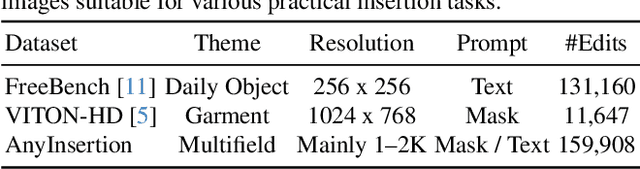
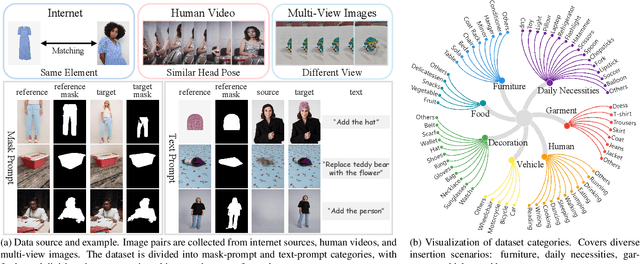

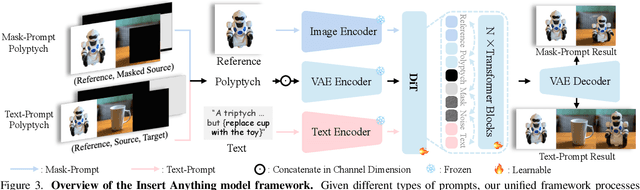
This work presents Insert Anything, a unified framework for reference-based image insertion that seamlessly integrates objects from reference images into target scenes under flexible, user-specified control guidance. Instead of training separate models for individual tasks, our approach is trained once on our new AnyInsertion dataset--comprising 120K prompt-image pairs covering diverse tasks such as person, object, and garment insertion--and effortlessly generalizes to a wide range of insertion scenarios. Such a challenging setting requires capturing both identity features and fine-grained details, while allowing versatile local adaptations in style, color, and texture. To this end, we propose to leverage the multimodal attention of the Diffusion Transformer (DiT) to support both mask- and text-guided editing. Furthermore, we introduce an in-context editing mechanism that treats the reference image as contextual information, employing two prompting strategies to harmonize the inserted elements with the target scene while faithfully preserving their distinctive features. Extensive experiments on AnyInsertion, DreamBooth, and VTON-HD benchmarks demonstrate that our method consistently outperforms existing alternatives, underscoring its great potential in real-world applications such as creative content generation, virtual try-on, and scene composition.