 Add to Chrome
 Add to Firefox
 Add to Edge
CWI: Composite Humanoid Whole-Body Imitation System for Loco-manipulation
Jun 26, 2026
Achieving everyday tasks with humanoid robots requires coordinating stable locomotion with versatile manipulation. However, existing whole-body controllers still face significant challenges. Methods trained solely via command sampling, without motion-capture (MoCap) data, often struggle with sparse rewards and require carefully tuned curricula to converge. This is especially problematic for upper-body control, where the resulting motions deviate from human-like statistics and degrade whole-body coordination. Conversely, approaches that imitate full-body MoCap data suffer from dataset imbalance, as many locomotion trajectories are overly aggressive for stable-locomotion scenarios, necessitating extensive data filtering and augmentation. To address this, we present Composite Whole-Body Imitation (CWI), a framework that decouples the use of MoCap data for upper-body manipulation and lower-body locomotion. This decoupling allows us to exploit the full MoCap dataset of diverse manipulation references, while stable, command-conditioned lower-body locomotion is guided by dual discriminators trained on curated expert-quality walking and squatting clips via an Adversarial Motion Prior (AMP). A multi-critic architecture reduces conflicts among locomotion, manipulation, and motion-style objectives, and a teacher--student distillation stage yields a whole-body policy conditioned only on bimanual hand poses and velocity/height commands. We evaluate CWI through simulation experiments and real-world deployment on a full-size LimX Oli humanoid. The results show competitive loco-manipulation performance, robust whole-body coordination, and practical teleoperation without full-body motion-capture equipment. A project page with supplementary material can be found at https://cwi-ral.github.io/CWI-RAL-Webpage.

Commonsense Scene Graph-based Target Localization for Object Search
Mar 30, 2024
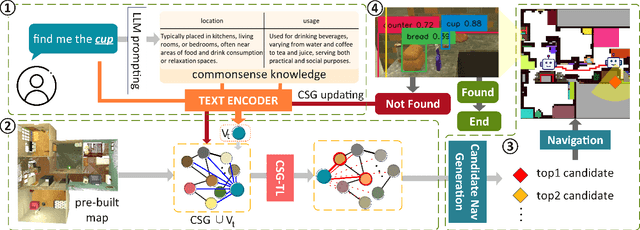

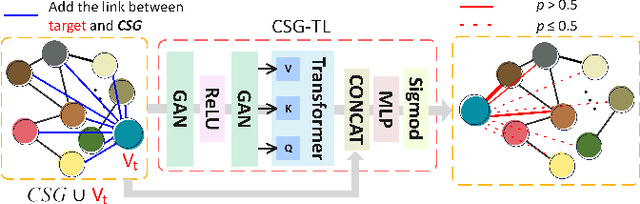
Object search is a fundamental skill for household robots, yet the core problem lies in the robot's ability to locate the target object accurately. The dynamic nature of household environments, characterized by the arbitrary placement of daily objects by users, makes it challenging to perform target localization. To efficiently locate the target object, the robot needs to be equipped with knowledge at both the object and room level. However, existing approaches rely solely on one type of knowledge, leading to unsatisfactory object localization performance and, consequently, inefficient object search processes. To address this problem, we propose a commonsense scene graph-based target localization, CSG-TL, to enhance target object search in the household environment. Given the pre-built map with stationary items, the robot models the room-level knowledge with object-level commonsense knowledge generated by a large language model (LLM) to a commonsense scene graph (CSG), supporting both types of knowledge for CSG-TL. To demonstrate the superiority of CSG-TL on target localization, extensive experiments are performed on the real-world ScanNet dataset and the AI2THOR simulator. Moreover, we have extended CSG-TL to an object search framework, CSG-OS, validated in both simulated and real-world environments. Code and videos are available at https://sites.google.com/view/csg-os.
GraspGPT: Leveraging Semantic Knowledge from a Large Language Model for Task-Oriented Grasping
Jul 30, 2023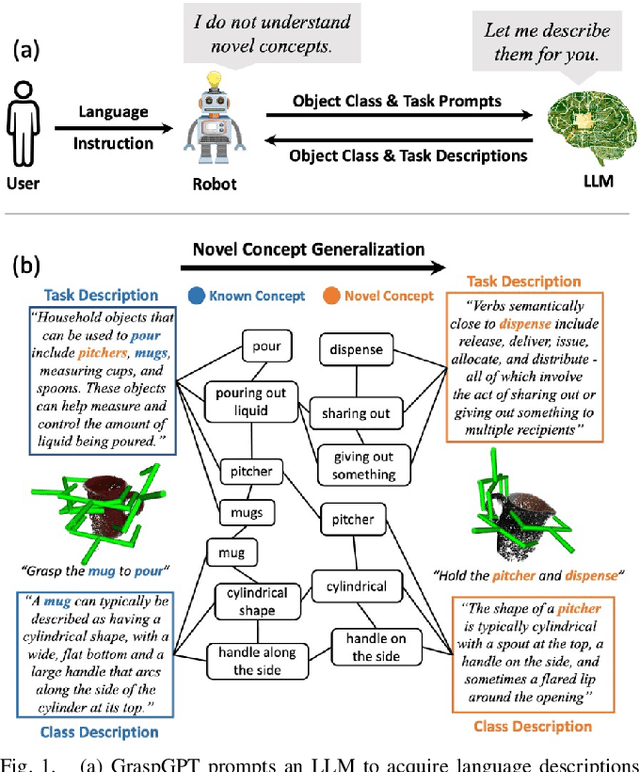
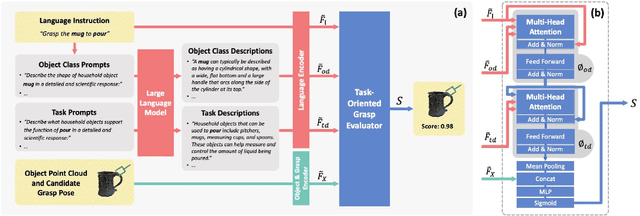
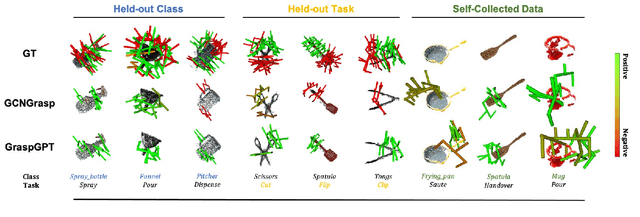
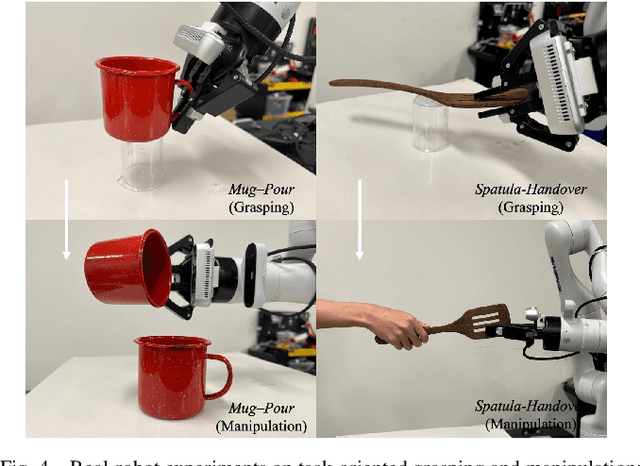
Task-oriented grasping (TOG) refers to the problem of predicting grasps on an object that enable subsequent manipulation tasks. To model the complex relationships between objects, tasks, and grasps, existing methods incorporate semantic knowledge as priors into TOG pipelines. However, the existing semantic knowledge is typically constructed based on closed-world concept sets, restraining the generalization to novel concepts out of the pre-defined sets. To address this issue, we propose GraspGPT, a large language model (LLM) based TOG framework that leverages the open-end semantic knowledge from an LLM to achieve zero-shot generalization to novel concepts. We conduct experiments on Language Augmented TaskGrasp (LA-TaskGrasp) dataset and demonstrate that GraspGPT outperforms existing TOG methods on different held-out settings when generalizing to novel concepts out of the training set. The effectiveness of GraspGPT is further validated in real-robot experiments. Our code, data, appendix, and video are publicly available at https://sites.google.com/view/graspgpt/.