 Add to Chrome
 Add to Firefox
 Add to Edge
CWI: Composite Humanoid Whole-Body Imitation System for Loco-manipulation
Jun 26, 2026
Achieving everyday tasks with humanoid robots requires coordinating stable locomotion with versatile manipulation. However, existing whole-body controllers still face significant challenges. Methods trained solely via command sampling, without motion-capture (MoCap) data, often struggle with sparse rewards and require carefully tuned curricula to converge. This is especially problematic for upper-body control, where the resulting motions deviate from human-like statistics and degrade whole-body coordination. Conversely, approaches that imitate full-body MoCap data suffer from dataset imbalance, as many locomotion trajectories are overly aggressive for stable-locomotion scenarios, necessitating extensive data filtering and augmentation. To address this, we present Composite Whole-Body Imitation (CWI), a framework that decouples the use of MoCap data for upper-body manipulation and lower-body locomotion. This decoupling allows us to exploit the full MoCap dataset of diverse manipulation references, while stable, command-conditioned lower-body locomotion is guided by dual discriminators trained on curated expert-quality walking and squatting clips via an Adversarial Motion Prior (AMP). A multi-critic architecture reduces conflicts among locomotion, manipulation, and motion-style objectives, and a teacher--student distillation stage yields a whole-body policy conditioned only on bimanual hand poses and velocity/height commands. We evaluate CWI through simulation experiments and real-world deployment on a full-size LimX Oli humanoid. The results show competitive loco-manipulation performance, robust whole-body coordination, and practical teleoperation without full-body motion-capture equipment. A project page with supplementary material can be found at https://cwi-ral.github.io/CWI-RAL-Webpage.

Learning Whole-Body Loco-Manipulation for Omni-Directional Task Space Pose Tracking with a Wheeled-Quadrupedal-Manipulator
Dec 04, 2024
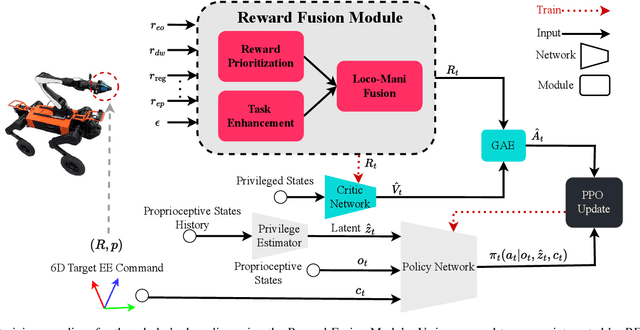
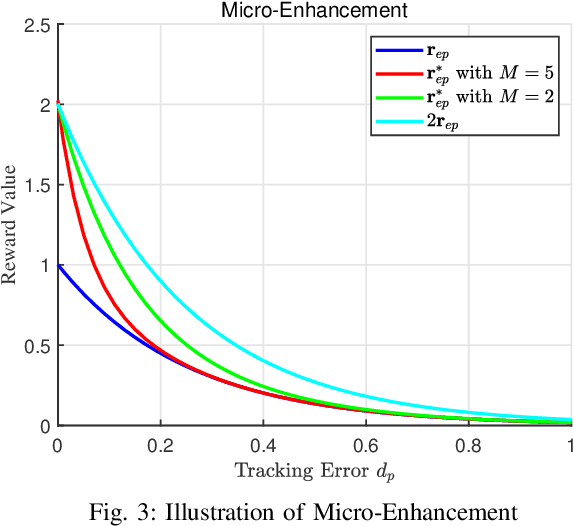
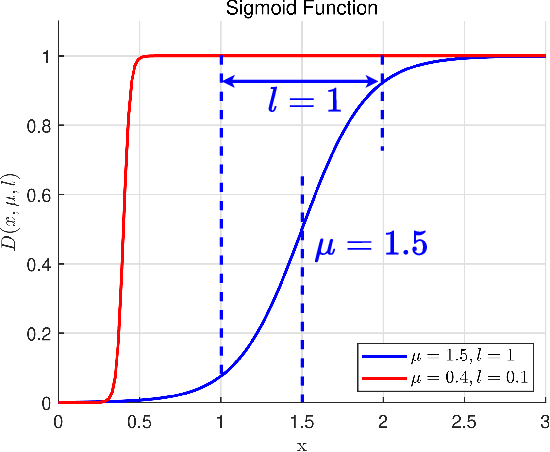
In this paper, we study the whole-body loco-manipulation problem using reinforcement learning (RL). Specifically, we focus on the problem of how to coordinate the floating base and the robotic arm of a wheeled-quadrupedal manipulator robot to achieve direct six-dimensional (6D) end-effector (EE) pose tracking in task space. Different from conventional whole-body loco-manipulation problems that track both floating-base and end-effector commands, the direct EE pose tracking problem requires inherent balance among redundant degrees of freedom in the whole-body motion. We leverage RL to solve this challenging problem. To address the associated difficulties, we develop a novel reward fusion module (RFM) that systematically integrates reward terms corresponding to different tasks in a nonlinear manner. In such a way, the inherent multi-stage and hierarchical feature of the loco-manipulation problem can be carefully accommodated. By combining the proposed RFM with the a teacher-student RL training paradigm, we present a complete RL scheme to achieve 6D EE pose tracking for the wheeled-quadruped manipulator robot. Extensive simulation and hardware experiments demonstrate the significance of the RFM. In particular, we enable smooth and precise tracking performance, achieving state-of-the-art tracking position error of less than 5 cm, and rotation error of less than 0.1 rad. Please refer to https://clearlab-sustech.github.io/RFM_loco_mani/ for more experimental videos.