 Add to Chrome
 Add to Firefox
 Add to Edge
ZhuLong: Execution-Grounded LLM Agent for EDA Scripting with Offline API Self-Exploration
Aug 08, 2026
EDA scripting with tool-specific, often undocumented APIs remains a long-tail bottleneck that existing LLMs fail to address. This paper presents ZhuLong, an execution-grounded LLM coding agent for PyAether and SKILL that combines API retrieval, documentation inspection, and sandbox execution via unified MCP tools, augmented by an offline API self-exploration mechanism that infers undocumented API behaviors through counterfactual experimentation. We evaluate ZhuLong on EDA-Eval-PyAether, a benchmark of 158 real-world tasks with assertion-based execution, where the complete system achieves 78.5% Pass@1 in the commercial Empyrean Aether environment, substantially outperforming a pure LLM baseline (23.6%). Ablation studies identify sandbox execution as the dominant performance driver (41.2 pp drop when removed), with the self-exploration mechanism contributing an additional 3.2 pp accuracy gain and a 22.1% reduction in per-task tool calls. On 20 interactive tasks involving unsaved layouts and schematics, ZhuLong achieves 60.0% Pass@1 for PyAether and 50.0% for SKILL.

CausalCellSegmenter: Causal Inference inspired Diversified Aggregation Convolution for Pathology Image Segmentation
Mar 10, 2024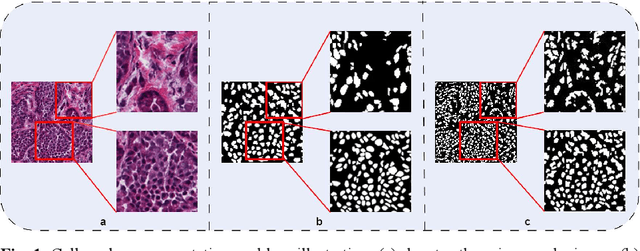
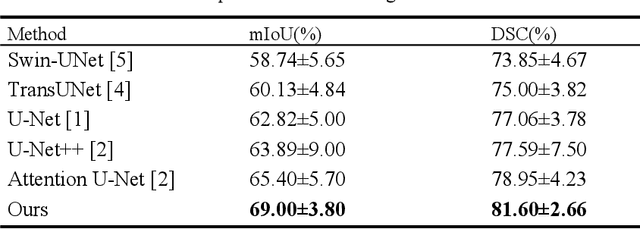

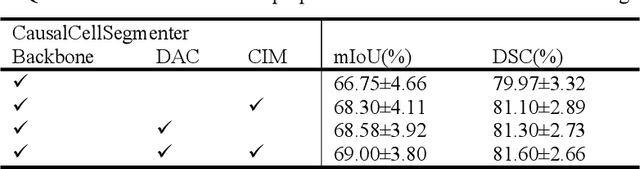
Deep learning models have shown promising performance for cell nucleus segmentation in the field of pathology image analysis. However, training a robust model from multiple domains remains a great challenge for cell nucleus segmentation. Additionally, the shortcomings of background noise, highly overlapping between cell nucleus, and blurred edges often lead to poor performance. To address these challenges, we propose a novel framework termed CausalCellSegmenter, which combines Causal Inference Module (CIM) with Diversified Aggregation Convolution (DAC) techniques. The DAC module is designed which incorporates diverse downsampling features through a simple, parameter-free attention module (SimAM), aiming to overcome the problems of false-positive identification and edge blurring. Furthermore, we introduce CIM to leverage sample weighting by directly removing the spurious correlations between features for every input sample and concentrating more on the correlation between features and labels. Extensive experiments on the MoNuSeg-2018 dataset achieves promising results, outperforming other state-of-the-art methods, where the mIoU and DSC scores growing by 3.6% and 2.65%.
Speaker Identification from Raw Waveform with LineNet
May 31, 2021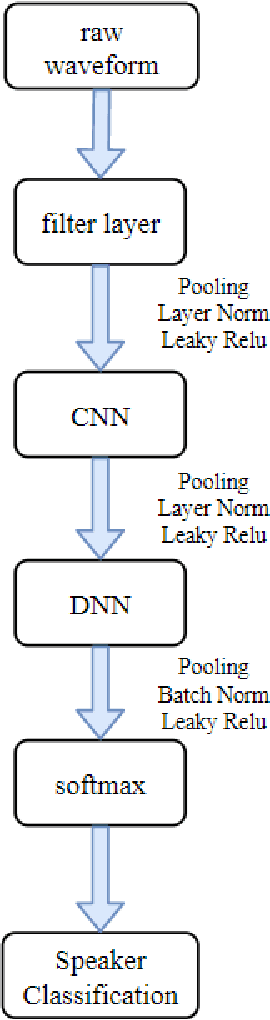
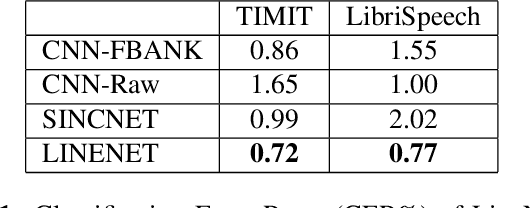
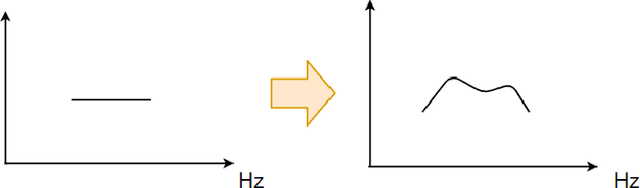
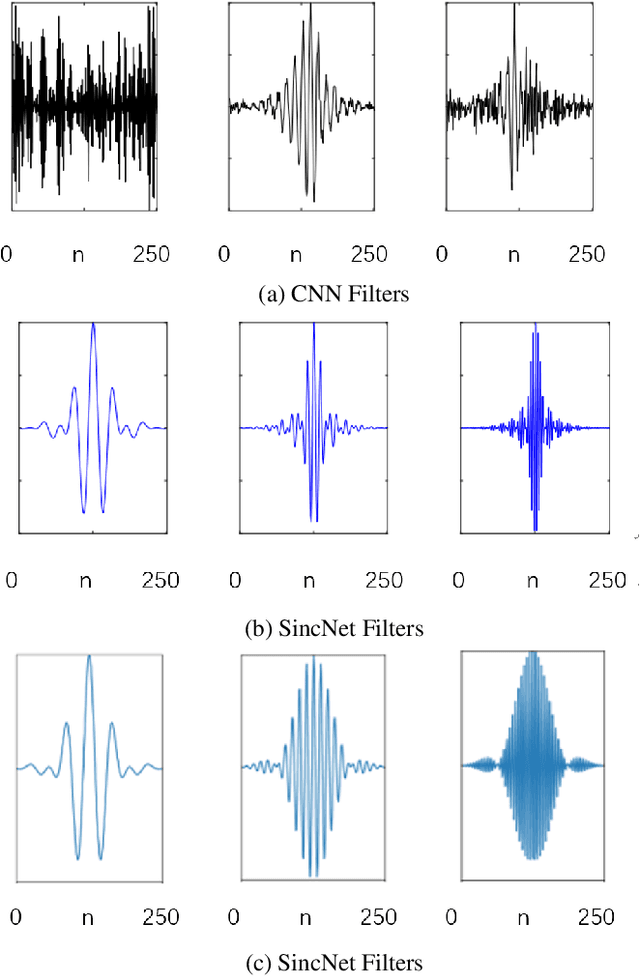
Speaker Identification using i-vector has gradually been replaced by speaker Identification using deep learning. Speaker Identification based on Convolutional Neural Networks (CNNs) has been widely used in recent years, which learn low-level speech representations from raw waveforms. On this basis, a CNN architecture called SincNet proposes a kind of unique convolutional layer, which has achieved band-pass filters. Compared with standard CNNs, SincNet learns the low and high cutoff frequencies of each filter.This paper proposes an improved CNNs architecture called LineNet, which encourages the first convolutional layer to implement more specific filters than SincNet. LineNet parameterizes the frequency domain shape and can realize band-pass filters by learning some deformation points in frequency domain. Compared with standard CNN, LineNet can learn the characteristics of each filter. Compared with SincNet, LineNet can learn more characteristic parameters, instead of only low and high cutoff frequencies. This provides a personalized filter bank for different tasks. As a result, our experiments show that the LineNet converges faster than standard CNN and performs better than SincNet.