 Add to Chrome
 Add to Firefox
 Add to Edge
Empowering Credit Risk Detection in Weixin Pay with Billion-Scale Deep Graph Learning
Aug 03, 2026
Credit risk detection, particularly mitigating individual fraud, is crucial for maintaining the stability of digital financial ecosystems. Accurately identifying credit fraud among billions of users is critical for minimizing financial losses and safeguarding the sustainability of inclusive financial services. Given that credit fraud risks are often concealed within heterogeneous user-risk graphs, Graph Neural Networks (GNNs) have emerged as an effective tool for risk mining by capturing complex dependencies. To address the scalability bottleneck of industrial GNNs, distributed training based on subgraphs is indispensable. However, existing strategies often compromise topological integrity for load balancing. This can be catastrophic for risk detection, as it indiscriminately severs the long-tail evidence chains essential for risk propagation. Overlapping subgraphs can restore severed risk contexts but inevitably introduce redundancy and noise, while overlooking the representation alignment across different local subgraphs. In this paper, we propose a risk-aware overlapping subgraph learning framework for large-scale credit risk detection. We first construct base partitions to ensure load balance. Then, we perform budget-constrained sampling that selects informative long-tail nodes, thereby preserving critical risk diffusion patterns while filtering out noise. To mitigate representation inconsistency, we design a cross-subgraph consistency alignment mechanism. By enforcing alignment constraints on the overlapping nodes, we harmonize the local representations into a globally consistent latent space. Extensive experiments on Weixin Pay's production dataset demonstrate that our model significantly outperforms existing strategies for risk detection, offering a scalable and effective solution for industrial graph learning.

Rapid Image Labeling via Neuro-Symbolic Learning
Jun 18, 2023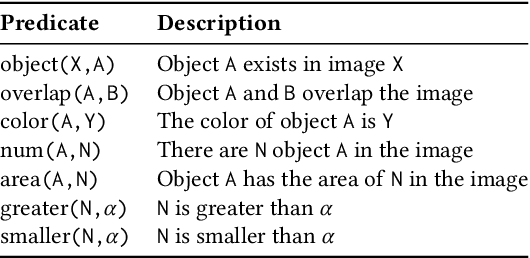
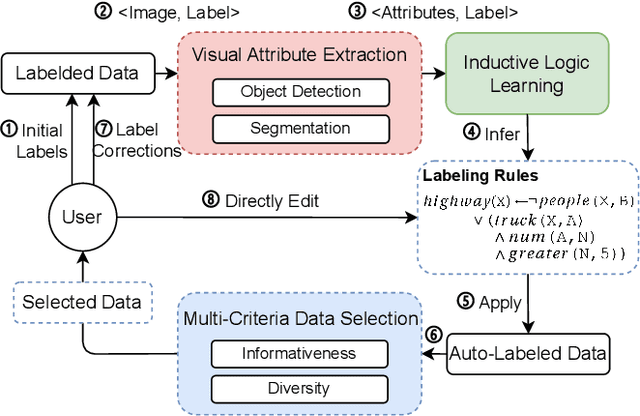
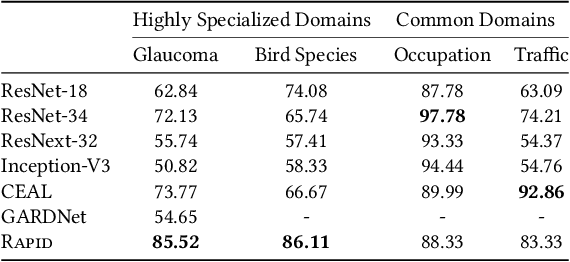
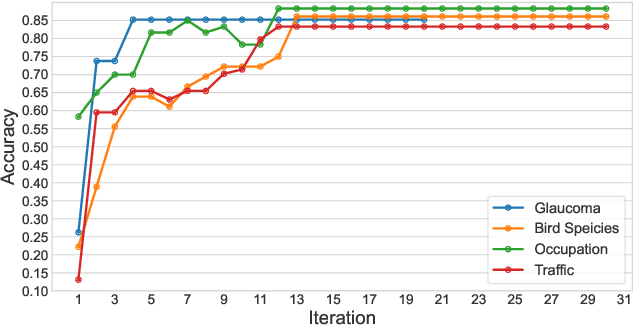
The success of Computer Vision (CV) relies heavily on manually annotated data. However, it is prohibitively expensive to annotate images in key domains such as healthcare, where data labeling requires significant domain expertise and cannot be easily delegated to crowd workers. To address this challenge, we propose a neuro-symbolic approach called Rapid, which infers image labeling rules from a small amount of labeled data provided by domain experts and automatically labels unannotated data using the rules. Specifically, Rapid combines pre-trained CV models and inductive logic learning to infer the logic-based labeling rules. Rapid achieves a labeling accuracy of 83.33% to 88.33% on four image labeling tasks with only 12 to 39 labeled samples. In particular, Rapid significantly outperforms finetuned CV models in two highly specialized tasks. These results demonstrate the effectiveness of Rapid in learning from small data and its capability to generalize among different tasks. Code and our dataset are publicly available at https://github.com/Neural-Symbolic-Image-Labeling/
Consistent Network Alignment with Node Embedding
May 10, 2020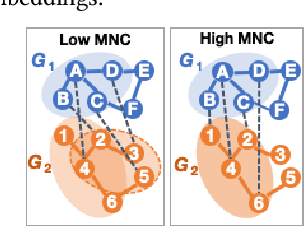
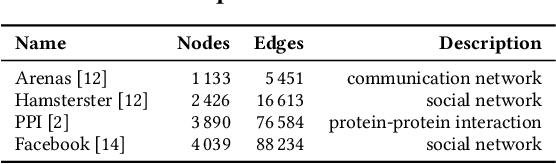
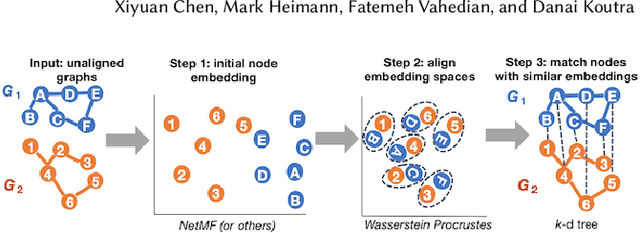
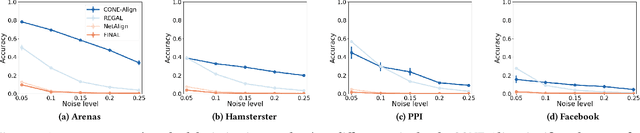
Network alignment, the process of finding correspondences between nodes in different graphs, has significant scientific and industrial applications. We find that many existing network alignment methods fail to achieve accurate alignments because they break up node neighborhoods during alignment, failing to preserve matched neighborhood consistency. To improve this, we propose CONE-Align, which matches nodes based on embeddings that model intra-network proximity and are aligned to be comparable across networks. Experiments on diverse, challenging datasets show that CONE-Align is robust and obtains up to 49% greater accuracy than the state-of-the-art graph alignment algorithms.