 Add to Chrome
 Add to Firefox
 Add to Edge
Pyramid Forcing: Head-Aware Pyramid KV Cache Policy for High-Quality Long Video Generation
May 13, 2026
Autoregressive video generation enables streaming and open-ended long video synthesis, but still suffers from long-term degradation caused by accumulated errors. Existing KVCache strategies usually apply unified historical-frame retention, implicitly assuming homogeneous historical dependencies across attention heads. We revisit historical-frame attention and reveal three distinct head types: Anchor Heads require broad long-range context, Wave Heads exhibit periodic temporal dependencies, and Veil Heads focus on initial and adjacent frames. Based on this finding, we propose Pyramid Forcing, a head-aware pyramidal KVCache framework that identifies head types offline, assigns behavior-specific cache policies, and supports heterogeneous cache lengths via efficient ragged-cache attention. Experiments on Self Forcing and Causal Forcing show that Pyramid Forcing consistently improves long-horizon generation quality on VBench-Long, increasing the 60-second Self Forcing score from 77.87 to 81.21 while enhancing motion dynamics, visual fidelity, and semantic consistency. Project: https://if-lab-pku.github.io/Pyramid-Forcing/.

On provable privacy vulnerabilities of graph representations
Feb 06, 2024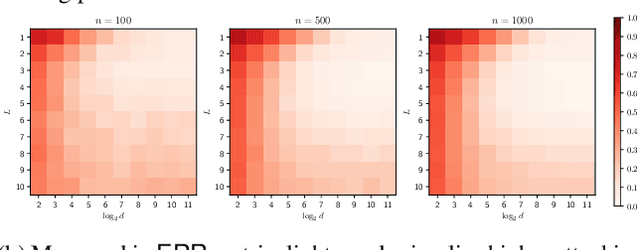
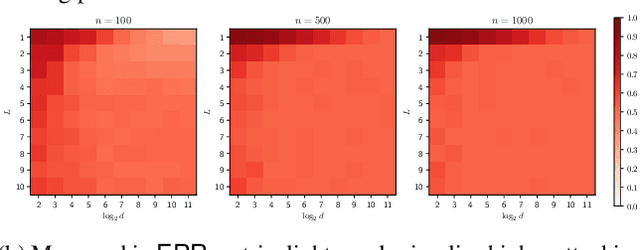
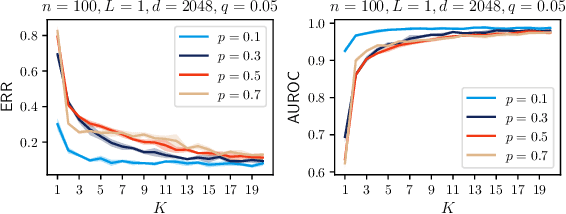
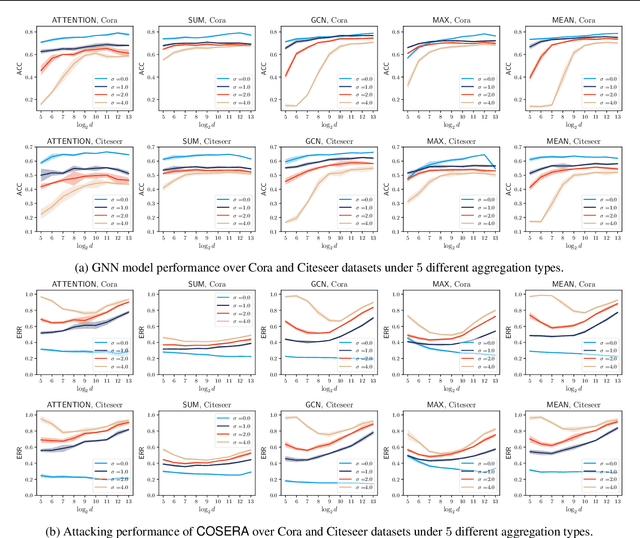
Graph representation learning (GRL) is critical for extracting insights from complex network structures, but it also raises security concerns due to potential privacy vulnerabilities in these representations. This paper investigates the structural vulnerabilities in graph neural models where sensitive topological information can be inferred through edge reconstruction attacks. Our research primarily addresses the theoretical underpinnings of cosine-similarity-based edge reconstruction attacks (COSERA), providing theoretical and empirical evidence that such attacks can perfectly reconstruct sparse Erdos Renyi graphs with independent random features as graph size increases. Conversely, we establish that sparsity is a critical factor for COSERA's effectiveness, as demonstrated through analysis and experiments on stochastic block models. Finally, we explore the resilience of (provably) private graph representations produced via noisy aggregation (NAG) mechanism against COSERA. We empirically delineate instances wherein COSERA demonstrates both efficacy and deficiency in its capacity to function as an instrument for elucidating the trade-off between privacy and utility.
Knowledge-inspired Subdomain Adaptation for Cross-Domain Knowledge Transfer
Aug 17, 2023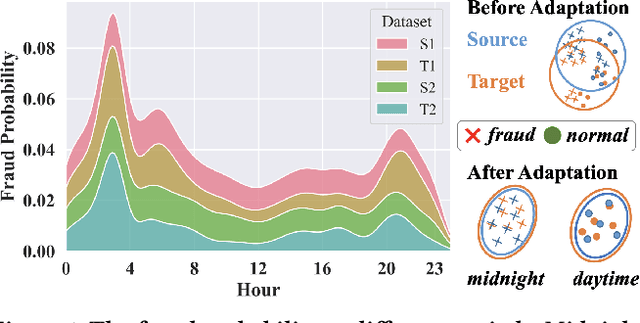
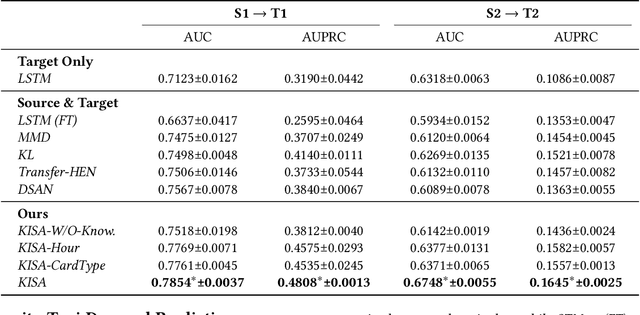
Most state-of-the-art deep domain adaptation techniques align source and target samples in a global fashion. That is, after alignment, each source sample is expected to become similar to any target sample. However, global alignment may not always be optimal or necessary in practice. For example, consider cross-domain fraud detection, where there are two types of transactions: credit and non-credit. Aligning credit and non-credit transactions separately may yield better performance than global alignment, as credit transactions are unlikely to exhibit patterns similar to non-credit transactions. To enable such fine-grained domain adaption, we propose a novel Knowledge-Inspired Subdomain Adaptation (KISA) framework. In particular, (1) We provide the theoretical insight that KISA minimizes the shared expected loss which is the premise for the success of domain adaptation methods. (2) We propose the knowledge-inspired subdomain division problem that plays a crucial role in fine-grained domain adaption. (3) We design a knowledge fusion network to exploit diverse domain knowledge. Extensive experiments demonstrate that KISA achieves remarkable results on fraud detection and traffic demand prediction tasks.