 Add to Chrome
 Add to Firefox
 Add to Edge
FinHardBench: Can LLMs Generate Latency-Aware Hardware for Financial Computing?
Aug 02, 2026
Can large language models generate not just correct, but fast hardware? This paper investigates the question in financial FPGA design, where 5-10 nanoseconds of latency determines competitive advantage and designs iterate continuously as protocols, strategies, and regulations evolve. FinHardBench, a benchmark of 33 financial computing tasks, is presented together with three experiments that mirror the real-world FPGA iteration cycle: generating new modules from specifications, tuning system-level configurations across a 6-stage trading pipeline, and adapting existing modules to specification changes. Evaluation of six LLMs on 1530+ experiment rounds yields three findings: (1) models achieve 19-61% functional correctness with timing degradation up to 13.7$\times$ on specific tasks; (2) in system-level design space exploration, top LLMs converge to the optimal configuration with higher reliability than random search, simulated annealing, and Bayesian optimization baselines (5/5 seeds vs. 0-4/5 at the same 24-round budget); (3) strategy-level specification changes remain unsolved for most models. Across the six models, generation and DSE rankings overlap moderately: the strongest code generator is not the fastest architecture optimizer, and the weakest code generator (MiniMax M2.7) still reaches the system optimum on 4 of 5 seeds. On the tasks in FinHardBench, difficulty tracks training data pattern availability more closely than abstraction level. FinHardBench is released as an open-source benchmark.

AnalogSAGE: Self-evolving Analog Design Multi-Agents with Stratified Memory and Grounded Experience
Dec 27, 2025Analog circuit design remains a knowledge- and experience-intensive process that relies heavily on human intuition for topology generation and device parameter tuning. Existing LLM-based approaches typically depend on prompt-driven netlist generation or predefined topology templates, limiting their ability to satisfy complex specification requirements. We propose AnalogSAGE, an open-source self-evolving multi-agent framework that coordinates three-stage agent explorations through four stratified memory layers, enabling iterative refinement with simulation-grounded feedback. To support reproducibility and generality, we release the source code. Our benchmark spans ten specification-driven operational amplifier design problems of varying difficulty, enabling quantitative and cross-task comparison under identical conditions. Evaluated under the open-source SKY130 PDK with ngspice, AnalogSAGE achieves a 10$\times$ overall pass rate, a 48$\times$ Pass@1, and a 4$\times$ reduction in parameter search space compared with existing frameworks, demonstrating that stratified memory and grounded reasoning substantially enhance the reliability and autonomy of analog design automation in practice.
LLM4SecHW: Leveraging Domain Specific Large Language Model for Hardware Debugging
Jan 28, 2024

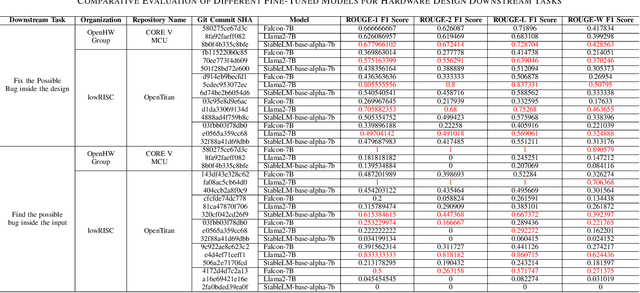
This paper presents LLM4SecHW, a novel framework for hardware debugging that leverages domain specific Large Language Model (LLM). Despite the success of LLMs in automating various software development tasks, their application in the hardware security domain has been limited due to the constraints of commercial LLMs and the scarcity of domain specific data. To address these challenges, we propose a unique approach to compile a dataset of open source hardware design defects and their remediation steps, utilizing version control data. This dataset provides a substantial foundation for training machine learning models for hardware. LLM4SecHW employs fine tuning of medium sized LLMs based on this dataset, enabling the identification and rectification of bugs in hardware designs. This pioneering approach offers a reference workflow for the application of fine tuning domain specific LLMs in other research areas. We evaluate the performance of our proposed system on various open source hardware designs, demonstrating its efficacy in accurately identifying and correcting defects. Our work brings a new perspective on automating the quality control process in hardware design.
* 6 pages. 1 figure
Hardware Phi-1.5B: A Large Language Model Encodes Hardware Domain Specific Knowledge
Jan 27, 2024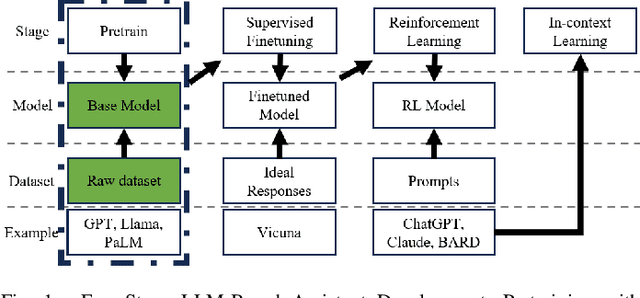


In the rapidly evolving semiconductor industry, where research, design, verification, and manufacturing are intricately linked, the potential of Large Language Models to revolutionize hardware design and security verification is immense. The primary challenge, however, lies in the complexity of hardware specific issues that are not adequately addressed by the natural language or software code knowledge typically acquired during the pretraining stage. Additionally, the scarcity of datasets specific to the hardware domain poses a significant hurdle in developing a foundational model. Addressing these challenges, this paper introduces Hardware Phi 1.5B, an innovative large language model specifically tailored for the hardware domain of the semiconductor industry. We have developed a specialized, tiered dataset comprising small, medium, and large subsets and focused our efforts on pretraining using the medium dataset. This approach harnesses the compact yet efficient architecture of the Phi 1.5B model. The creation of this first pretrained, hardware domain specific large language model marks a significant advancement, offering improved performance in hardware design and verification tasks and illustrating a promising path forward for AI applications in the semiconductor sector.
* 6 pages, 6 figures