 Add to Chrome
 Add to Firefox
 Add to Edge
Empowering Reliable Visual-Centric Instruction Following in MLLMs
Jan 06, 2026
Evaluating the instruction-following (IF) capabilities of Multimodal Large Language Models (MLLMs) is essential for rigorously assessing how faithfully model outputs adhere to user-specified intentions. Nevertheless, existing benchmarks for evaluating MLLMs' instruction-following capability primarily focus on verbal instructions in the textual modality. These limitations hinder a thorough analysis of instruction-following capabilities, as they overlook the implicit constraints embedded in the semantically rich visual modality. To address this gap, we introduce VC-IFEval, a new benchmark accompanied by a systematically constructed dataset that evaluates MLLMs' instruction-following ability under multimodal settings. Our benchmark systematically incorporates vision-dependent constraints into instruction design, enabling a more rigorous and fine-grained assessment of how well MLLMs align their outputs with both visual input and textual instructions. Furthermore, by fine-tuning MLLMs on our dataset, we achieve substantial gains in visual instruction-following accuracy and adherence. Through extensive evaluation across representative MLLMs, we provide new insights into the strengths and limitations of current models.

CREAM: Consistency Regularized Self-Rewarding Language Models
Oct 17, 2024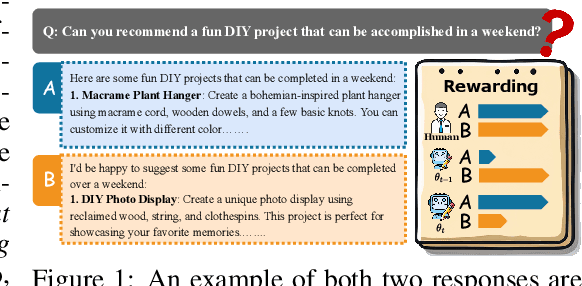
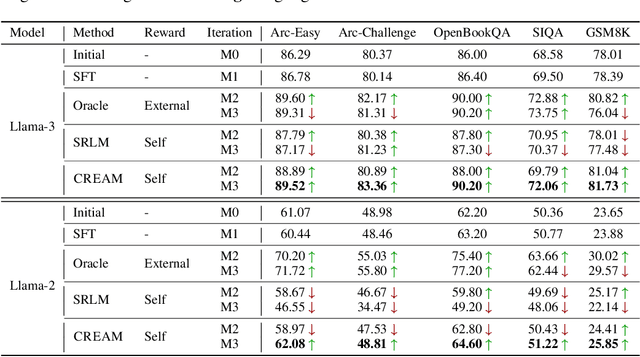
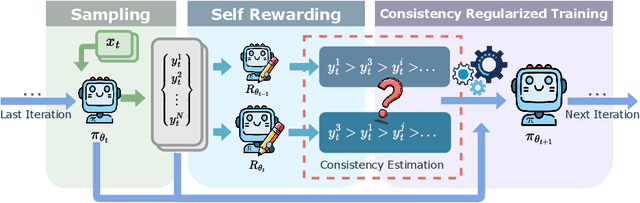
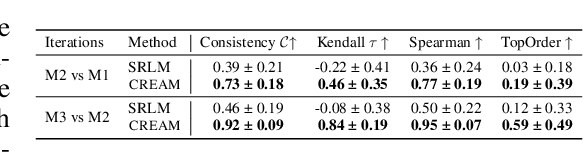
Recent self-rewarding large language models (LLM) have successfully applied LLM-as-a-Judge to iteratively improve the alignment performance without the need of human annotations for preference data. These methods commonly utilize the same LLM to act as both the policy model (which generates responses) and the reward model (which scores and ranks those responses). The ranked responses are then used as preference pairs to train the LLM via direct alignment technologies (e.g. DPO). However, it is noteworthy that throughout this process, there is no guarantee of accuracy in the rewarding and ranking, which is critical for ensuring accurate rewards and high-quality preference data. Empirical results from relatively small LLMs (e.g., 7B parameters) also indicate that improvements from self-rewarding may diminish after several iterations in certain situations, which we hypothesize is due to accumulated bias in the reward system. This bias can lead to unreliable preference data for training the LLM. To address this issue, we first formulate and analyze the generalized iterative preference fine-tuning framework for self-rewarding language model. We then introduce the regularization to this generalized framework to mitigate the overconfident preference labeling in the self-rewarding process. Based on this theoretical insight, we propose a Consistency Regularized sElf-rewarding lAnguage Model (CREAM) that leverages the rewarding consistency across different iterations to regularize the self-rewarding training, helping the model to learn from more reliable preference data. With this explicit regularization, our empirical results demonstrate the superiority of CREAM in improving both reward consistency and alignment performance. The code is publicly available at https://github.com/Raibows/CREAM.