 Add to Chrome
 Add to Firefox
 Add to Edge
GoGoTB: Agentic RTL Verification with Specification-Grounded Coverage Closure
Jul 28, 2026
Functional verification dominates integrated circuit (IC) front-end engineering effort, and a single missed bug that escapes to silicon can trigger a costly respin. Recent large language models (LLMs) offer new opportunities to automate this process, yet existing LLM-based approaches generate each component through independent single-turn calls with no shared context, leaving interface mismatches undetected and reported coverage disconnected from specification requirements. To address these challenges, we present GoGoTB, an agentic framework that achieves end-to-end verification closure through three subsystems: an agentic execution control layer, an evolvable knowledge system, and specification-grounded coverage closure. The execution control layer separates deterministic enforcement from LLM reasoning at every tool and stage boundary. The knowledge system dispatches methodology and design-specific expertise on demand. The coverage framework anchors every bin to a named specification behavior so that each residual gap has a diagnosable root cause and a targeted remedy. Tested on 8 register transfer level (RTL) designs without any human intervention, GoGoTB achieves 100\% environment generation success and averages 98.4\% line, 97.2\% branch, 97.0\% toggle, and 83.2\% functional coverage. No prior work successfully generates a complete verification environment or achieves meaningful coverage on the same benchmarks.

PANDA: An LLM-Enhanced Performance-Driven Analog Design Framework Bridging Design Intent and Layout Generation
Jun 13, 2026Traditional design of analog circuits heavily relies on manual interventions across topology, sizing, and layout, with prior automation addressing stages in isolation. In this work, we propose PANDA, an LLM-enhanced framework that bridges high-level design intent to final layout by actively managing cross-stage dependencies through guided topology synthesis, substructure-aware sizing, and constraint-driven layout generation. This shifts automation from algorithm-centric execution to intent-centric co-design, reducing turnaround time from days or weeks to hours while improving design performance.
KATO: Knowledge Alignment and Transfer for Transistor Sizing of Different Design and Technology
Apr 19, 2024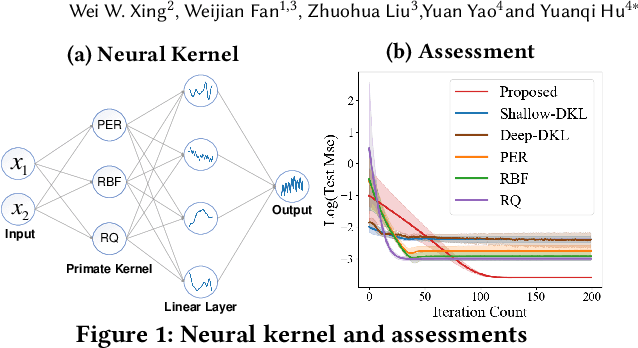
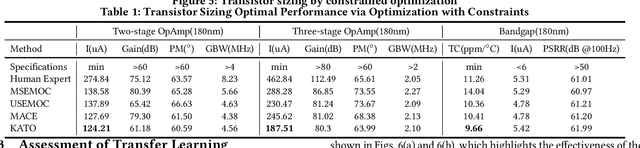
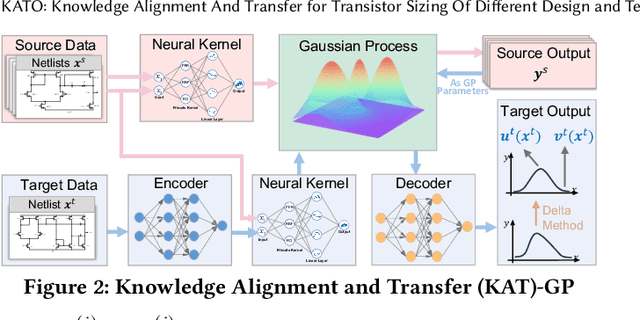
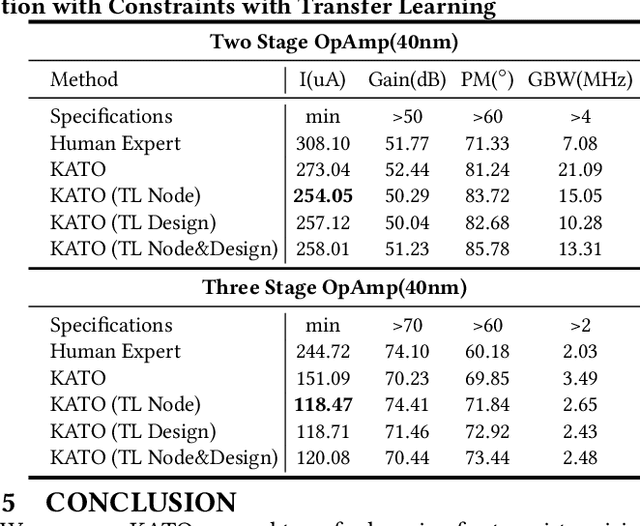
Automatic transistor sizing in circuit design continues to be a formidable challenge. Despite that Bayesian optimization (BO) has achieved significant success, it is circuit-specific, limiting the accumulation and transfer of design knowledge for broader applications. This paper proposes (1) efficient automatic kernel construction, (2) the first transfer learning across different circuits and technology nodes for BO, and (3) a selective transfer learning scheme to ensure only useful knowledge is utilized. These three novel components are integrated into BO with Multi-objective Acquisition Ensemble (MACE) to form Knowledge Alignment and Transfer Optimization (KATO) to deliver state-of-the-art performance: up to 2x simulation reduction and 1.2x design improvement over the baselines.