 Add to Chrome
 Add to Firefox
 Add to Edge
OmniDrive: An LLM-Choreographed Multi-Agent World Model with Unified Latent Co-Compression for Multi-View Driving Video Generation
Jun 16, 2026
Generative world models for autonomous driving face two unresolved tensions: heterogeneous control injection, where free-form language, HD-maps, trajectories, and camera poses reside in incompatible representational spaces, and post-hoc cross-view fusion, where per-camera latents fail to encode global 3-D geometry. We trace both to a single root cause: the absence of a shared symbolic interlingua aligning language, geometry, and pixels at the latent-token level. We present DRIVE-CHOREO, an LLM-choreographed multi-agent world model that recasts controllable multi-view video generation as latent choreography. Three Qwen2.5-VL agents - a Director parsing user intent into a structured WorldScript, a Cartographer grounding it into spatially-anchored layout tokens, and an Auditor feeding cross-view critiques back as auxiliary supervision - jointly author a single position-aware token sequence. This sequence is co-compressed with the multi-view video via a view-time permutation that enforces inter-camera geometry within the convolutional receptive field of a 3-D VAE. On nuScenes, DRIVE-CHOREO sets new state-of-the-art multi-view consistency and BEV mAP (21.6) with competitive FVD (45.7); a detector trained purely on our synthetic data gains +2.4 NDS on the real validation split, validating downstream utility.

Two Heads are Better than One: Distilling Large Language Model Features Into Small Models with Feature Decomposition and Mixture
Nov 11, 2025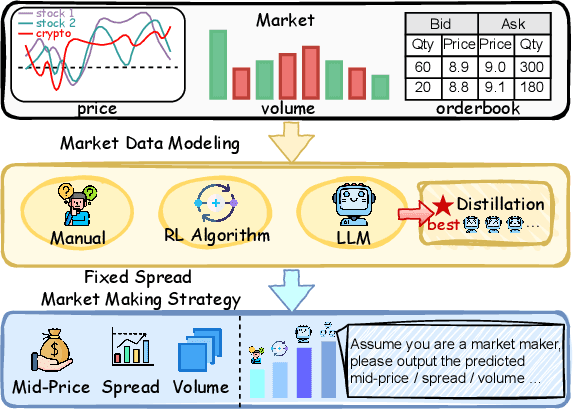

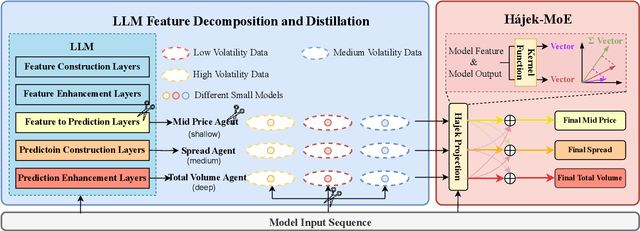
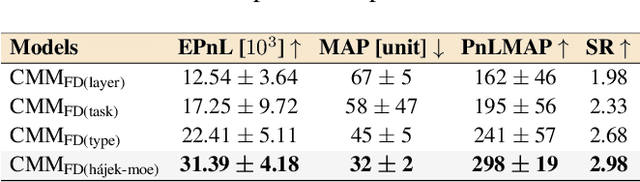
Market making (MM) through Reinforcement Learning (RL) has attracted significant attention in financial trading. With the development of Large Language Models (LLMs), more and more attempts are being made to apply LLMs to financial areas. A simple, direct application of LLM as an agent shows significant performance. Such methods are hindered by their slow inference speed, while most of the current research has not studied LLM distillation for this specific task. To address this, we first propose the normalized fluorescent probe to study the mechanism of the LLM's feature. Based on the observation found by our investigation, we propose Cooperative Market Making (CMM), a novel framework that decouples LLM features across three orthogonal dimensions: layer, task, and data. Various student models collaboratively learn simple LLM features along with different dimensions, with each model responsible for a distinct feature to achieve knowledge distillation. Furthermore, CMM introduces an Hájek-MoE to integrate the output of the student models by investigating the contribution of different models in a kernel function-generated common feature space. Extensive experimental results on four real-world market datasets demonstrate the superiority of CMM over the current distillation method and RL-based market-making strategies.