 Add to Chrome
 Add to Firefox
 Add to Edge
SCALMU: Synthetically-trained Coupling of Adaptive Learned Multiplicative Updates for Hyperspectral-Multispectral Fusion
May 29, 2026
HyperSpectral-MultiSpectral Image (HSI-MSI) fusion enables high-resolution hyperspectral imaging by combining the rich spectral information of low-spatial-resolution hyperspectral images with the detailed spatial structure of multispectral images. Classical methods such as Coupled Nonnegative Matrix Factorization (CNMF) benefit from a strong physical interpretability but suffer from inferior results compared to their deep-learning counterparts. To address this limitation, we propose SCALMU (Synthetically-trained Coupling of Adaptive Learned Multiplicative Updates), a novel unrolled neural network architecture that integrates adaptive learnable matrices within the classical framework of CNMF multiplicative updates, improving its results. Due to its architectural proximity with CNMF, the resulting algorithm preserves physical interpretability and nonnegativity constraints. To overcome data scarcity for training, we additionally generate a synthetic HSI-MSI dataset via the dead leaves model, enabling synthetic supervision. SCALMU is then trained end-to-end on this dataset. Experiments demonstrate SCALMU's superiority over state-of-the-art methods on several datasets. The code is available at https://github.com/xinxinxu99/SCALMU.git

Synthetic Abundance Maps for Unsupervised Super-Resolution of Hyperspectral Remote Sensing Images
Jan 30, 2026Hyperspectral single image super-resolution (HS-SISR) aims to enhance the spatial resolution of hyperspectral images to fully exploit their spectral information. While considerable progress has been made in this field, most existing methods are supervised and require ground truth data for training-data that is often unavailable in practice. To overcome this limitation, we propose a novel unsupervised training framework for HS-SISR, based on synthetic abundance data. The approach begins by unmixing the hyperspectral image into endmembers and abundances. A neural network is then trained to perform abundance super-resolution using synthetic abundances only. These synthetic abundance maps are generated from a dead leaves model whose characteristics are inherited from the low-resolution image to be super-resolved. This trained network is subsequently used to enhance the spatial resolution of the original image's abundances, and the final super-resolution hyperspectral image is reconstructed by combining them with the endmembers. Experimental results demonstrate both the training value of the synthetic data and the effectiveness of the proposed method.
Super-résolution non supervisée d'images hyperspectrales de télédétection utilisant un entraînement entièrement synthétique
Jan 30, 2026Hyperspectral single image super-resolution (SISR) aims to enhance spatial resolution while preserving the rich spectral information of hyperspectral images. Most existing methods rely on supervised learning with high-resolution ground truth data, which is often unavailable in practice. To overcome this limitation, we propose an unsupervised learning approach based on synthetic abundance data. The hyperspectral image is first decomposed into endmembers and abundance maps through hyperspectral unmixing. A neural network is then trained to super-resolve these maps using data generated with the dead leaves model, which replicates the statistical properties of real abundances. The final super-resolution hyperspectral image is reconstructed by recombining the super-resolved abundance maps with the endmembers. Experimental results demonstrate the effectiveness of our method and the relevance of synthetic data for training.
Unsupervised Super-Resolution of Hyperspectral Remote Sensing Images Using Fully Synthetic Training
Jan 23, 2026Considerable work has been dedicated to hyperspectral single image super-resolution to improve the spatial resolution of hyperspectral images and fully exploit their potential. However, most of these methods are supervised and require some data with ground truth for training, which is often non-available. To overcome this problem, we propose a new unsupervised training strategy for the super-resolution of hyperspectral remote sensing images, based on the use of synthetic abundance data. Its first step decomposes the hyperspectral image into abundances and endmembers by unmixing. Then, an abundance super-resolution neural network is trained using synthetic abundances, which are generated using the dead leaves model in such a way as to faithfully mimic real abundance statistics. Next, the spatial resolution of the considered hyperspectral image abundances is increased using this trained network, and the high resolution hyperspectral image is finally obtained by recombination with the endmembers. Experimental results show the training potential of the synthetic images, and demonstrate the method effectiveness.
Two Heads are Better than One: Distilling Large Language Model Features Into Small Models with Feature Decomposition and Mixture
Nov 11, 2025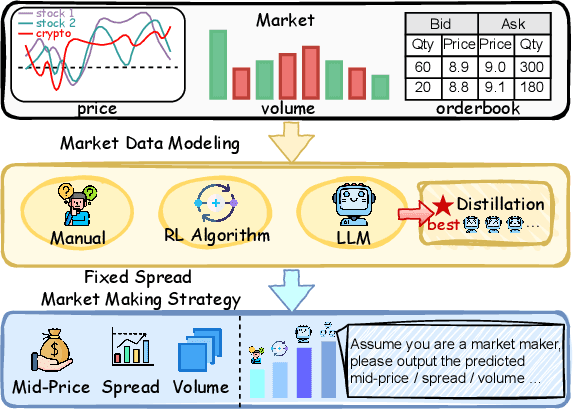

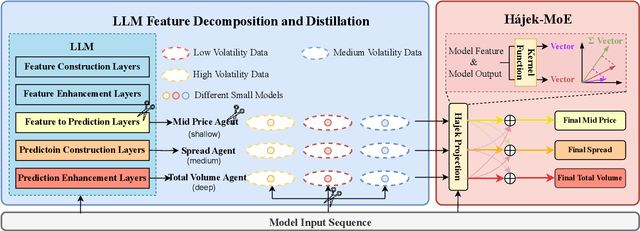
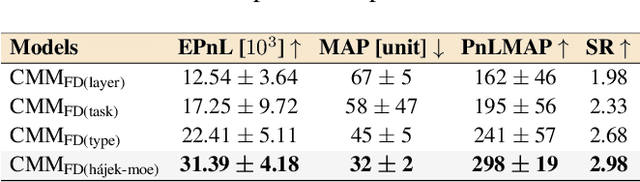
Market making (MM) through Reinforcement Learning (RL) has attracted significant attention in financial trading. With the development of Large Language Models (LLMs), more and more attempts are being made to apply LLMs to financial areas. A simple, direct application of LLM as an agent shows significant performance. Such methods are hindered by their slow inference speed, while most of the current research has not studied LLM distillation for this specific task. To address this, we first propose the normalized fluorescent probe to study the mechanism of the LLM's feature. Based on the observation found by our investigation, we propose Cooperative Market Making (CMM), a novel framework that decouples LLM features across three orthogonal dimensions: layer, task, and data. Various student models collaboratively learn simple LLM features along with different dimensions, with each model responsible for a distinct feature to achieve knowledge distillation. Furthermore, CMM introduces an Hájek-MoE to integrate the output of the student models by investigating the contribution of different models in a kernel function-generated common feature space. Extensive experimental results on four real-world market datasets demonstrate the superiority of CMM over the current distillation method and RL-based market-making strategies.