 Add to Chrome
 Add to Firefox
 Add to Edge
TenExp: Mixture-of-Experts-Based Tensor Decomposition Structure Search Framework
Mar 03, 2026
Recently, tensor decompositions continue to emerge and receive increasing attention. Selecting a suitable tensor decomposition to exactly capture the low-rank structures behind the data is at the heart of the tensor decomposition field, which remains a challenging and relatively under-explored problem. Current tensor decomposition structure search methods are still confined by a fixed factor-interaction family (e.g., tensor contraction) and cannot deliver the mixture of decompositions. To address this problem, we elaborately design a mixture-of-experts-based tensor decomposition structure search framework (termed as TenExp), which allows us to dynamically select and activate suitable tensor decompositions in an unsupervised fashion. This framework enjoys two unique advantages over the state-of-the-art tensor decomposition structure search methods. Firstly, TenExp can provide a suitable single decomposition beyond a fixed factor-interaction family. Secondly, TenExp can deliver a suitable mixture of decompositions beyond a single decomposition. Theoretically, we also provide the approximation error bound of TenExp, which reveals the approximation capability of TenExp. Extensive experiments on both synthetic and realistic datasets demonstrate the superiority of the proposed TenExp compared to the state-of-the-art tensor decomposition-based methods.

DTR: A Unified Deep Tensor Representation Framework for Multimedia Data Recovery
Jul 07, 2024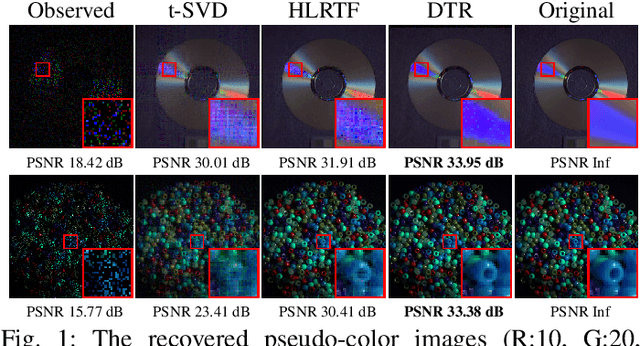
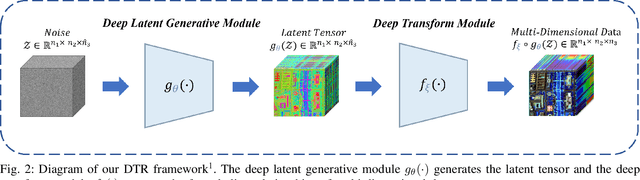
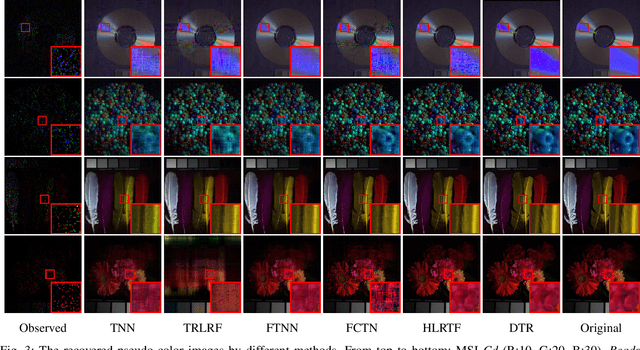
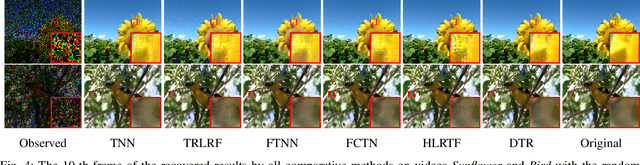
Recently, the transform-based tensor representation has attracted increasing attention in multimedia data (e.g., images and videos) recovery problems, which consists of two indispensable components, i.e., transform and characterization. Previously, the development of transform-based tensor representation mainly focuses on the transform aspect. Although several attempts consider using shallow matrix factorization (e.g., singular value decomposition and negative matrix factorization) to characterize the frontal slices of transformed tensor (termed as latent tensor), the faithful characterization aspect is underexplored. To address this issue, we propose a unified Deep Tensor Representation (termed as DTR) framework by synergistically combining the deep latent generative module and the deep transform module. Especially, the deep latent generative module can faithfully generate the latent tensor as compared with shallow matrix factorization. The new DTR framework not only allows us to better understand the classic shallow representations, but also leads us to explore new representation. To examine the representation ability of the proposed DTR, we consider the representative multi-dimensional data recovery task and suggest an unsupervised DTR-based multi-dimensional data recovery model. Extensive experiments demonstrate that DTR achieves superior performance compared to state-of-the-art methods in both quantitative and qualitative aspects, especially for fine details recovery.