 Add to Chrome
 Add to Firefox
 Add to Edge
PGVMS: A Prompt-Guided Unified Framework for Virtual Multiplex IHC Staining with Pathological Semantic Learning
Feb 26, 2026
Immunohistochemical (IHC) staining enables precise molecular profiling of protein expression, with over 200 clinically available antibody-based tests in modern pathology. However, comprehensive IHC analysis is frequently limited by insufficient tissue quantities in small biopsies. Therefore, virtual multiplex staining emerges as an innovative solution to digitally transform H&E images into multiple IHC representations, yet current methods still face three critical challenges: (1) inadequate semantic guidance for multi-staining, (2) inconsistent distribution of immunochemistry staining, and (3) spatial misalignment across different stain modalities. To overcome these limitations, we present a prompt-guided framework for virtual multiplex IHC staining using only uniplex training data (PGVMS). Our framework introduces three key innovations corresponding to each challenge: First, an adaptive prompt guidance mechanism employing a pathological visual language model dynamically adjusts staining prompts to resolve semantic guidance limitations (Challenge 1). Second, our protein-aware learning strategy (PALS) maintains precise protein expression patterns by direct quantification and constraint of protein distributions (Challenge 2). Third, the prototype-consistent learning strategy (PCLS) establishes cross-image semantic interaction to correct spatial misalignments (Challenge 3).
* Accepted by TMI

Joint Modelling Histology and Molecular Markers for Cancer Classification
Feb 11, 2025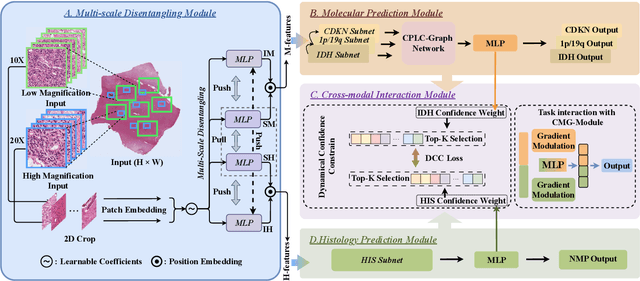
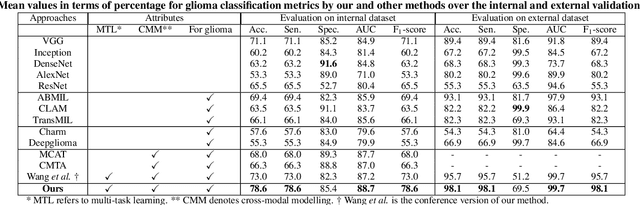
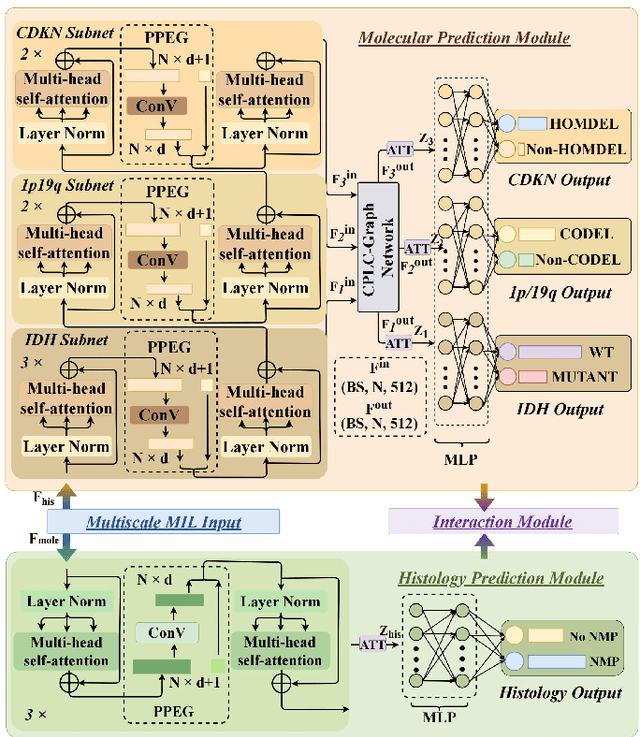
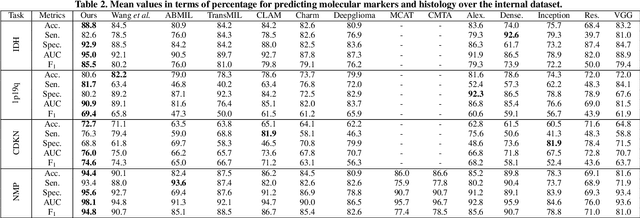
Cancers are characterized by remarkable heterogeneity and diverse prognosis. Accurate cancer classification is essential for patient stratification and clinical decision-making. Although digital pathology has been advancing cancer diagnosis and prognosis, the paradigm in cancer pathology has shifted from purely relying on histology features to incorporating molecular markers. There is an urgent need for digital pathology methods to meet the needs of the new paradigm. We introduce a novel digital pathology approach to jointly predict molecular markers and histology features and model their interactions for cancer classification. Firstly, to mitigate the challenge of cross-magnification information propagation, we propose a multi-scale disentangling module, enabling the extraction of multi-scale features from high-magnification (cellular-level) to low-magnification (tissue-level) whole slide images. Further, based on the multi-scale features, we propose an attention-based hierarchical multi-task multi-instance learning framework to simultaneously predict histology and molecular markers. Moreover, we propose a co-occurrence probability-based label correlation graph network to model the co-occurrence of molecular markers. Lastly, we design a cross-modal interaction module with the dynamic confidence constrain loss and a cross-modal gradient modulation strategy, to model the interactions of histology and molecular markers. Our experiments demonstrate that our method outperforms other state-of-the-art methods in classifying glioma, histology features and molecular markers. Our method promises to promote precise oncology with the potential to advance biomedical research and clinical applications. The code is available at https://github.com/LHY1007/M3C2