 Add to Chrome
 Add to Firefox
 Add to Edge
PGVMS: A Prompt-Guided Unified Framework for Virtual Multiplex IHC Staining with Pathological Semantic Learning
Feb 26, 2026
Immunohistochemical (IHC) staining enables precise molecular profiling of protein expression, with over 200 clinically available antibody-based tests in modern pathology. However, comprehensive IHC analysis is frequently limited by insufficient tissue quantities in small biopsies. Therefore, virtual multiplex staining emerges as an innovative solution to digitally transform H&E images into multiple IHC representations, yet current methods still face three critical challenges: (1) inadequate semantic guidance for multi-staining, (2) inconsistent distribution of immunochemistry staining, and (3) spatial misalignment across different stain modalities. To overcome these limitations, we present a prompt-guided framework for virtual multiplex IHC staining using only uniplex training data (PGVMS). Our framework introduces three key innovations corresponding to each challenge: First, an adaptive prompt guidance mechanism employing a pathological visual language model dynamically adjusts staining prompts to resolve semantic guidance limitations (Challenge 1). Second, our protein-aware learning strategy (PALS) maintains precise protein expression patterns by direct quantification and constraint of protein distributions (Challenge 2). Third, the prototype-consistent learning strategy (PCLS) establishes cross-image semantic interaction to correct spatial misalignments (Challenge 3).
* Accepted by TMI

Pathological Semantics-Preserving Learning for H&E-to-IHC Virtual Staining
Jul 04, 2024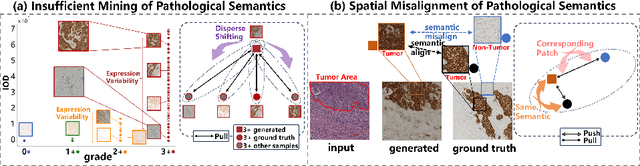

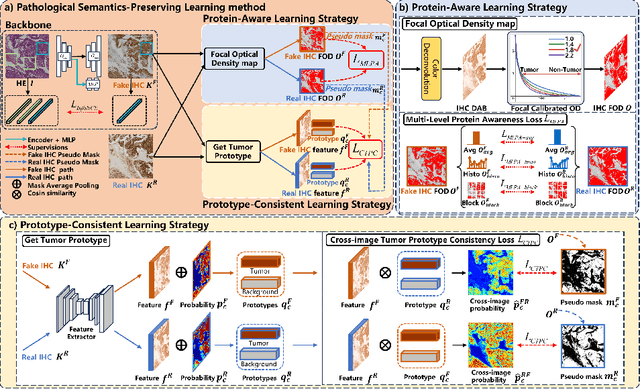
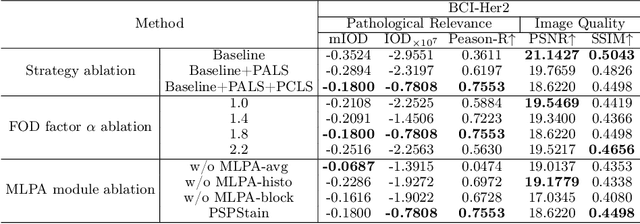
Conventional hematoxylin-eosin (H&E) staining is limited to revealing cell morphology and distribution, whereas immunohistochemical (IHC) staining provides precise and specific visualization of protein activation at the molecular level. Virtual staining technology has emerged as a solution for highly efficient IHC examination, which directly transforms H&E-stained images to IHC-stained images. However, virtual staining is challenged by the insufficient mining of pathological semantics and the spatial misalignment of pathological semantics. To address these issues, we propose the Pathological Semantics-Preserving Learning method for Virtual Staining (PSPStain), which directly incorporates the molecular-level semantic information and enhances semantics interaction despite any spatial inconsistency. Specifically, PSPStain comprises two novel learning strategies: 1) Protein-Aware Learning Strategy (PALS) with Focal Optical Density (FOD) map maintains the coherence of protein expression level, which represents molecular-level semantic information; 2) Prototype-Consistent Learning Strategy (PCLS), which enhances cross-image semantic interaction by prototypical consistency learning. We evaluate PSPStain on two public datasets using five metrics: three clinically relevant metrics and two for image quality. Extensive experiments indicate that PSPStain outperforms current state-of-the-art H&E-to-IHC virtual staining methods and demonstrates a high pathological correlation between the staging of real and virtual stains.