 Add to Chrome
 Add to Firefox
 Add to Edge
MAny: Merge Anything for Multimodal Continual Instruction Tuning
Apr 15, 2026
Multimodal Continual Instruction Tuning (MCIT) is essential for sequential task adaptation of Multimodal Large Language Models (MLLMs) but is severely restricted by catastrophic forgetting. While existing literature focuses on the reasoning language backbone, in this work, we expose a critical yet neglected dual-forgetting phenomenon across both perception drift in Cross-modal Projection Space and reasoning collapse in Low-rank Parameter Space. To resolve this, we present \textbf{MAny} (\textbf{M}erge \textbf{Any}thing), a framework that merges task-specific knowledge through \textbf{C}ross-modal \textbf{P}rojection \textbf{M}erging (\textbf{CPM}) and \textbf{L}ow-rank \textbf{P}arameter \textbf{M}erging (\textbf{LPM}). Specifically, CPM recovers perceptual alignment by adaptively merging cross-modal visual representations via visual-prototype guidance, ensuring accurate feature recovery during inference. Simultaneously, LPM eliminates mutual interference among task-specific low-rank modules by recursively merging low-rank weight matrices. By leveraging recursive least squares, LPM provides a closed-form solution that mathematically guarantees an optimal fusion trajectory for reasoning stability. Notably, MAny operates as a training-free paradigm that achieves knowledge merging via efficient CPU-based algebraic operations, eliminating additional gradient-based optimization beyond initial tuning. Our extensive evaluations confirm the superior performance and robustness of MAny across multiple MLLMs and benchmarks. Specifically, on the UCIT benchmark, MAny achieves significant leads of up to 8.57\% and 2.85\% in final average accuracy over state-of-the-art methods across two different MLLMs, respectively.

NTIRE 2024 Challenge on Image Super-Resolution ($\times$4): Methods and Results
Apr 15, 2024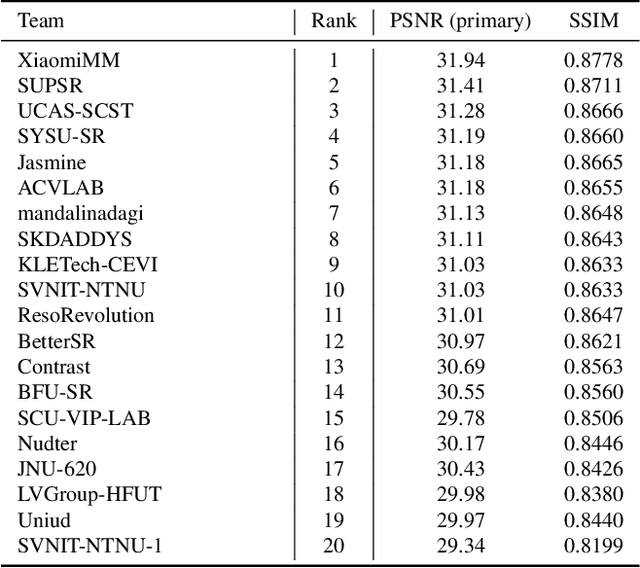


This paper reviews the NTIRE 2024 challenge on image super-resolution ($\times$4), highlighting the solutions proposed and the outcomes obtained. The challenge involves generating corresponding high-resolution (HR) images, magnified by a factor of four, from low-resolution (LR) inputs using prior information. The LR images originate from bicubic downsampling degradation. The aim of the challenge is to obtain designs/solutions with the most advanced SR performance, with no constraints on computational resources (e.g., model size and FLOPs) or training data. The track of this challenge assesses performance with the PSNR metric on the DIV2K testing dataset. The competition attracted 199 registrants, with 20 teams submitting valid entries. This collective endeavour not only pushes the boundaries of performance in single-image SR but also offers a comprehensive overview of current trends in this field.