 Add to Chrome
 Add to Firefox
 Add to Edge
CLIP-Inspector: Model-Level Backdoor Detection for Prompt-Tuned CLIP via OOD Trigger Inversion
Apr 10, 2026
Organisations with limited data and computational resources increasingly outsource model training to Machine Learning as a Service (MLaaS) providers, who adapt vision-language models (VLMs) such as CLIP to downstream tasks via prompt tuning rather than training from scratch. This semi-honest setting creates a security risk where a malicious provider can follow the prompt-tuning protocol yet implant a backdoor, forcing triggered inputs to be classified into an attacker-chosen class, even for out-of-distribution (OOD) data. Such backdoors leave encoders untouched, making them undetectable to existing methods that focus on encoder corruption. Other data-level methods that sanitize data before training or during inference, also fail to answer the critical question, "Is the delivered model backdoored or not?" To address this model-level verification problem, we introduce CLIP-Inspector (CI), a backdoor detection method designed for prompt-tuned CLIP models. Assuming white-box access to the delivered model and a pool of unlabeled OOD images, CI reconstructs possible triggers for each class to determine if the model exhibits backdoor behaviour or not. Additionally, we demonstrate that using CI's reconstructed trigger for fine-tuning on correctly labeled triggered inputs enables us to re-align the model and reduce backdoor effectiveness. Through extensive experiments across ten datasets and four backdoor attacks, we demonstrate that CI can reconstruct effective triggers in a single epoch using only 1,000 OOD images, achieving a 94% detection accuracy (47/50 models). Compared to adapted trigger-inversion baselines, CI yields a markedly higher AUROC score (0.973 vs 0.495/0.687), thus enabling the vetting and post-hoc repair of prompt-tuned CLIP models to ensure safe deployment.

Army of Thieves: Enhancing Black-Box Model Extraction via Ensemble based sample selection
Nov 08, 2023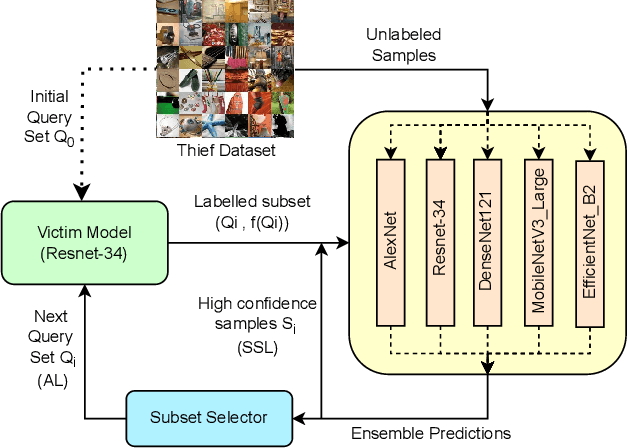
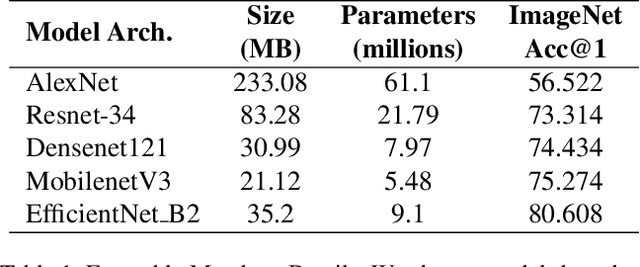

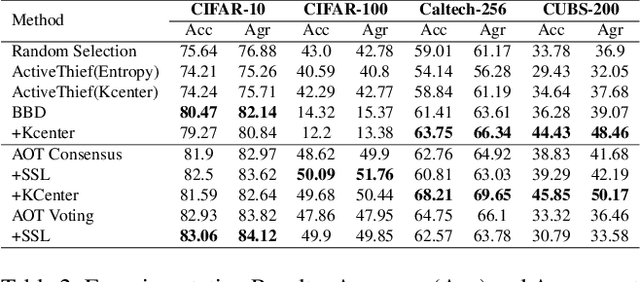
Machine Learning (ML) models become vulnerable to Model Stealing Attacks (MSA) when they are deployed as a service. In such attacks, the deployed model is queried repeatedly to build a labelled dataset. This dataset allows the attacker to train a thief model that mimics the original model. To maximize query efficiency, the attacker has to select the most informative subset of data points from the pool of available data. Existing attack strategies utilize approaches like Active Learning and Semi-Supervised learning to minimize costs. However, in the black-box setting, these approaches may select sub-optimal samples as they train only one thief model. Depending on the thief model's capacity and the data it was pretrained on, the model might even select noisy samples that harm the learning process. In this work, we explore the usage of an ensemble of deep learning models as our thief model. We call our attack Army of Thieves(AOT) as we train multiple models with varying complexities to leverage the crowd's wisdom. Based on the ensemble's collective decision, uncertain samples are selected for querying, while the most confident samples are directly included in the training data. Our approach is the first one to utilize an ensemble of thief models to perform model extraction. We outperform the base approaches of existing state-of-the-art methods by at least 3% and achieve a 21% higher adversarial sample transferability than previous work for models trained on the CIFAR-10 dataset.