 Add to Chrome
 Add to Firefox
 Add to Edge
ConvFill: Model Collaboration for Responsive Conversational Voice Agents
Nov 10, 2025
Deploying conversational voice agents with large language models faces a critical challenge: cloud-based foundation models provide deep reasoning and domain knowledge but introduce latency that disrupts natural conversation, while on-device models respond immediately but lack sophistication. We propose conversational infill, a task where a lightweight on-device model generates contextually appropriate dialogue while seamlessly incorporating streaming knowledge from a powerful backend model. This approach decouples response latency from model capability, enabling systems that feel responsive while accessing the full power of large-scale models. We present ConvFill, a 360M parameter model trained on synthetic multi-domain conversations. Evaluation across multiple backend models shows that conversational infill can be successfully learned, with ConvFill achieving accuracy improvements of 36-42% over standalone small models of the same size while consistently retaining sub-200ms response latencies. Our results demonstrate the promise of this approach for building on-device conversational agents that are both immediately responsive and knowledgeable.

SnappyMeal: Design and Longitudinal Evaluation of a Multimodal AI Food Logging Application
Nov 05, 2025Food logging, both self-directed and prescribed, plays a critical role in uncovering correlations between diet, medical, fitness, and health outcomes. Through conversations with nutritional experts and individuals who practice dietary tracking, we find current logging methods, such as handwritten and app-based journaling, are inflexible and result in low adherence and potentially inaccurate nutritional summaries. These findings, corroborated by prior literature, emphasize the urgent need for improved food logging methods. In response, we propose SnappyMeal, an AI-powered dietary tracking system that leverages multimodal inputs to enable users to more flexibly log their food intake. SnappyMeal introduces goal-dependent follow-up questions to intelligently seek missing context from the user and information retrieval from user grocery receipts and nutritional databases to improve accuracy. We evaluate SnappyMeal through publicly available nutrition benchmarks and a multi-user, 3-week, in-the-wild deployment capturing over 500 logged food instances. Users strongly praised the multiple available input methods and reported a strong perceived accuracy. These insights suggest that multimodal AI systems can be leveraged to significantly improve dietary tracking flexibility and context-awareness, laying the groundwork for a new class of intelligent self-tracking applications.
Substance over Style: Evaluating Proactive Conversational Coaching Agents
Mar 25, 2025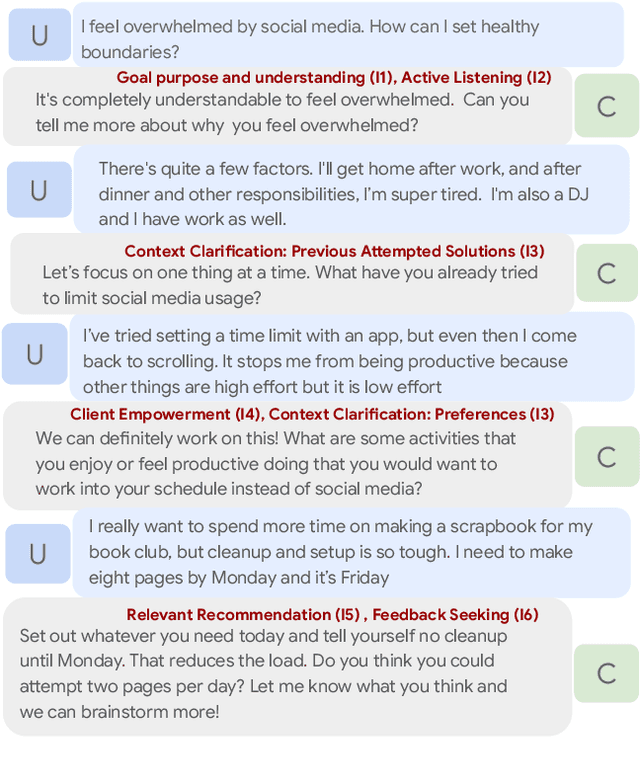
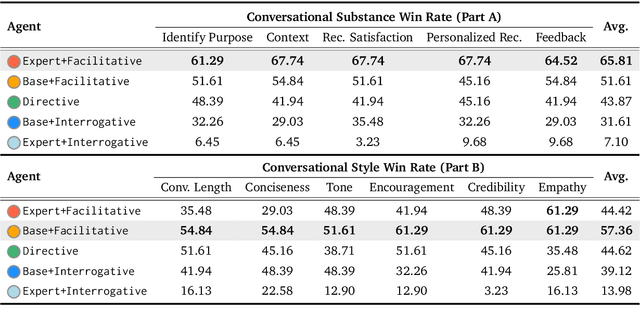
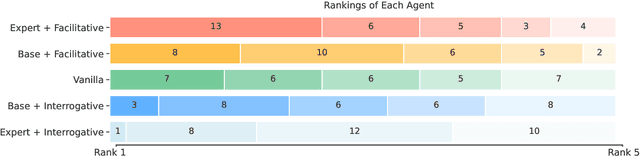
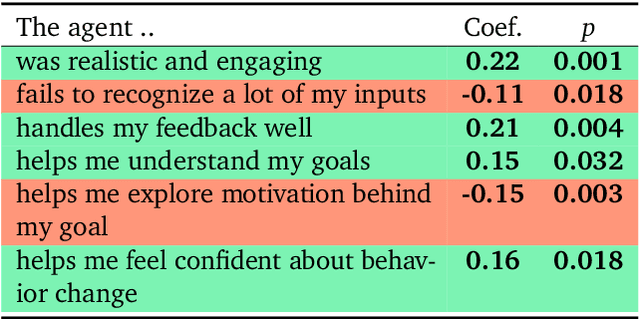
While NLP research has made strides in conversational tasks, many approaches focus on single-turn responses with well-defined objectives or evaluation criteria. In contrast, coaching presents unique challenges with initially undefined goals that evolve through multi-turn interactions, subjective evaluation criteria, mixed-initiative dialogue. In this work, we describe and implement five multi-turn coaching agents that exhibit distinct conversational styles, and evaluate them through a user study, collecting first-person feedback on 155 conversations. We find that users highly value core functionality, and that stylistic components in absence of core components are viewed negatively. By comparing user feedback with third-person evaluations from health experts and an LM, we reveal significant misalignment across evaluation approaches. Our findings provide insights into design and evaluation of conversational coaching agents and contribute toward improving human-centered NLP applications.