 Add to Chrome
 Add to Firefox
 Add to Edge
Encouraging Inferable Behavior for Autonomy: Repeated Bimatrix Stackelberg Games with Observations
Sep 30, 2023
When interacting with other non-competitive decision-making agents, it is critical for an autonomous agent to have inferable behavior: Their actions must convey their intention and strategy. For example, an autonomous car's strategy must be inferable by the pedestrians interacting with the car. We model the inferability problem using a repeated bimatrix Stackelberg game with observations where a leader and a follower repeatedly interact. During the interactions, the leader uses a fixed, potentially mixed strategy. The follower, on the other hand, does not know the leader's strategy and dynamically reacts based on observations that are the leader's previous actions. In the setting with observations, the leader may suffer from an inferability loss, i.e., the performance compared to the setting where the follower has perfect information of the leader's strategy. We show that the inferability loss is upper-bounded by a function of the number of interactions and the stochasticity level of the leader's strategy, encouraging the use of inferable strategies with lower stochasticity levels. As a converse result, we also provide a game where the required number of interactions is lower bounded by a function of the desired inferability loss.

Specification-Driven Video Search via Foundation Models and Formal Verification
Sep 18, 2023The increasing abundance of video data enables users to search for events of interest, e.g., emergency incidents. Meanwhile, it raises new concerns, such as the need for preserving privacy. Existing approaches to video search require either manual inspection or a deep learning model with massive training. We develop a method that uses recent advances in vision and language models, as well as formal methods, to search for events of interest in video clips automatically and efficiently. The method consists of an algorithm to map text-based event descriptions into linear temporal logic over finite traces (LTL$_f$) and an algorithm to construct an automaton encoding the video information. Then, the method formally verifies the automaton representing the video against the LTL$_f$ specifications and adds the pertinent video clips to the search result if the automaton satisfies the specifications. We provide qualitative and quantitative analysis to demonstrate the video-searching capability of the proposed method. It achieves over 90 percent precision in searching over privacy-sensitive videos and a state-of-the-art autonomous driving dataset.
Verifiable Reinforcement Learning Systems via Compositionality
Sep 09, 2023We propose a framework for verifiable and compositional reinforcement learning (RL) in which a collection of RL subsystems, each of which learns to accomplish a separate subtask, are composed to achieve an overall task. The framework consists of a high-level model, represented as a parametric Markov decision process, which is used to plan and analyze compositions of subsystems, and of the collection of low-level subsystems themselves. The subsystems are implemented as deep RL agents operating under partial observability. By defining interfaces between the subsystems, the framework enables automatic decompositions of task specifications, e.g., reach a target set of states with a probability of at least 0.95, into individual subtask specifications, i.e. achieve the subsystem's exit conditions with at least some minimum probability, given that its entry conditions are met. This in turn allows for the independent training and testing of the subsystems. We present theoretical results guaranteeing that if each subsystem learns a policy satisfying its subtask specification, then their composition is guaranteed to satisfy the overall task specification. Conversely, if the subtask specifications cannot all be satisfied by the learned policies, we present a method, formulated as the problem of finding an optimal set of parameters in the high-level model, to automatically update the subtask specifications to account for the observed shortcomings. The result is an iterative procedure for defining subtask specifications, and for training the subsystems to meet them. Experimental results demonstrate the presented framework's novel capabilities in environments with both full and partial observability, discrete and continuous state and action spaces, as well as deterministic and stochastic dynamics.
Active Inverse Learning in Stackelberg Trajectory Games
Aug 15, 2023Game-theoretic inverse learning is the problem of inferring the players' objectives from their actions. We formulate an inverse learning problem in a Stackelberg game between a leader and a follower, where each player's action is the trajectory of a dynamical system. We propose an active inverse learning method for the leader to infer which hypothesis among a finite set of candidates describes the follower's objective function. Instead of using passively observed trajectories like existing methods, the proposed method actively maximizes the differences in the follower's trajectories under different hypotheses to accelerate the leader's inference. We demonstrate the proposed method in a receding-horizon repeated trajectory game. Compared with uniformly random inputs, the leader inputs provided by the proposed method accelerate the convergence of the probability of different hypotheses conditioned on the follower's trajectory by orders of magnitude.
Multimodal Pretrained Models for Sequential Decision-Making: Synthesis, Verification, Grounding, and Perception
Aug 10, 2023Recently developed pretrained models can encode rich world knowledge expressed in multiple modalities, such as text and images. However, the outputs of these models cannot be integrated into algorithms to solve sequential decision-making tasks. We develop an algorithm that utilizes the knowledge from pretrained models to construct and verify controllers for sequential decision-making tasks, and to ground these controllers to task environments through visual observations. In particular, the algorithm queries a pretrained model with a user-provided, text-based task description and uses the model's output to construct an automaton-based controller that encodes the model's task-relevant knowledge. It then verifies whether the knowledge encoded in the controller is consistent with other independently available knowledge, which may include abstract information on the environment or user-provided specifications. If this verification step discovers any inconsistency, the algorithm automatically refines the controller to resolve the inconsistency. Next, the algorithm leverages the vision and language capabilities of pretrained models to ground the controller to the task environment. It collects image-based observations from the task environment and uses the pretrained model to link these observations to the text-based control logic encoded in the controller (e.g., actions and conditions that trigger the actions). We propose a mechanism to ensure the controller satisfies the user-provided specification even when perceptual uncertainties are present. We demonstrate the algorithm's ability to construct, verify, and ground automaton-based controllers through a suite of real-world tasks, including daily life and robot manipulation tasks.
Reinforcement Learning with Temporal-Logic-Based Causal Diagrams
Jun 23, 2023We study a class of reinforcement learning (RL) tasks where the objective of the agent is to accomplish temporally extended goals. In this setting, a common approach is to represent the tasks as deterministic finite automata (DFA) and integrate them into the state-space for RL algorithms. However, while these machines model the reward function, they often overlook the causal knowledge about the environment. To address this limitation, we propose the Temporal-Logic-based Causal Diagram (TL-CD) in RL, which captures the temporal causal relationships between different properties of the environment. We exploit the TL-CD to devise an RL algorithm in which an agent requires significantly less exploration of the environment. To this end, based on a TL-CD and a task DFA, we identify configurations where the agent can determine the expected rewards early during an exploration. Through a series of case studies, we demonstrate the benefits of using TL-CDs, particularly the faster convergence of the algorithm to an optimal policy due to reduced exploration of the environment.
How to Learn and Generalize From Three Minutes of Data: Physics-Constrained and Uncertainty-Aware Neural Stochastic Differential Equations
Jun 10, 2023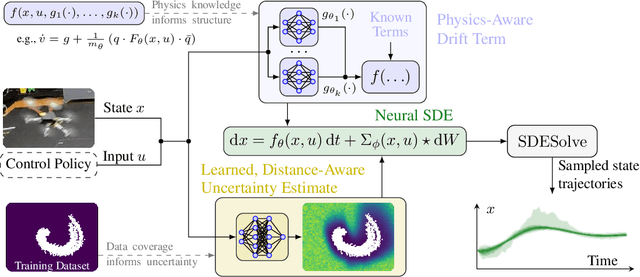
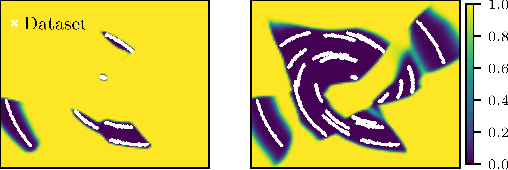
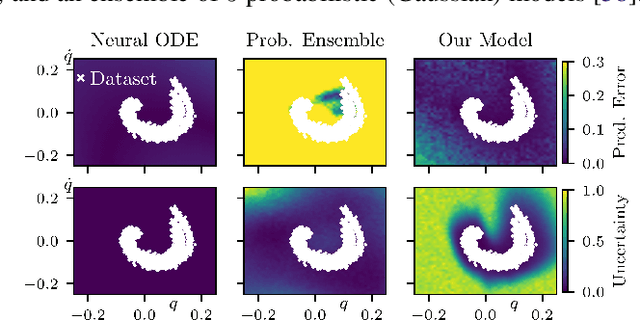
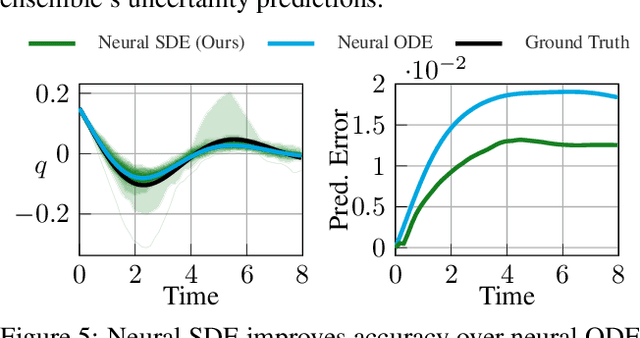
We present a framework and algorithms to learn controlled dynamics models using neural stochastic differential equations (SDEs) -- SDEs whose drift and diffusion terms are both parametrized by neural networks. We construct the drift term to leverage a priori physics knowledge as inductive bias, and we design the diffusion term to represent a distance-aware estimate of the uncertainty in the learned model's predictions -- it matches the system's underlying stochasticity when evaluated on states near those from the training dataset, and it predicts highly stochastic dynamics when evaluated on states beyond the training regime. The proposed neural SDEs can be evaluated quickly enough for use in model predictive control algorithms, or they can be used as simulators for model-based reinforcement learning. Furthermore, they make accurate predictions over long time horizons, even when trained on small datasets that cover limited regions of the state space. We demonstrate these capabilities through experiments on simulated robotic systems, as well as by using them to model and control a hexacopter's flight dynamics: A neural SDE trained using only three minutes of manually collected flight data results in a model-based control policy that accurately tracks aggressive trajectories that push the hexacopter's velocity and Euler angles to nearly double the maximum values observed in the training dataset.
Autonomous Drifting with 3 Minutes of Data via Learned Tire Models
Jun 10, 2023Near the limits of adhesion, the forces generated by a tire are nonlinear and intricately coupled. Efficient and accurate modelling in this region could improve safety, especially in emergency situations where high forces are required. To this end, we propose a novel family of tire force models based on neural ordinary differential equations and a neural-ExpTanh parameterization. These models are designed to satisfy physically insightful assumptions while also having sufficient fidelity to capture higher-order effects directly from vehicle state measurements. They are used as drop-in replacements for an analytical brush tire model in an existing nonlinear model predictive control framework. Experiments with a customized Toyota Supra show that scarce amounts of driving data -- less than three minutes -- is sufficient to achieve high-performance autonomous drifting on various trajectories with speeds up to 45mph. Comparisons with the benchmark model show a $4 \times$ improvement in tracking performance, smoother control inputs, and faster and more consistent computation time.
Reinforcement Learning With Reward Machines in Stochastic Games
May 27, 2023We investigate multi-agent reinforcement learning for stochastic games with complex tasks, where the reward functions are non-Markovian. We utilize reward machines to incorporate high-level knowledge of complex tasks. We develop an algorithm called Q-learning with reward machines for stochastic games (QRM-SG), to learn the best-response strategy at Nash equilibrium for each agent. In QRM-SG, we define the Q-function at a Nash equilibrium in augmented state space. The augmented state space integrates the state of the stochastic game and the state of reward machines. Each agent learns the Q-functions of all agents in the system. We prove that Q-functions learned in QRM-SG converge to the Q-functions at a Nash equilibrium if the stage game at each time step during learning has a global optimum point or a saddle point, and the agents update Q-functions based on the best-response strategy at this point. We use the Lemke-Howson method to derive the best-response strategy given current Q-functions. The three case studies show that QRM-SG can learn the best-response strategies effectively. QRM-SG learns the best-response strategies after around 7500 episodes in Case Study I, 1000 episodes in Case Study II, and 1500 episodes in Case Study III, while baseline methods such as Nash Q-learning and MADDPG fail to converge to the Nash equilibrium in all three case studies.
Reward-Machine-Guided, Self-Paced Reinforcement Learning
May 25, 2023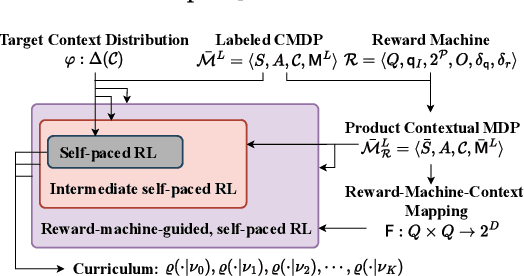
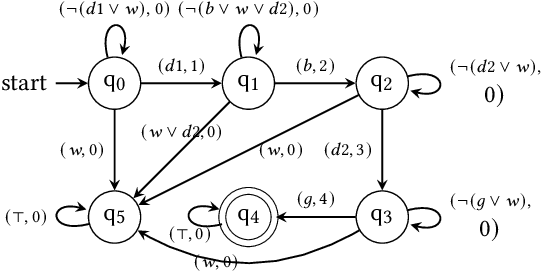
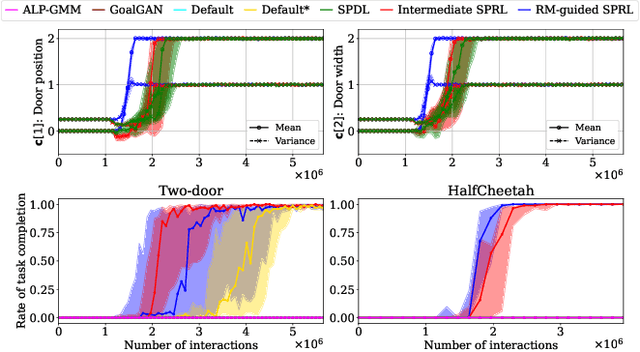
Self-paced reinforcement learning (RL) aims to improve the data efficiency of learning by automatically creating sequences, namely curricula, of probability distributions over contexts. However, existing techniques for self-paced RL fail in long-horizon planning tasks that involve temporally extended behaviors. We hypothesize that taking advantage of prior knowledge about the underlying task structure can improve the effectiveness of self-paced RL. We develop a self-paced RL algorithm guided by reward machines, i.e., a type of finite-state machine that encodes the underlying task structure. The algorithm integrates reward machines in 1) the update of the policy and value functions obtained by any RL algorithm of choice, and 2) the update of the automated curriculum that generates context distributions. Our empirical results evidence that the proposed algorithm achieves optimal behavior reliably even in cases in which existing baselines cannot make any meaningful progress. It also decreases the curriculum length and reduces the variance in the curriculum generation process by up to one-fourth and four orders of magnitude, respectively.