 Add to Chrome
 Add to Firefox
 Add to Edge
SecCodeBench-V2 Technical Report
Feb 17, 2026
We introduce SecCodeBench-V2, a publicly released benchmark for evaluating Large Language Model (LLM) copilots' capabilities of generating secure code. SecCodeBench-V2 comprises 98 generation and fix scenarios derived from Alibaba Group's industrial productions, where the underlying security issues span 22 common CWE (Common Weakness Enumeration) categories across five programming languages: Java, C, Python, Go, and Node.js. SecCodeBench-V2 adopts a function-level task formulation: each scenario provides a complete project scaffold and requires the model to implement or patch a designated target function under fixed interfaces and dependencies. For each scenario, SecCodeBench-V2 provides executable proof-of-concept (PoC) test cases for both functional validation and security verification. All test cases are authored and double-reviewed by security experts, ensuring high fidelity, broad coverage, and reliable ground truth. Beyond the benchmark itself, we build a unified evaluation pipeline that assesses models primarily via dynamic execution. For most scenarios, we compile and run model-generated artifacts in isolated environments and execute PoC test cases to validate both functional correctness and security properties. For scenarios where security issues cannot be adjudicated with deterministic test cases, we additionally employ an LLM-as-a-judge oracle. To summarize performance across heterogeneous scenarios and difficulty levels, we design a Pass@K-based scoring protocol with principled aggregation over scenarios and severity, enabling holistic and comparable evaluation across models. Overall, SecCodeBench-V2 provides a rigorous and reproducible foundation for assessing the security posture of AI coding assistants, with results and artifacts released at https://alibaba.github.io/sec-code-bench. The benchmark is publicly available at https://github.com/alibaba/sec-code-bench.

AIArena: A Blockchain-Based Decentralized AI Training Platform
Dec 19, 2024The rapid advancement of AI has underscored critical challenges in its development and implementation, largely due to centralized control by a few major corporations. This concentration of power intensifies biases within AI models, resulting from inadequate governance and oversight mechanisms. Additionally, it limits public involvement and heightens concerns about the integrity of model generation. Such monopolistic control over data and AI outputs threatens both innovation and fair data usage, as users inadvertently contribute data that primarily benefits these corporations. In this work, we propose AIArena, a blockchain-based decentralized AI training platform designed to democratize AI development and alignment through on-chain incentive mechanisms. AIArena fosters an open and collaborative environment where participants can contribute models and computing resources. Its on-chain consensus mechanism ensures fair rewards for participants based on their contributions. We instantiate and implement AIArena on the public Base blockchain Sepolia testnet, and the evaluation results demonstrate the feasibility of AIArena in real-world applications.
Data Interpreter: An LLM Agent For Data Science
Mar 12, 2024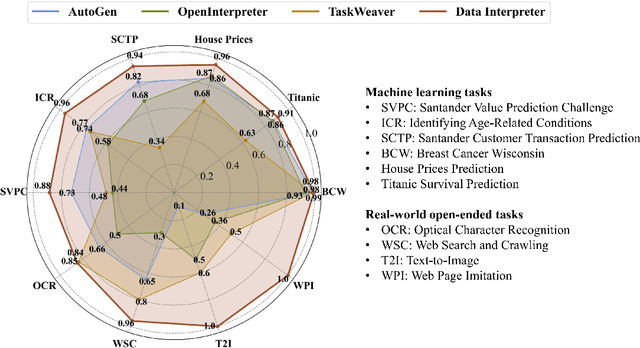


Large Language Model (LLM)-based agents have demonstrated remarkable effectiveness. However, their performance can be compromised in data science scenarios that require real-time data adjustment, expertise in optimization due to complex dependencies among various tasks, and the ability to identify logical errors for precise reasoning. In this study, we introduce the Data Interpreter, a solution designed to solve with code that emphasizes three pivotal techniques to augment problem-solving in data science: 1) dynamic planning with hierarchical graph structures for real-time data adaptability;2) tool integration dynamically to enhance code proficiency during execution, enriching the requisite expertise;3) logical inconsistency identification in feedback, and efficiency enhancement through experience recording. We evaluate the Data Interpreter on various data science and real-world tasks. Compared to open-source baselines, it demonstrated superior performance, exhibiting significant improvements in machine learning tasks, increasing from 0.86 to 0.95. Additionally, it showed a 26% increase in the MATH dataset and a remarkable 112% improvement in open-ended tasks. The solution will be released at https://github.com/geekan/MetaGPT.