 Add to Chrome
 Add to Firefox
 Add to Edge
EPEdit: Redefining Image Editing with Generative AI and User-Centric Design
Jun 23, 2026
The demand for image manipulation has seen a significant increase recently. Traditional tools like Photoshop and Capture One, while powerful, require considerable expertise to use effectively. Generative AI has introduced alternative platforms, such as Luminar Neo, Pixlr X, and Canva. However, many of these solutions, including resource-heavy models like Stable Diffusion, often require substantial retraining and fine-tuning, leading to high costs for users. To address these challenges, we introduce Efficient Photo Editor (EPEdit), an application that integrates a robust backend framework with a user-friendly front-end interface. EPEdit supports a wide range of creative image editing tasks, including image generation, object replacement, object removal, background modification, changes in object pose or perspective, region-specific editing, and thematic collection design, all guided by masks and prompts. Users can interact with the system through simple text commands or by marking areas for precise adjustments, making it accessible even to those without technical expertise. At its core, EPEdit leverages zero-shot image editing algorithms based on Stable Diffusion model, removing the need for additional fine-tuning. This approach enables efficient image manipulation and thematic collection creation. User evaluations for tasks of image editing, thematic design, and overall system performance demonstrate that EPEdit outperforms existing solutions, offering a user-friendly, cost-effective solution for comprehensive image editing.

EDGER: EDge-Guided with HEatmap Refinement for Generalizable Image Forgery Localization
May 12, 2026Text-guided inpainting has made image forgery increasingly realistic, challenging both SID and IFL. However, existing methods often struggle to point out suspicious signals across domains. To address this problem, we propose EDGER, a patch-based, dual-branch framework that localizes manipulated regions in arbitrary resolution images without sacrificing native resolution. The first branch, Edge-Guided Segmentation, introduces a Frequency-based Edge Detector to emphasize high-frequency inconsistencies at manipulation boundaries, and fine-tunes a SegFormer to fuse RGB and edge features for pixel-level masks. Since edge evidence is most informative only when patches contain both authentic and manipulated pixels, we complement Edge-Guided Segmentation with a Synthetic Heatmapping branch, a classification-based localizer that fine-tunes a CLIP-ViT image encoder with LoRA to flag fully synthetic patches. Together, Synthetic Heatmapping provides coarse, patch-level synthetic priors, while Edge-Guided Segmentation sharpens boundaries within partially manipulated patches, yielding comprehensive localization. Evaluated in the MediaEval 2025, SynthIM challenge, Manipulated Region Localization Task's setting, our approach scales to multi-megapixel imagery and exhibits strong cross-domain generalization. Extensive ablations highlight the complementary roles of frequency-based edge cues and patch-level synthetic priors in driving accurate, resolution-agnostic localization.
Robust Deepfake Detection: Mitigating Spatial Attention Drift via Calibrated Complementary Ensembles
Apr 28, 2026Current deepfake detection models achieve state-of-the-art performance on pristine academic datasets but suffer severe spatial attention drift under real-world compound degradations, such as blurring and severe lossy compression. To address this vulnerability, we propose a foundation-driven forensic framework that integrates an extreme compound degradation engine with a structurally constrained, multi-stream architecture. During training, our degradation pipeline systematically destroys high-frequency artifacts, optimizing the DINOv2-Giant backbone to extract invariant geometric and semantic priors. We then process images through three specialized pathways: a Global Texture stream, a Localized Facial stream, and a Hybrid Semantic Fusion stream incorporating CLIP. Through analyzing spatial attribution via Score-CAM and feature stability using Cosine Similarity, we quantitatively demonstrate that these streams extract non-redundant, complementary feature representations and stabilize attention entropy. By aggregating these predictions via a calibrated, discretized voting mechanism, our ensemble successfully suppresses background attention drift while acting as a robust geometric anchor. Our approach yields highly stable zero-shot generalization, achieving Fourth Place in the NTIRE 2026 Robust Deepfake Detection Challenge at CVPR. Code is available at https://github.com/khoalephanminh/ntire26-deepfake-challenge.
Robust Deepfake Detection, NTIRE 2026 Challenge: Report
Apr 27, 2026Robustness is a long-overlooked problem in deepfake detection. However, detection performance is nearly worthless in the real world if it suffers under exposure to even slight image degradation. In addition to weaker degradations that can accidentally occur in the image processing pipeline, there is another risk of malicious deepfakes that specifically introduce degradations, purposefully exploiting the detector's weaknesses in that regard. Here, we present an overview of the NTIRE 2026 Robust Deepfake Detection Challenge, which specifically addresses that problem. Participants were tasked with building a detector that would later be tested on an unknown test-set, which included both common and uncommon degradations of various strengths. With a total number of 337 participants and 57 submissions to the final leaderboard, the first edition of the challenge was well received. To ensure the reliability of the results, participants were given only 24h to complete the test run with no labels provided, limiting the possibility of training on the test data. Furthermore, the top solutions were scored on a private test-set to detect any such overfitting. This report presents the competition setting, dataset preparation, as well as details and performance of methods. Top methods rely on large foundation models, ensembles, and degradation training to combine generality and robustness.
Event-Enriched Image Analysis Grand Challenge at ACM Multimedia 2025
Aug 26, 2025The Event-Enriched Image Analysis (EVENTA) Grand Challenge, hosted at ACM Multimedia 2025, introduces the first large-scale benchmark for event-level multimodal understanding. Traditional captioning and retrieval tasks largely focus on surface-level recognition of people, objects, and scenes, often overlooking the contextual and semantic dimensions that define real-world events. EVENTA addresses this gap by integrating contextual, temporal, and semantic information to capture the who, when, where, what, and why behind an image. Built upon the OpenEvents V1 dataset, the challenge features two tracks: Event-Enriched Image Retrieval and Captioning, and Event-Based Image Retrieval. A total of 45 teams from six countries participated, with evaluation conducted through Public and Private Test phases to ensure fairness and reproducibility. The top three teams were invited to present their solutions at ACM Multimedia 2025. EVENTA establishes a foundation for context-aware, narrative-driven multimedia AI, with applications in journalism, media analysis, cultural archiving, and accessibility. Further details about the challenge are available at the official homepage: https://ltnghia.github.io/eventa/eventa-2025.
SketchANIMAR: Sketch-based 3D Animal Fine-Grained Retrieval
Apr 12, 2023The retrieval of 3D objects has gained significant importance in recent years due to its broad range of applications in computer vision, computer graphics, virtual reality, and augmented reality. However, the retrieval of 3D objects presents significant challenges due to the intricate nature of 3D models, which can vary in shape, size, and texture, and have numerous polygons and vertices. To this end, we introduce a novel SHREC challenge track that focuses on retrieving relevant 3D animal models from a dataset using sketch queries and expedites accessing 3D models through available sketches. Furthermore, a new dataset named ANIMAR was constructed in this study, comprising a collection of 711 unique 3D animal models and 140 corresponding sketch queries. Our contest requires participants to retrieve 3D models based on complex and detailed sketches. We receive satisfactory results from eight teams and 204 runs. Although further improvement is necessary, the proposed task has the potential to incentivize additional research in the domain of 3D object retrieval, potentially yielding benefits for a wide range of applications. We also provide insights into potential areas of future research, such as improving techniques for feature extraction and matching, and creating more diverse datasets to evaluate retrieval performance.
TextANIMAR: Text-based 3D Animal Fine-Grained Retrieval
Apr 12, 2023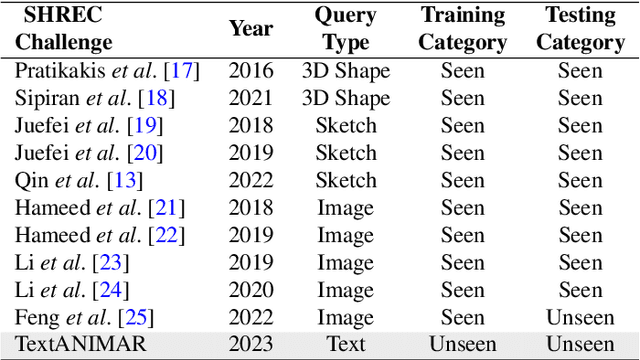
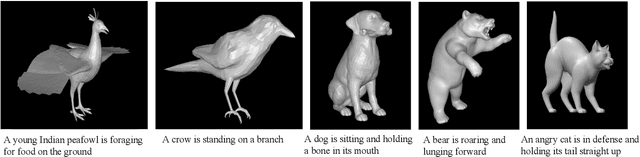
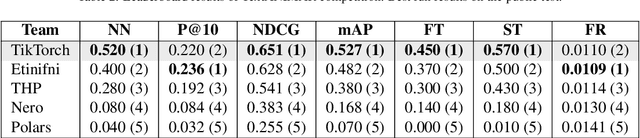
3D object retrieval is an important yet challenging task, which has drawn more and more attention in recent years. While existing approaches have made strides in addressing this issue, they are often limited to restricted settings such as image and sketch queries, which are often unfriendly interactions for common users. In order to overcome these limitations, this paper presents a novel SHREC challenge track focusing on text-based fine-grained retrieval of 3D animal models. Unlike previous SHREC challenge tracks, the proposed task is considerably more challenging, requiring participants to develop innovative approaches to tackle the problem of text-based retrieval. Despite the increased difficulty, we believe that this task has the potential to drive useful applications in practice and facilitate more intuitive interactions with 3D objects. Five groups participated in our competition, submitting a total of 114 runs. While the results obtained in our competition are satisfactory, we note that the challenges presented by this task are far from being fully solved. As such, we provide insights into potential areas for future research and improvements. We believe that we can help push the boundaries of 3D object retrieval and facilitate more user-friendly interactions via vision-language technologies.