 Add to Chrome
 Add to Firefox
 Add to Edge
Forged Calamity: Benchmark for Cross-Domain Synthetic Disaster Detection in the Age of Diffusion
Jun 17, 2026
The rapid advancement of text-to-image diffusion models has enabled the creation of highly photorealistic synthetic images that closely resemble real photographs, making it increasingly difficult to distinguish authentic content from AI-generated fabrications. This poses challenges for cybersecurity, digital forensics, and disaster response, where fake imagery of floods, fires, or earthquakes can spread misinformation or disrupt emergency operations. To address this, we introduce Forged Calamity, a benchmark dataset for synthetic disaster detection containing 30,000 images, including 6,000 real and 24,000 synthetic samples generated by four diffusion models. Comprehensive experiments across fine-tuned and zero-shot settings reveal consistent weaknesses in current forensic approaches. Fine-tuned detectors perform well in-distribution but lose up to 50\% accuracy on unseen generators or disaster types, showing overfitting to model-specific artifacts. Zero-shot generalized detectors also struggle to maintain stable accuracy, with only limited resilience in a few representation-robust models. These findings highlight persistent generalization gaps and the urgent need for domain- and model-agnostic detection methods to ensure visual authenticity in the diffusion era.

Event-Enriched Image Analysis Grand Challenge at ACM Multimedia 2025
Aug 26, 2025The Event-Enriched Image Analysis (EVENTA) Grand Challenge, hosted at ACM Multimedia 2025, introduces the first large-scale benchmark for event-level multimodal understanding. Traditional captioning and retrieval tasks largely focus on surface-level recognition of people, objects, and scenes, often overlooking the contextual and semantic dimensions that define real-world events. EVENTA addresses this gap by integrating contextual, temporal, and semantic information to capture the who, when, where, what, and why behind an image. Built upon the OpenEvents V1 dataset, the challenge features two tracks: Event-Enriched Image Retrieval and Captioning, and Event-Based Image Retrieval. A total of 45 teams from six countries participated, with evaluation conducted through Public and Private Test phases to ensure fairness and reproducibility. The top three teams were invited to present their solutions at ACM Multimedia 2025. EVENTA establishes a foundation for context-aware, narrative-driven multimedia AI, with applications in journalism, media analysis, cultural archiving, and accessibility. Further details about the challenge are available at the official homepage: https://ltnghia.github.io/eventa/eventa-2025.
SketchANIMAR: Sketch-based 3D Animal Fine-Grained Retrieval
Apr 12, 2023The retrieval of 3D objects has gained significant importance in recent years due to its broad range of applications in computer vision, computer graphics, virtual reality, and augmented reality. However, the retrieval of 3D objects presents significant challenges due to the intricate nature of 3D models, which can vary in shape, size, and texture, and have numerous polygons and vertices. To this end, we introduce a novel SHREC challenge track that focuses on retrieving relevant 3D animal models from a dataset using sketch queries and expedites accessing 3D models through available sketches. Furthermore, a new dataset named ANIMAR was constructed in this study, comprising a collection of 711 unique 3D animal models and 140 corresponding sketch queries. Our contest requires participants to retrieve 3D models based on complex and detailed sketches. We receive satisfactory results from eight teams and 204 runs. Although further improvement is necessary, the proposed task has the potential to incentivize additional research in the domain of 3D object retrieval, potentially yielding benefits for a wide range of applications. We also provide insights into potential areas of future research, such as improving techniques for feature extraction and matching, and creating more diverse datasets to evaluate retrieval performance.
TextANIMAR: Text-based 3D Animal Fine-Grained Retrieval
Apr 12, 2023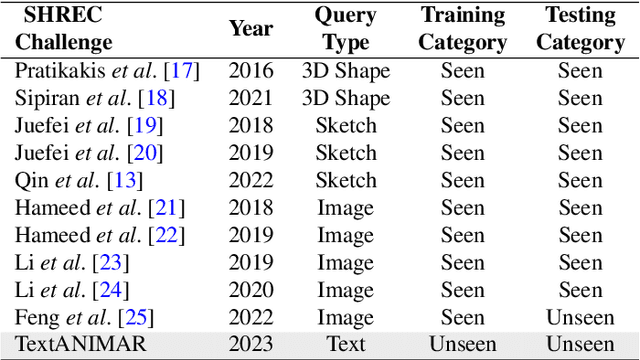
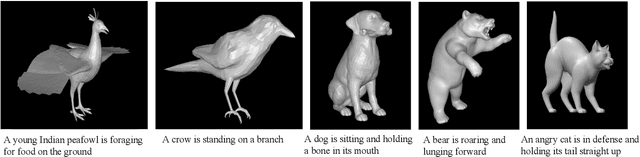
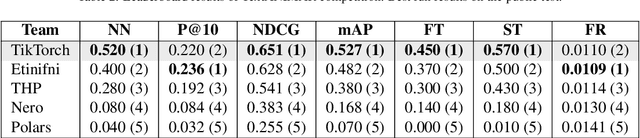
3D object retrieval is an important yet challenging task, which has drawn more and more attention in recent years. While existing approaches have made strides in addressing this issue, they are often limited to restricted settings such as image and sketch queries, which are often unfriendly interactions for common users. In order to overcome these limitations, this paper presents a novel SHREC challenge track focusing on text-based fine-grained retrieval of 3D animal models. Unlike previous SHREC challenge tracks, the proposed task is considerably more challenging, requiring participants to develop innovative approaches to tackle the problem of text-based retrieval. Despite the increased difficulty, we believe that this task has the potential to drive useful applications in practice and facilitate more intuitive interactions with 3D objects. Five groups participated in our competition, submitting a total of 114 runs. While the results obtained in our competition are satisfactory, we note that the challenges presented by this task are far from being fully solved. As such, we provide insights into potential areas for future research and improvements. We believe that we can help push the boundaries of 3D object retrieval and facilitate more user-friendly interactions via vision-language technologies.