 Add to Chrome
 Add to Firefox
 Add to Edge
UniDFKD: A Unified Semantic Prior Framework for Architecture-Agnostic Data-Free Knowledge Distillation
Aug 10, 2026
Data-Free Knowledge Distillation (DFKD) transfers knowledge from a pretrained teacher model to a compact student model by synthesizing semantically informative data, eliminating the need for access to the original training dataset. Existing DFKD methods rely heavily on architecture-specific statistical priors (e.g., Batch Normalization statistics) to guide data synthesis, however, such architecture-dependent priors are often absent in modern architectures such as Vision Transformers (ViTs), resulting in degraded semantic quality of the synthesized data and consequently catastrophic performance degradation. In this paper, we propose \emph{UniDFKD}, a unified data-free knowledge distillation framework that replaces architecture-specific statistics with explicit, architecture-agnostic semantic priors. \emph{UniDFKD} governs the entire synthesis-distillation pipeline along three dimensions: (1) Categorical Semantic Conditioning (CSC) defines \emph{what} to synthesize by persistently modulating the generator with language-derived embeddings to capture semantic diversity; (2) Spatial Semantic Anchoring (SSA) dictates \emph{where} evidence belongs by anchoring the teacher's spatial attributions to a Gaussian prior; and (3) Spatial Semantic Distillation (SSD) controls \emph{how} knowledge is transferred by explicitly aligning teacher-student spatial evidence alongside predictions. Extensive experiments across CNNs and ViTs demonstrate that UniDFKD establishes a new state-of-the-art, outperforming existing methods by an average absolute margin of over 20\% in both homogeneous and heterogeneous settings.

The Next Screenshot Knows: Gated Hindsight Distillation for Mobile GUI Agents
Aug 06, 2026GUI agents are commonly trained offline from successful interaction trajectories. Standard training decomposes each trajectory into prefix-action pairs: the agent predicts an action from the current screen and interaction history, while the subsequent observation is discarded. This removes the rationale of why an action is correct: the evidence often appears only on the subsequent screen. For example, to enable Soft Wrap, the agent should click Edit or View, but nothing reveals this until the menu opens. Without such evidence, standard imitation gives the model little chance of ever sampling and thus learning the correct reasoning. To address this issue, we propose Gated Hindsight Distillation (GHD), which uses the next screenshot as privileged information during training. A student predicts from the observable trajectory prefix, while a parameter-sharing teacher additionally observes the next screenshot and re-scores the student's on-policy responses. We apply distillation only when the student fails and the hindsight-conditioned teacher recovers the demonstrated action. GHD improves task success over GRPO on AndroidWorld and AndroidLab across two vision-language models. The code and checkpoints will be made available.
Minimizing Maximum Model Discrepancy for Transferable Black-box Targeted Attacks
Dec 18, 2022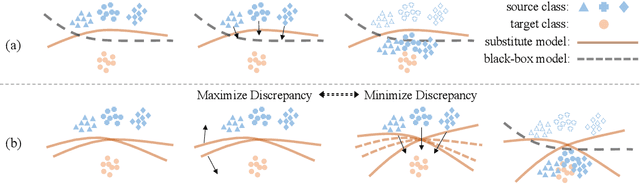
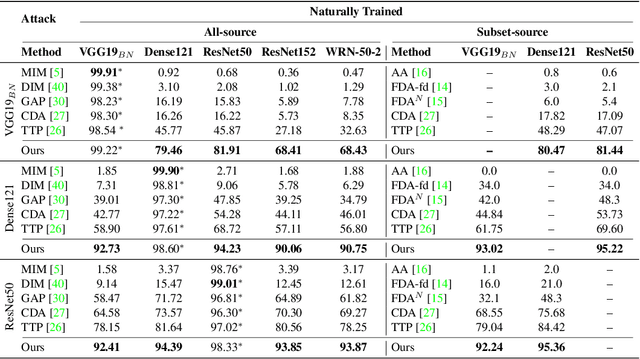
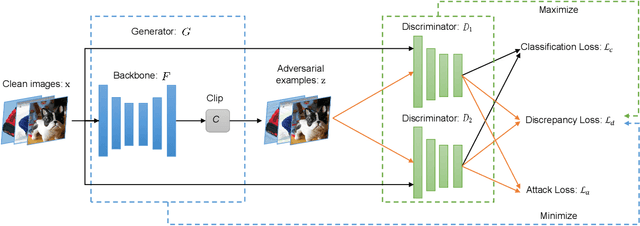
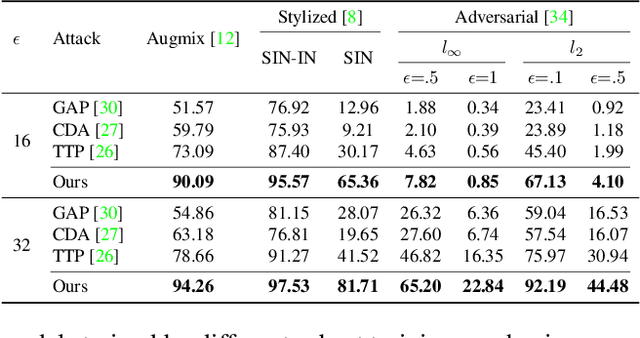
In this work, we study the black-box targeted attack problem from the model discrepancy perspective. On the theoretical side, we present a generalization error bound for black-box targeted attacks, which gives a rigorous theoretical analysis for guaranteeing the success of the attack. We reveal that the attack error on a target model mainly depends on empirical attack error on the substitute model and the maximum model discrepancy among substitute models. On the algorithmic side, we derive a new algorithm for black-box targeted attacks based on our theoretical analysis, in which we additionally minimize the maximum model discrepancy(M3D) of the substitute models when training the generator to generate adversarial examples. In this way, our model is capable of crafting highly transferable adversarial examples that are robust to the model variation, thus improving the success rate for attacking the black-box model. We conduct extensive experiments on the ImageNet dataset with different classification models, and our proposed approach outperforms existing state-of-the-art methods by a significant margin. Our codes will be released.
Undoing the Damage of Label Shift for Cross-domain Semantic Segmentation
Apr 12, 2022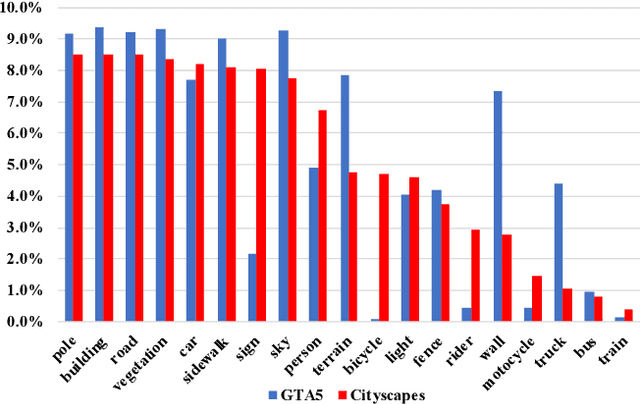
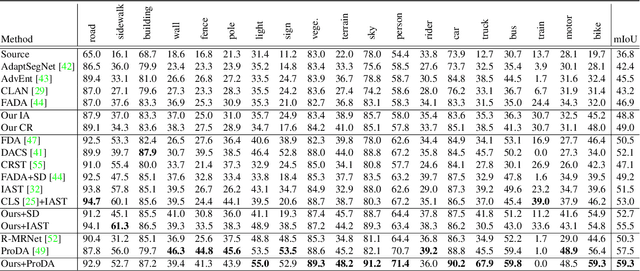
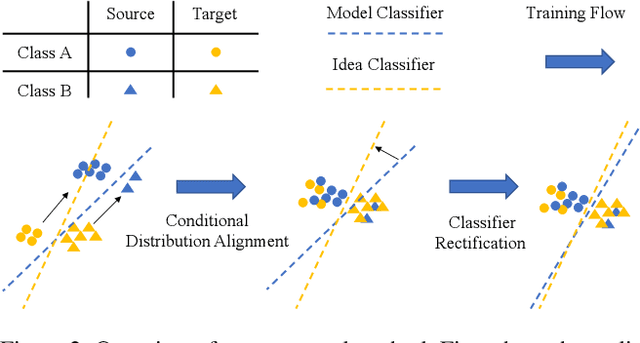
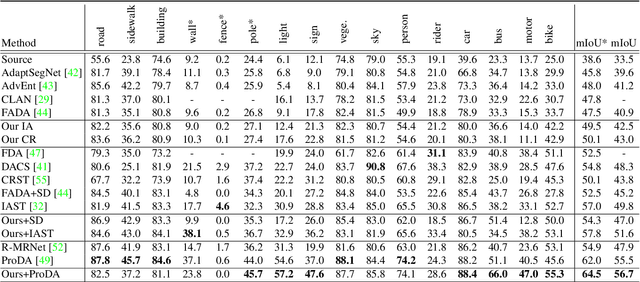
Existing works typically treat cross-domain semantic segmentation (CDSS) as a data distribution mismatch problem and focus on aligning the marginal distribution or conditional distribution. However, the label shift issue is unfortunately overlooked, which actually commonly exists in the CDSS task, and often causes a classifier bias in the learnt model. In this paper, we give an in-depth analysis and show that the damage of label shift can be overcome by aligning the data conditional distribution and correcting the posterior probability. To this end, we propose a novel approach to undo the damage of the label shift problem in CDSS. In implementation, we adopt class-level feature alignment for conditional distribution alignment, as well as two simple yet effective methods to rectify the classifier bias from source to target by remolding the classifier predictions. We conduct extensive experiments on the benchmark datasets of urban scenes, including GTA5 to Cityscapes and SYNTHIA to Cityscapes, where our proposed approach outperforms previous methods by a large margin. For instance, our model equipped with a self-training strategy reaches 59.3% mIoU on GTA5 to Cityscapes, pushing to a new state-of-the-art. The code will be available at https://github.com/manmanjun/Undoing UDA.