 Add to Chrome
 Add to Firefox
 Add to Edge
The Next Screenshot Knows: Gated Hindsight Distillation for Mobile GUI Agents
Aug 06, 2026
GUI agents are commonly trained offline from successful interaction trajectories. Standard training decomposes each trajectory into prefix-action pairs: the agent predicts an action from the current screen and interaction history, while the subsequent observation is discarded. This removes the rationale of why an action is correct: the evidence often appears only on the subsequent screen. For example, to enable Soft Wrap, the agent should click Edit or View, but nothing reveals this until the menu opens. Without such evidence, standard imitation gives the model little chance of ever sampling and thus learning the correct reasoning. To address this issue, we propose Gated Hindsight Distillation (GHD), which uses the next screenshot as privileged information during training. A student predicts from the observable trajectory prefix, while a parameter-sharing teacher additionally observes the next screenshot and re-scores the student's on-policy responses. We apply distillation only when the student fails and the hindsight-conditioned teacher recovers the demonstrated action. GHD improves task success over GRPO on AndroidWorld and AndroidLab across two vision-language models. The code and checkpoints will be made available.

Instance-Free Domain Adaptive Object Detection
Feb 06, 2026While Domain Adaptive Object Detection (DAOD) has made significant strides, most methods rely on unlabeled target data that is assumed to contain sufficient foreground instances. However, in many practical scenarios (e.g., wildlife monitoring, lesion detection), collecting target domain data with objects of interest is prohibitively costly, whereas background-only data is abundant. This common practical constraint introduces a significant technical challenge: the difficulty of achieving domain alignment when target instances are unavailable, forcing adaptation to rely solely on the target background information. We formulate this challenge as the novel problem of Instance-Free Domain Adaptive Object Detection. To tackle this, we propose the Relational and Structural Consistency Network (RSCN) which pioneers an alignment strategy based on background feature prototypes while simultaneously encouraging consistency in the relationship between the source foreground features and the background features within each domain, enabling robust adaptation even without target instances. To facilitate research, we further curate three specialized benchmarks, including simulative auto-driving detection, wildlife detection, and lung nodule detection. Extensive experiments show that RSCN significantly outperforms existing DAOD methods across all three benchmarks in the instance-free scenario. The code and benchmarks will be released soon.
Towards Unsupervised Model Selection for Domain Adaptive Object Detection
Dec 23, 2024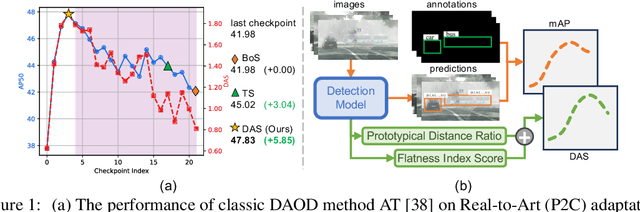

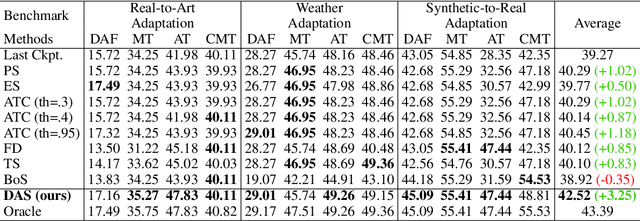
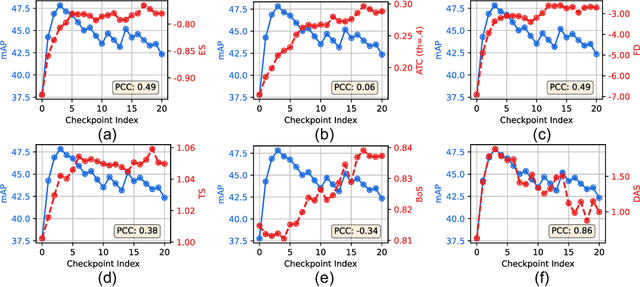
Evaluating the performance of deep models in new scenarios has drawn increasing attention in recent years. However, while it is possible to collect data from new scenarios, the annotations are not always available. Existing DAOD methods often rely on validation or test sets on the target domain for model selection, which is impractical in real-world applications. In this paper, we propose a novel unsupervised model selection approach for domain adaptive object detection, which is able to select almost the optimal model for the target domain without using any target labels. Our approach is based on the flat minima principle, i,e., models located in the flat minima region in the parameter space usually exhibit excellent generalization ability. However, traditional methods require labeled data to evaluate how well a model is located in the flat minima region, which is unrealistic for the DAOD task. Therefore, we design a Detection Adaptation Score (DAS) approach to approximately measure the flat minima without using target labels. We show via a generalization bound that the flatness can be deemed as model variance, while the minima depend on the domain distribution distance for the DAOD task. Accordingly, we propose a Flatness Index Score (FIS) to assess the flatness by measuring the classification and localization fluctuation before and after perturbations of model parameters and a Prototypical Distance Ratio (PDR) score to seek the minima by measuring the transferability and discriminability of the models. In this way, the proposed DAS approach can effectively evaluate the model generalization ability on the target domain. We have conducted extensive experiments on various DAOD benchmarks and approaches, and the experimental results show that the proposed DAS correlates well with the performance of DAOD models and can be used as an effective tool for model selection after training.