 Add to Chrome
 Add to Firefox
 Add to Edge
GenAI for Social Work Field Education: Client Simulation with Real-Time Feedback
Jan 26, 2026
Field education is the signature pedagogy of social work, yet providing timely and objective feedback during training is constrained by the availability of instructors and counseling clients. In this paper, we present SWITCH, the Social Work Interactive Training Chatbot. SWITCH integrates realistic client simulation, real-time counseling skill classification, and a Motivational Interviewing (MI) progression system into the training workflow. To model a client, SWITCH uses a cognitively grounded profile comprising static fields (e.g., background, beliefs) and dynamic fields (e.g., emotions, automatic thoughts, openness), allowing the agent's behavior to evolve throughout a session realistically. The skill classification module identifies the counseling skills from the user utterances, and feeds the result to the MI controller that regulates the MI stage transitions. To enhance classification accuracy, we study in-context learning with retrieval over annotated transcripts, and a fine-tuned BERT multi-label classifier. In the experiments, we demonstrated that both BERT-based approach and in-context learning outperforms the baseline with big margin. SWITCH thereby offers a scalable, low-cost, and consistent training workflow that complements field education, and allows supervisors to focus on higher-level mentorship.

Evaluation of Large Language Models in Legal Applications: Challenges, Methods, and Future Directions
Jan 21, 2026Large language models (LLMs) are being increasingly integrated into legal applications, including judicial decision support, legal practice assistance, and public-facing legal services. While LLMs show strong potential in handling legal knowledge and tasks, their deployment in real-world legal settings raises critical concerns beyond surface-level accuracy, involving the soundness of legal reasoning processes and trustworthy issues such as fairness and reliability. Systematic evaluation of LLM performance in legal tasks has therefore become essential for their responsible adoption. This survey identifies key challenges in evaluating LLMs for legal tasks grounded in real-world legal practice. We analyze the major difficulties involved in assessing LLM performance in the legal domain, including outcome correctness, reasoning reliability, and trustworthiness. Building on these challenges, we review and categorize existing evaluation methods and benchmarks according to their task design, datasets, and evaluation metrics. We further discuss the extent to which current approaches address these challenges, highlight their limitations, and outline future research directions toward more realistic, reliable, and legally grounded evaluation frameworks for LLMs in legal domains.
QBR: A Question-Bank-Based Approach to Fine-Grained Legal Knowledge Retrieval for the General Public
May 08, 2025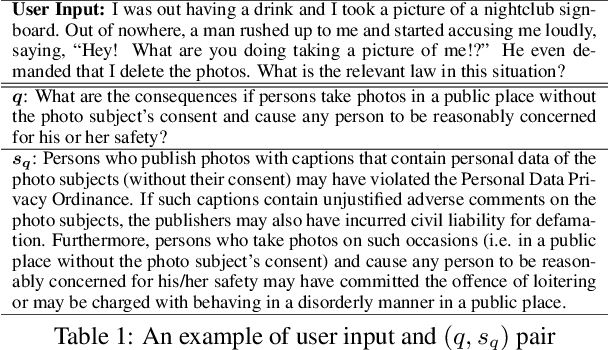

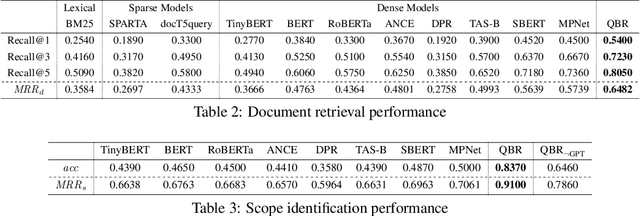
Retrieval of legal knowledge by the general public is a challenging problem due to the technicality of the professional knowledge and the lack of fundamental understanding by laypersons on the subject. Traditional information retrieval techniques assume that users are capable of formulating succinct and precise queries for effective document retrieval. In practice, however, the wide gap between the highly technical contents and untrained users makes legal knowledge retrieval very difficult. We propose a methodology, called QBR, which employs a Questions Bank (QB) as an effective medium for bridging the knowledge gap. We show how the QB is used to derive training samples to enhance the embedding of knowledge units within documents, which leads to effective fine-grained knowledge retrieval. We discuss and evaluate through experiments various advantages of QBR over traditional methods. These include more accurate, efficient, and explainable document retrieval, better comprehension of retrieval results, and highly effective fine-grained knowledge retrieval. We also present some case studies and show that QBR achieves social impact by assisting citizens to resolve everyday legal concerns.
Bringing legal knowledge to the public by constructing a legal question bank using large-scale pre-trained language model
May 07, 2025Access to legal information is fundamental to access to justice. Yet accessibility refers not only to making legal documents available to the public, but also rendering legal information comprehensible to them. A vexing problem in bringing legal information to the public is how to turn formal legal documents such as legislation and judgments, which are often highly technical, to easily navigable and comprehensible knowledge to those without legal education. In this study, we formulate a three-step approach for bringing legal knowledge to laypersons, tackling the issues of navigability and comprehensibility. First, we translate selected sections of the law into snippets (called CLIC-pages), each being a small piece of article that focuses on explaining certain technical legal concept in layperson's terms. Second, we construct a Legal Question Bank (LQB), which is a collection of legal questions whose answers can be found in the CLIC-pages. Third, we design an interactive CLIC Recommender (CRec). Given a user's verbal description of a legal situation that requires a legal solution, CRec interprets the user's input and shortlists questions from the question bank that are most likely relevant to the given legal situation and recommends their corresponding CLIC pages where relevant legal knowledge can be found. In this paper we focus on the technical aspects of creating an LQB. We show how large-scale pre-trained language models, such as GPT-3, can be used to generate legal questions. We compare machine-generated questions (MGQs) against human-composed questions (HCQs) and find that MGQs are more scalable, cost-effective, and more diversified, while HCQs are more precise. We also show a prototype of CRec and illustrate through an example how our 3-step approach effectively brings relevant legal knowledge to the public.