 Add to Chrome
 Add to Firefox
 Add to Edge
AcademiClaw: When Students Set Challenges for AI Agents
May 04, 2026
Benchmarks within the OpenClaw ecosystem have thus far evaluated exclusively assistant-level tasks, leaving the academic-level capabilities of OpenClaw largely unexamined. We introduce AcademiClaw, a bilingual benchmark of 80 complex, long-horizon tasks sourced directly from university students' real academic workflows -- homework, research projects, competitions, and personal projects -- that they found current AI agents unable to solve effectively. Curated from 230 student-submitted candidates through rigorous expert review, the final task set spans 25+ professional domains, ranging from olympiad-level mathematics and linguistics problems to GPU-intensive reinforcement learning and full-stack system debugging, with 16 tasks requiring CUDA GPU execution. Each task executes in an isolated Docker sandbox and is scored on task completion by multi-dimensional rubrics combining six complementary techniques, with an independent five-category safety audit providing additional behavioral analysis. Experiments on six frontier models show that even the best achieves only a 55\% pass rate. Further analysis uncovers sharp capability boundaries across task domains, divergent behavioral strategies among models, and a disconnect between token consumption and output quality, providing fine-grained diagnostic signals beyond what aggregate metrics reveal. We hope that AcademiClaw and its open-sourced data and code can serve as a useful resource for the OpenClaw community, driving progress toward agents that are more capable and versatile across the full breadth of real-world academic demands. All data and code are available at https://github.com/GAIR-NLP/AcademiClaw.

Online Location Planning for AI-Defined Vehicles: Optimizing Joint Tasks of Order Serving and Spatio-Temporal Heterogeneous Model Fine-Tuning
Feb 06, 2025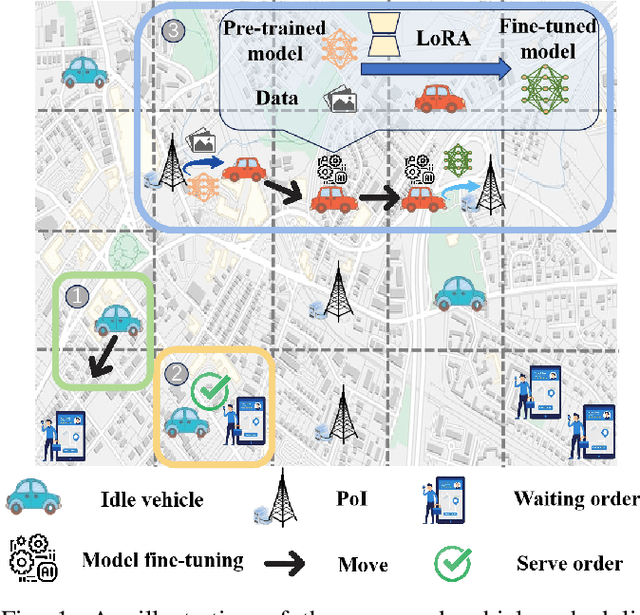
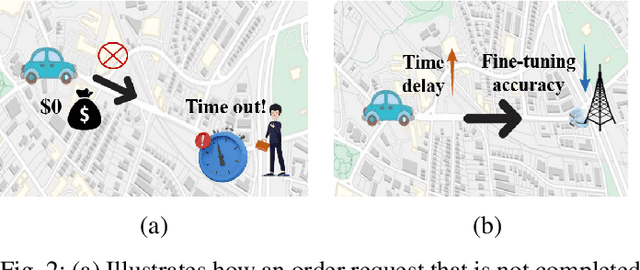
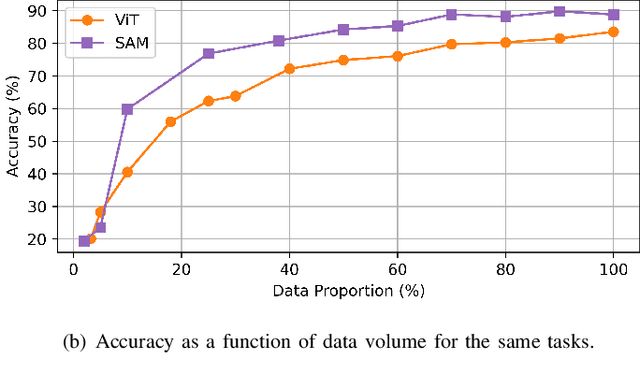
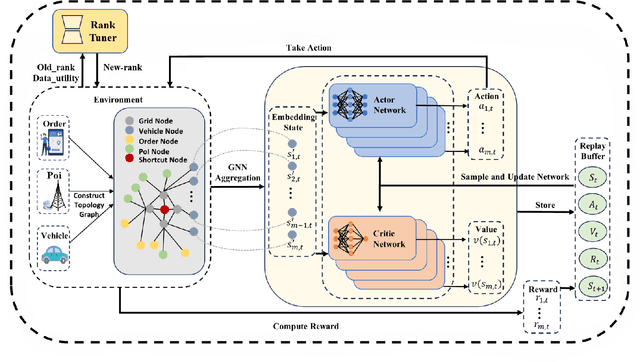
Advances in artificial intelligence (AI) including foundation models (FMs), are increasingly transforming human society, with smart city driving the evolution of urban living.Meanwhile, vehicle crowdsensing (VCS) has emerged as a key enabler, leveraging vehicles' mobility and sensor-equipped capabilities. In particular, ride-hailing vehicles can effectively facilitate flexible data collection and contribute towards urban intelligence, despite resource limitations. Therefore, this work explores a promising scenario, where edge-assisted vehicles perform joint tasks of order serving and the emerging foundation model fine-tuning using various urban data. However, integrating the VCS AI task with the conventional order serving task is challenging, due to their inconsistent spatio-temporal characteristics: (i) The distributions of ride orders and data point-of-interests (PoIs) may not coincide in geography, both following a priori unknown patterns; (ii) they have distinct forms of temporal effects, i.e., prolonged waiting makes orders become instantly invalid while data with increased staleness gradually reduces its utility for model fine-tuning.To overcome these obstacles, we propose an online framework based on multi-agent reinforcement learning (MARL) with careful augmentation. A new quality-of-service (QoS) metric is designed to characterize and balance the utility of the two joint tasks, under the effects of varying data volumes and staleness. We also integrate graph neural networks (GNNs) with MARL to enhance state representations, capturing graph-structured, time-varying dependencies among vehicles and across locations. Extensive experiments on our testbed simulator, utilizing various real-world foundation model fine-tuning tasks and the New York City Taxi ride order dataset, demonstrate the advantage of our proposed method.